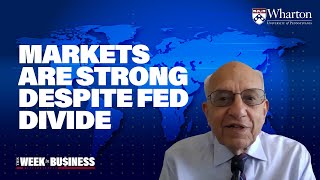
저자: JeremySiegel · 외국인
요약 보기
Fed의 25bp 인하 후 추가 인하 필요성 주장. 금리는 낮은 3%대가 적정하다고 봄(10년물 4%대). 고용 둔화가 뚜렷하나 소비는 유지 중이며, 관세 영향은 AI를 통한 기업 마진 개선으로 상쇄 가능하다고 평가. 9월 PCE가 예상보다 낮을 가능성과 고용 지표가 향후 중요하다고 언급. AI 투자 지속과 비AI 기업의 AI 도입 확산이 수혜 요인이라고 주장.
다듬은 글
And time to talk the economy and much more with our friend Jeremy Seagull, professor ameritus here at the Wharton School and a senior economist at Wisdom Tree. Jeremy, how are you today, sir? I'm doing well, Dan. Thank you. Thank you. All right, so we're coming out of a Fed meeting where we got a 25 basis point cut.
I don't think anybody is surprised at that, but give us your thoughts on what maybe we're looking at moving forward because it seems a lot of the conversation is uh more cuts to come. Yeah, it was it was an interesting meeting from everyone knew it was going to be 25 as you said. I I found a couple things interesting.
I I found uh uh the it was interesting that Chris Waller only voted for 25, did not descent for 50, which I thought was interesting since he was uh one of the leading candidates for new Fred chair and obviously Trump wants more than uh 25. I also thought it was interesting that Kevin Hassid also brooded as one of the top candidates um said, "Oh, he's all right with 25." Of course, he's not on the Fed right now, but um uh we all expected Steve Merin to go for 50, which he did.
Uh but the rest was a big support, I think, for Chair Powell. I mean, they all uh I thought there was going to be dissents on both sides. Um, also I thought it was interesting that um that uh although the median cut was two more cuts, half almost half say I don't want any more cuts and and then about half said yeah I'll go one cut each of the next two meetings.
So there's still a lot of division there on the Fed. Uh I mean my feeling is they should be cutting. Uh I've made that point, you know, that uh I believe that the Fed funds rate should be in the low threes given that the 10-year is in the low fours and that there should be a gap between the two. But um uh you know, clearly the data has held up strong um and um uh I can understand the division at the Fed.
Could you make a case for a 50 basis point cut this mo most recent meeting, Jeremy? I I mean I could make that case for a 50 basis point cut because uh you know I I think the Fed us moves too slow. I've I've written on the fact that in the past the Fed used to move much more up and down. It it wasn't viewed as if you start moving up you've got to keep on moving up or start moving down you keep on moving down.
They look at the data every time. Um u employment growth has really weakened. uh certainly inflation has not but there are two very important factors. One, housing is definitely not showing the increases either at the rent or the price big part of the CPI. Um and also the tariffs which I do not believe should be a reason for raising rates um to the extent that they go in because they're really a tax.
So for that reason, um I don't know if if I were on the board would I would have joined MRN on on a disscent, but I certainly would have voiced some support for for that position. But that being said, and as this we're taping this interview on a Tuesday, it will run on a Friday. We will have PCE data.
We will have more weekly claims data. Then you go out a week, you're going to have another jobs report coming our way. So there is a lot of data that we're looking at in the next, you know, 10 days to two weeks that may be able to kind of guide us as to what we're going to see play out here. Yeah, most certainly.
By the way, I think the Friday report, and again, it might be dangerous for me to to say so, you know, before while people might be listening to it afterwards, but I think that it's going to be quite tame. In fact, there's a possibility the CPI I mean the PCE deflator which is what does come out might on the overall be a tenth less than what is currently expected which is 3/10.
I don't think I think that's going to look good. Uh the jobless claims which we had that one big uh you know weekly jump was due to Texas. They claimed there were fraudulent claims from Texas and we did see the next week it drop back into the 200 to 240 zone which is the safe zone. Um and that is expected also to be on Thursday.
Now when we get to the employment data in the following weeks I mean that's when when things really start you know getting uh interesting again uh in those uh you know will we you know will that tremendous slowdown that that we get will that continue and will that uh drive a negative print which I think is psychologically uh quite uh quite important but one has to say at this point um spending is holding up it's not going gang busters but it is it is holding up and even the high frequency uh and the anecdotal data uh suggests that we do have that holding up.
Um again if if tariffs suddenly hit like a near when people start buying for Christmas and the holidays and they really see that uh you know prices going up could that turn psychology quickly? a possibility, but clearly we have not seen that yet. And and then you throw in what seemingly is a belief out there that there is some room to run for the economy in terms of growth.
Uh the OECD upping its forecast uh both globally and the US. Uh your friend James Bullard in an interview on CNBC uh on Tuesday uh seemingly saying the same thing. So there's, you know, while there are still many questions out there, there seems to be some optimism as to where potentially this economy could be headed.
Yeah. Well, you know, for months I've been saying the stock market has been going up because for whatever negative effects the tariffs have, and you know, I'm on record saying I don't like these tariffs. Uh AI has a good opportunity to offset them for profit margins for companies. I mean they can save more you know money using AI than they might be losing on the tariff side and that is why the stock one of the reasons as well as the tax cut reasons and others that that that the stock market is in fact doing so well.
Let me finish up. Speaking of AI, uh we got the announcement by OpenAI and Nvidia of their partnership, but have you talk about just the level of investment that is being put in by so many companies in and around AI and then obviously all of the other areas that could be impacted when you think of energy and supply chain and technology.
I mean, we're looking at a very unique time in our history, aren't we? Yeah, absolutely. I mean AI is a revolution. There's no sign of any stoppage or slowdown in that spending at all. Um in fact as as as we see if anything there's a sign of acceleration uh in the spending on that and again what we want which has been the only thing that's been slower than expected is the adoption of AI to actually improve uh the profits and save on costs by the the nonAI firms.
uh that could be the real beneficiary ultimately of the AI revolution. Jeremy, always great to talk with you and get your thoughts. Thank you, sir. Thank you very much. And you got it. Jeremy Seagull, uh Wharton ameritus professor of finance and also senior economist at Wisdomree.


Comments 0