
원문 보기
Every few decades, the financial operating system rewires itself. Most people don't see it happening until the new rules are already making other people rich. Tom Lee believes 2025 is one of those moments. At token 2049, he called it the biggest macro shift since 1971 when the dollar went off gold and finance as we know it was rebuilt from scratch.
This time, that rebuild isn't happening on Wall Street. It's happening on chain. In this video, we'll break down Lee's thesis, play the most important moments from his keynote, and translate them into clear takeaways for Bitcoin, Ethereum, and the broader crypto market. , make sure to . Because if Tom Lee is right, we're standing at the start of a monetary reset.
And history tells us when money changes, markets follow. Let me level set. The reason I think 2025 is the biggest macro shift since the gold standard is I got to take you back to 1971. And in 1971, the dollar went fully synthetic. That was the year that Nixon ended the convertability of dollars into gold.
Now, think about that for a moment. In 1971, the dollar no longer represented anything except another dollar or promise to repay. And when we think about that, most people said, "Well, gold was the trade in 1971." That's true, but it wasn't really the big opportunity. In 1971, the financial system had to suddenly think of ways to make sure the dollar remained dominant because if the dollar wasn't convertible into gold, another currency could be dominant.
And so what Wall Street did was they created a huge market for the dollar. Money market funds, futures, debit cards, mortgage back securities, currency swaps, interest rate swaps, index futures, zero coupons, etc. That was the innovation that followed 1971. And in fact, seven of the top 30 largest companies in the world now are financial institutions.
1971 wasn't a historical footnote. It was the moment money went synthetic. When Nixon ended gold convertability, the dollar stopped being backed by anything real. To keep it dominant, Wall Street had to reinvent finance from the ground up. They built entire markets to give that new dollar gravity. Money market funds, futures, swaps, mortgage back securities, index derivatives.
Each one was designed to create demand for dollars and make the system too integrated to fail. Lee's point is simple. When the foundation of money shifts, the infrastructure around it explodes. Innovation accelerates. New rails emerge. Entire industries form to stabilize the new regime. In the 1970s and 80s, that transformation made the dollar unstoppable.
It became the base layer for global trade, credit, and capital flows. In 2025, Lee believes the same kind of rebuild is happening again, only this time, it's happening on the blockchain. The old financial rails were built to support synthetic dollars. The next generation is being built to support digital assets.
What that means is that we now have a new moment in 2025, which is we now have more things becoming synthetic. And so that's why Bitcoin of course uh remains the OG in our view because you now have a digital store of value. But I think you want to think about the other side of that ledger. What is Wall Street going to do?
And in our view, Wall Street is going to play a very significant role in creating a market for digital assets. Lee draws a clear line between the two giants. Bitcoin is the original store of value, digital gold with better physics. It's portable, verifiable, and untouchable by policy or borders. That role doesn't change.
It compounds as trust in the system erodess. Wall Street's role isn't to replace Bitcoin. It's to build around it. To create markets, products, and financial instruments that plug directly into this new form of collateral. And when it comes to building, Lee says the center of gravity is shifting toward Ethereum.
Institutions need a neutral public programmable network, something they can use to settle, tokenize, and automate value. Ethereum already fits that description. It's the same pattern we saw after 1971. The dollar became the base asset. Wall Street built the rails that amplified it. Now, Bitcoin is the asset and Ethereum is becoming the rails.
If that pattern holds, the upside isn't just in holding the coins, it's in understanding how this new financial stack takes shape. And that brings us to Bitcoin's valuation anchor. And in our view, the biggest winner here is Ethereum. So, let's think about what it means for Bitcoin's upside. If gold today is at 4,000 per ounce and maybe it'll get to 5,000 per ounce, well, we want to think about what Bitcoin's gold to Bitcoin to gold ratio is.
You know, what percentage of Bitcoin's network value should mirror that of gold. And if it's only at 10%. Then you get a $140,000 value for Bitcoin. I think that number is too low. I think it's going to basically match gold's value or even exceed it. And that's how you get to the 1.4 to $2.2 million of value per Bitcoin.
So, uh, we're still quite bullish on Bitcoin here at around 110,000. Lee values Bitcoin the same way you'd value gold, not as a meme, but as a benchmark. If Bitcoin captures even 10% of gold's market value, that's roughly $140,000 per coin. If it reaches full parody with gold or even surpasses it, you're looking at somewhere between 1.4 and $2.2 $2 million.
You can debate the exact numbers, but the logic holds. Gold is the current store of value benchmark. Bitcoin is the digital upgrade. As that monetary role gets adopted, the valuation follows. It's not about hype or h havinging cycles. It's about function. Bitcoin doesn't need new narratives to rise.
It just needs the world to keep using it as savings that can't be printed away. And that framework leads directly into the second pillar of Lee's thesis, the rise of the synthetic dollar and why stable coins are becoming the new engine of global finance. So, a lot will happen on crypto. And we already know Ethereum has experienced this chat GBT moment because of stable coins.
Um, here's just a list of different companies and entities that are building stable coin projects. And you might wonder, why does the US government care about stable coins? Well, it's the same reason the US cared about the synthetic dollar staying strong. Today, the US dollar is 27% of GDP, but it's 57% of central bank reserves.
That 57% shows you that Wall Street's efforts to make the dollar the standard of transactions after 1971 was effective. It's 88% of financial market trades. Okay. But it's a it's basically 100% of stable coin denomination. So by moving to a synthetic dollar tokenized on a blockchain, the dollar could become even more dominant.
And collectively, stable coins are the 12th largest holder of treasuries in the world. Stable coins aren't just another crypto product. They're a policy tool. They pull the US dollar onto public rails, global 24/7 programmable. And in doing that, they lock in dollar dominance by making USD the default settlement layer for onchain commerce.
Lee's point is direct. Washington cares about stable coins for the same reason it cared about the post 1971 financial system. They keep the dollar at the center. As stable coins scale into the trillions and accumulate treasuries, they don't just mirror crypto adoption. They become one of the largest buyers of US debt and a key source of liquidity for the entire economy.
Step back and you can see the new architecture forming. Bitcoin is the pristine collateral, the store of value. Stable coins are the execution layer, the bridge between the digital and real economy, and Wall Street is gearing up to build products, credit markets, and infrastructure around both. The question is, what chain becomes the programmable settlement engine for all of it?
Lee's answer is clear, Ethereum. And he backs it with hard data. rising institutional adoption, the majority of total value locked, and major payment networks already running pilots on its rails. But the real signal isn't in the adoption alone. It's how that activity could reshape Ethereum's value relative to Bitcoin.
Where will Ethereum go? I mean, one, I I have some thoughts I'll share, but again, if you look at this chart, it's not bearish. Okay, this is a bullish chart. And another chart to think about is Ethereum's price ratio to Bitcoin. Um, it's currently at 0.036. The average has been 0.047 and the high in 2021 was 0.087.
I think that these numbers matter because to me, Ethereum is having its 2025 moment like 1971. I think its price ratio should at least recover to its prior high of 0087. So, what does that mean? Well, if you look at Bitcoin's price, and we think it'll be at least 250,000 by the end of this year, okay, that's the rows.
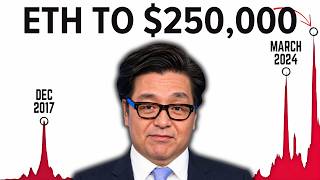
So, it's the second to last row. If Ethereum price ratio gets to its 8-year average of 0.0479, that implies 12,000 per Ethereum token. If it gets to its 2021 high, which I think is justifiable given how much is happening fundamentally on uh Ethereum, that's $22,000 per ETH. Okay. But I don't think that's the ceiling.
The ceiling, sorry. Another way point is that Ethereum becomes the payment rails of the future and so its network value matches Bitcoin. Well, that would be $62,000 per ETH token. So, with ETH at 4,100, as you can see, each of these three values represents tremendous upside. The simplest way to measure Ethereum's rise isn't by price, it's by its ratio to Bitcoin.
That chart tells you whether the build layer narrative is actually taking hold. Lee lays out three possible scenarios. If Ethereum just reverts to its long-term average around 048, that implies a $12,000 ETH based on his Bitcoin target. If momentum builds like it did in 2021, the ratio could revisit its previous high near 0087, roughly 22,000 per Ethereum.
And if Ethereum truly becomes the global payment and settlement layer with network value on par with Bitcoin, the ceiling could stretch towards 60,000. The precise numbers aren't the point. The mechanism is. As more real world assets, stable coins, and institutional products migrate onchain, Ethereum's utility compounds, more settlement, more tokenization, more staking, more throughput.
Each of those adds reasons for balance sheets to hold Ethereum, not as speculation, but as infrastructure. And that's the real takeaway here. Ethereum's upside isn't driven by hype or hing cycles. It's driven by adoption curves. It's what happens when Wall Street, AI, and the digital economy all start building on the same base layer.
Now, let's connect the dots and look at why Lee's framework matters right now and what it means for positioning in this cycle. What makes Lee's thesis stand out is that it isn't built on hype. It's built on regime change. He's not saying number go up because of momentum or memes. He's saying the plumbing of the financial system itself is shifting.
Synthetic dollars are moving onchain. Institutions are building compliant rails. AI is demanding verifiable identity, provenence, and data integrity. When the foundation of money changes, valuations don't just rise, they reset. He also draws a clear line between two kinds of value. Bitcoin's strength comes from its monetary premium, scarcity, credibility, and security that compound with time.
Ethereum's power comes from its platform premium. the value of activity migrating onchain driven by throughput developer adoption and institutional integration. Different engines, same direction of travel. Lee's framework also reframes the tired crypto versus tradfi debate. After 1971, finance didn't end.
It reinvented itself. The same thing is happening now. Wall Street won't disappear. It will port to public chains, strip out inefficiency, and expand margins. His comparison between Teor and the world's largest banks isn't just a flex. It's an illustration of what onchain operating leverage actually looks like.
And finally, this shift gives the United States a reason to lean in, not fight back. Stable coins aren't a side experiment. They bind the dollar to the internet's financial layer. If the world is going to transact onchain, Washington would rather those transactions settle in dollars than in anything else.
That alignment opens the door for regulation, scalability, and institutional confidence. The exact ingredients that turn a niche technology into a global standard. For Bitcoin, the path of least resistance is still up and to the right. The gold parody lens gives you a grounded anchor, not a fantasy, a framework.
You don't need a dozen new narratives or hype cycles. You just need adoption to keep climbing. More balance sheets treating Bitcoin as collateral, more credit markets priced around it, and more custody infrastructure making it usable at scale. Volatility will always come and go, but if Bitcoin keeps earning its role as digital savings, the long-term trajectory stays the same.
Ethereum story is different. Its success doesn't depend on becoming sound money. It depends on becoming indispensable. The signal isn't in price. It's in usage. Settlement volume, L2 throughput, stable coin float, tokenized assets, staking participation, and the steady burn of fees that tighten supply.
If those rails keep absorbing global activity, price will eventually follow. The ETH/BTC ratio is simply the scoreboard. Stable coins, meanwhile, have quietly become a macro indicator. Their supply and treasury holdings don't just track crypto. They track global liquidity. When the supply base expands and the issuers professionalize, the pipes are widening.
That's fuel for onchain activity and a tailwind for both Bitcoin and Ethereum. And then there's the next wave, tokenization, and what Lee calls invisible assets. Credit, real estate, IP, royalties, loyalty points, identity, even agentic AI. They're all moving toward onchain monetization. Each new category adds demand for settlement, liquidity, and collateral that supports Ethereum's platform premium and reinforces Bitcoin's position as the pristine base asset beneath it all.
Of course, there's push back. There always is. The first question everyone asks is, isn't this just 2021 all over again? Not quite. 2021 was retail driven hype, leverage, and speculation on immature rails. Lee's 2025 setup is the opposite. It's built on policy, infrastructure, and institutional adoption.
Stablecoin frameworks are being drafted. Major networks are running onchain pilots. Wall Street isn't watching from the sidelines anymore. Different fuel, different durability. Then there's the tribal question. Is this just about Ethereum? Lee's answer is no. The market's addressable size is the digitization of global economic activity, tens of trillions of dollars.
That leaves room for multiple winners. high throughput L1s, specialized domains, and parallel settlement systems. Ethereum simply leads today because it's the most neutral, programmable, and institutionally tested chain. But this isn't a winner take all story. It's a rising tide moment. And finally, the classic concern.
Cycles still happen. What about the next draw down? They do. That's why Lee spent so much time on Treasury Strategy. He points to Micro Strategy and Bitmine as examples of how to survive winters, keep the balance sheet clean, avoid leverage, and keep growing per share exposure to the underlying asset.
Intrinsic value keeps compounding even when prices don't. For investors, the translation is simple. Size positions so you can actually hold through the 30 to 50% draw downs that shake everyone else out. Tom Lee's message at Token 2049 isn't trust me, it's watch the plumbing. In 1971, the dollar went synthetic and Wall Street built an empire of markets to support it.
In 2025, the same transformation is happening again. Only this time, it's happening onchain. Bitcoin is capturing the monetary premium, the role of pristine programmable collateral. Stable coins are reinforcing the dollar's dominance, turning the green back into the default currency of the internet.
And Ethereum, the most neutral, battle tested base layer, is absorbing the buildout that follows. If Lee's map is even directionally right, the implications are clear. Bitcoin grows as more institutions treat it like savings and collateral. Stable coins expand into multi-trillion dollar infrastructure, professionalized and systemically essential.
And Ethereum evolves into the settlement engine for global commerce, compounding value every time the network is used. We'll end where we began. Regime shifts are messy at first and obvious in hindsight. Most investors miss them because they mistake noise for structure. Tom Lee isn't selling a prediction. He's showing you the structure. And if this breakdown helped, hit subscrib.


Comments 0