
원문 보기
So, a weak bond market is a bullish signal for gold. This is not a " bearish" signal. Look at what the Fed is doing. Never mind what Warsh says, I'd rather sell my gold to get 5% on 10-year Treasury bonds. But the market confirms my interpretation, because look what happened to the price of gold. The FOMC's view was that inflation was a problem.
It is too high, and the probability of its growth is higher. They were looking for an excuse, someone to blame for inflation. Some of them blamed AI for this . The stock market does not cause inflation. AI does not cause inflation. The Federal Reserve causes inflation. So, essentially, the government, by running large deficits and buying up Treasury bonds, is pursuing a soft, very soft fiscal policy, which makes it difficult for the Fed to try to pursue a tight monetary policy.
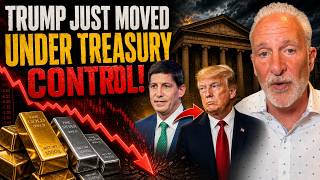
Quantitative easing is near. In fact, the Fed is already conducting quantitative easing. It's just not an official program, but they'll have to ramp it up, and it's obvious they won't be able to raise the stakes. This would put monetary policy at odds with fiscal policy. The Treasury Department announced that they are now going to double their purchases of long-term Treasury bonds.
These are treasury bonds with a maturity of 20, 30 years. They were buying 2 billion each, and now they will buy 4 billion each. Treasury bonds that they are going to buy back. And as soon as the announcement appeared, the price of gold rose sharply. In fact, I didn't even know about this announcement.
I had to look for information. I saw gold moving, bitcoin moving, stock futures moving, and I had to check the news. I wasn't even sure, because remember, I'm here on vacation. So I just had to go online and try to figure out what was going on. But many called it quantitative easing or " light" quantitative easing.
This is not quantitative easing. The Fed announced nothing. This is the Ministry of Finance. The Ministry of Finance is going to buy more long-term bonds. But unlike the Fed, the Treasury doesn't have a printing press, and it can't simply create money out of thin air to buy long-term bonds. So, where do they get the money from?
They sell more short-term bonds. So, he finances the debt. It buys back previously issued long-term debt obligations and replaces them with short- term ones. Why do they do this? Because this is a very reckless step. First of all, if you look at the average coupon on debt right now, on long-term debt that is issued for 10 years or longer, the average coupon is 3.44%.
Why would you refinance this? 30-year rates are currently at 5.3%. Now they have dropped just below 5.2%. I think I saw it was 5.18. And the 10-year-olds dropped to 4.6 with something. But if you have all this long-term debt at 3.44%, why the hell do you want to refinance it with Treasury bills at 4%?
I mean, it would be like someone with a mortgage. Maybe there are still 25 years left. And you have a mortgage at 3.5%. Why should you repay it by borrowing more money and taking an annual floating rate? No one would be stupid enough to do that except our government. They don't do it because they're stupid.
They do it because they are scared. This is truly a panicky move on the part of the government. This is a desperate attempt to stop long-term interest rates from rising by announcing that the government is going to buy up the bonds that everyone else is selling. Remember, they are actually getting in the way of this trade because the market doesn't want Treasury bonds.
The market is selling Treasuries, and now the US government has decided it will use taxpayer money , in essence, to buy what others are selling. Obviously, this is not a smart financial move. So why do they do this? They are trying to slow the growth rate of long-term bonds. But the payoff is that they are shortening the average maturity of the public debt, which is already just under 6 years, and it will become even shorter as this program expands, because it will not be enough.
This is just the first application, right? This is not the end. This is more like the beginning. And I've been saying for a long time that the Treasury is going to increase its buybacks. But it will also, you know, make it much harder for the Fed to raise short-term interest rates because now the government itself is more vulnerable to growth because it has to refinance this short-term debt.
So why do they do this? Why would the government swap long-term debt on which they have already recorded low yields to expose themselves to all these risks? It's all for the sake of expediency. They simply postpone solving problems. They are trying to trade short-term pain relief for long-term pain .
But the long-term pain will come when all this short-term debt is paid off and has to be refinanced, or because the Fed realizes this vulnerability and does not raise interest rates. In fact, what people are calling quantitative easing again is not quantitative easing, because the Fed is not buying.
So the money supply doesn't expand as a result of this, but it will expand because when the U.S. government sells these short-term Treasuries, who will buy them? I think the Fed will eventually buy them, effectively launching a quantitative easing program. And in fact, because the Treasury won't buy enough long-term bonds to stop growth.
They can slow it down a little, but they can't stop it. The Fed will eventually join the party. So quantitative easing is coming. In fact, the Fed is already conducting quantitative easing. It's just not an official program, but they'll have to build it up. And it is obvious that they will not be able to raise the rates.
This would lead to a conflict between monetary and fiscal policy . Fiscal policy is stimulatory. They are trying to lower long-term rates . So, essentially, the government, by running large deficits and buying up Treasury bonds, is pursuing a soft, very soft fiscal policy, which makes it difficult for the Fed to pursue a tight monetary policy because the Fed is worried about high inflation.
Now the Treasury is making the Fed's job even more difficult by increasing inflationary pressures. So as soon as the news comes out and people start talking about whether this is quantitative easing or whether this is more like " Operation Twist." If you remember, this was after they did the first quantitative easing.
I think it was between QE2 and QE3, they did " Operation Twist." And if you remember back then , I called it " Operation Deception, " because they were deceiving the country; The Fed sold short-term debt to buy long-term debt to lower long-term rates because markets were more sensitive to long-term rates, especially the mortgage market.
So , it's like "Operation Twist," only it's being conducted by the U.S. Treasury, not the Fed. But again , this is just a glimpse of what will happen next. The government is already panicking. They are going to sacrifice inflation to try to keep interest rates down. Again, I said I agree with Kevin Warsh: inflation is a choice.
He acted as if the Fed would not choose inflation. I said from the beginning that, of course, she would choose inflation, because she couldn't choose the opposite. And the fact that the Treasury Department is already moving in this direction indicates quite clearly that the Fed will move in the same direction.
The government says it wants to lower borrowing costs , but its own strategy could make it harder to fight inflation. Peter Schiff's argument suggests that Treasury intervention actually pressures the Fed to ease, even as officials publicly emphasize containing inflation . This contradiction is important because curbing profitability does not cancel debt.
It redistributes costs due to future inflation and a decline in purchasing power. For investors, the danger lies in the trap between negative real returns and rising asset prices. Peter Schiff goes on to explain why this policy resembles Operation Twist, but with a much more dangerous incentive. Anyway, I want to get back to the Fed, because later today, after this surprise announcement , of course, I don't know why anyone is surprised.
I mean, I wasn't surprised. I mean, I was waiting for this. I mean, I know the trap the government is in. They simply cannot allow the rates to rise. Therefore, they do everything they can to oppose the free market. But the free market wants higher interest rates for a reason. And the reason is that we have too much debt.
And the way to stop excessive debt is to make borrowing more expensive. The government wants to prevent this in order to continue borrowing more. But all this does is significantly intensify the future crisis, because the "bubble" inflates much more than if the market had burst it earlier. In fact, he would have burst it long ago if it weren't for government intervention in the market.
However, when the FOMC minutes were announced at 2:00 PM, they turned out to be even more hawkish than the markets had expected. And if it weren't for the morning announcement, the stock market could have collapsed today. The bond market could collapse. Profitability could increase because no one wanted to lower rates.
Everyone was talking about raising rates. Of course, there were dissenters who wanted to raise rates immediately, but the FOMC's view was that inflation was a problem, it was too high, and the likelihood of it rising was high. Now, you know, they were looking for an excuse or someone to blame for the inflation.
Some of them blamed artificial intelligence for this. The stock market does not cause inflation. Artificial intelligence does not cause inflation. The Federal Reserve causes inflation. The Fed sounded " hawkish," but markets barely reacted because the Treasury Department's policies had already changed the rules of the game.
According to Peter Schiff, FOMC minutes showed that officials were still concerned about inflation and even considered an immediate rate hike, but Treasury intervention softened the market reaction. This creates a dangerous gap between monetary rhetoric and fiscal reality. Investors are hearing about restraint, while government funding is becoming increasingly sensitive to interest rates.
If this gap widens, gold could become insurance against the very distrust of politics. Peter Schiff goes on to explain why the discussion of inflation completely ignores the deficits that cause it. The government is helping the Federal Reserve create inflation by running such huge deficits. So the fact that we have a national debt of $40 trillion and it's growing rapidly— because a few days ago , when I was doing the podcast, we were still about $80 or $100 billion short, but we're moving up quickly.
And that is what causes inflation. And again, it's not war that causes inflation. It is caused by the way we pay for it . These are the deficits we create. We did n't raise taxes to pay for the war. We did not cut other spending to free up resources for war. We were just wasting it. So, bigger deficits mean bigger inflation, but the Fed never says that.
They never mention these large deficits as the cause of inflation. They never talk about the entire money supply and the money they print. Although they talk about the balance and the need to reduce it. Well, how are they going to do that when the Fed is conducting Operation Twist? What? Are they going to try to resell the bonds that the US government is buying?
They will not negate what the Ministry of Finance is doing. Obviously, they will coordinate their actions. They will work together. So it's impossible. But if it weren't for this announcement , it could have been a big problem for the markets. Actually , I don't know, maybe the Treasury knew that the FOMC minutes would be " hawkish" and they had to neutralize it before it had a chance to affect the market.
So the markets effectively just ignored it. The likelihood of a rate hike has decreased, despite the FOMC minutes being more hawkish than expected, due to actions by the US Treasury . Now the market is confirming my interpretation, because look what happened to the price of gold. So, yesterday gold fell by about 80 bucks .
It closed near the lows of the day. This was probably the worst day for gold in at least a month, if not more. And you know, silver has also fallen. Gold is up about $185 today. The $40 trillion debt burden changes the inflation equation because every rate hike now has a fiscal price. Peter Schiff draws attention to the feedback loop between deficits , debt service, and monetary stimulus.
Higher rates increase government spending, while tighter policies become harder to maintain. The result is a market where gold can rise precisely because bonds are weakening, rather than in spite of it. Peter Schiff then reveals the dramatic reversal in gold that turned this policy contradiction into a market signal.
It closed above 4500. In fact, gold fell about $20 last night. So, the intraday increase was $200. Huge. Technically, it was a reversal day as we broke through yesterday's gold low today and then closed well above yesterday's high. So, a technical reversal. We are now 13% above the low for gold. Gold bottomed out just below 4,000.
If you remember, I was banging on the table on this podcast saying, “ Look, 4,000 is the bottom. You should, you know, you should buy it." And so, now we are above 4500. Silver also had a big day. It closed above $66 per ounce. Let me see where it is now. I'm recording this at night. It is now about 9:30 pm.
Well, silver is actually down about 18 cents now, 66.71. So, yes, well above 66. In fact, I think it might have gone above 67 earlier in the evening. Gold is retreating. It fell about $20 but is still trading above 4,500 . So, a very significant day for gold and silver. Mining stocks were on fire today.
Many of these stocks are up 7, 8, 9, 10, 11, 12%. I think GDX, GDXJ are up 8%... both of those indexes are up almost 40% in the last month, and they're up for exactly the reason I was talking about. Gold has fallen. Gold mining company stocks fell because people were fooled by Kevin Warsh's show. All these, you know, showy speeches: "Oh, yes, we're going to be tough on inflation." Inflation will return to 2%.
It was like everyone was saying, "Oh, he's the new sheriff in town." An intraday $200 reversal in gold carries more weight than another headline that inflation is under control. Peter Schiff's argument suggests that the sharp move above $4,500 reflects investors' awareness of Treasury weakness, and political intervention could boost demand for real assets.
Silver above 66 and miners approaching 40% monthly profit reinforces this signal. For investors who preserve capital, the lesson is simple. Bond market stress could be a catalyst for precious metals , not a reason to flee them. Peter Schiff goes on to reveal why the Fed's tough rhetoric has never matched its actual actions.
He's Paul Volcker reincarnated, and I said, "No way, the markets are wrong." He's not going to do that. "It's all just words." And I kept saying, “Look at what the Fed is doing. Pay no attention to what Walsh says. Look at the money supply. Look at the balance sheet. Look at the fact that they are not raising rates." All this tough rhetoric was inconsistent with them just sitting back and doing nothing.
And now the Treasury Department is making it even more difficult for the Fed to fight inflation. In fact, they create much greater pressure for inflation to rise as the Treasury continues to shorten the maturity of the national debt, and every time the Fed raises rates, it does even more damage to the budget.
The budget deficit is growing because servicing this debt now costs more. So when the Fed tries to fight inflation, it is actually laying the groundwork for even more inflation, because how is the government going to finance these larger deficits? Ultimately, the Fed will have to fund them. That's why I kept talking about the bond market falling, even though people worried that rising bond yields were a " bearish" signal for gold and silver.
But I insisted: no, this is a " bullish" signal. Because rising bond yields will force quantitative easing. Rising bond yields will weaken the economy. It will cause larger budget deficits. And in fact, the reason for the increase in bond yields was inflation. And it was n't that higher bond yields would become some kind of competition for gold.
Like, oh, I'd rather sell my gold to get 5 % on 10-year Treasury bonds. No. This was just another reason to sell Treasury bonds, because their prices were falling. When Treasury bond yields rise, it means their price falls. This means that if you own bonds, you are losing money. So , what do you want to do ?
You want to get rid of bonds and buy gold. Thus, a weak bond market is a bullish signal for gold. This is not a " bearish" signal. The biggest warning may be that rising Treasury yields are becoming a positive factor for gold, rather than competing with it. This is where Peter Schiff's thesis shifts from inflation to debt mechanics.
Higher rates increase the government's interest costs, widen the deficit, and potentially pressure the need for monetary stimulus. This creates an unusual vicious circle, where policies designed to restore stability can ultimately undermine the purchasing power of the currency. . Stay with us and stay connected.




Comments 0