원문 보기
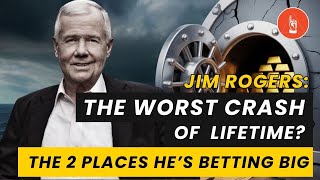
What if the American economy isn't slowly declining but racing toward collapse? It sounds dramatic, but when one of the most seasoned investors of our time, Jim Rogers, co-founder of the legendary Quantum Fund, declares that he's completely dumped all his US stocks and moved his money elsewhere, we should pay attention.
At a summit in Singapore just recently, Rogers dropped a massive bombshell. He's now holding zero US equities. None. Not a single one. And where did that capital go? China. and intriguingly a second undisclosed country. Do you think Jim Rogers is right about the US heading for a major financial crisis?
Yes or no? Let us know in the comments. In this episode of Endgame Compass, we're going to break down why Rogers believes the next American financial crisis could be the worst of his lifetime. It's precise reasoning for betting on China's tourism and infrastructure boom, and what's behind this secret country?
He's now investing in one you've probably never considered. This isn't doom man gloom for drama's sake. It's a grounded take based on debt patterns, consumption behavior, and why ignoring these trends might be the most dangerous decision of all. Settle in because what's buried at the end of this story could reshape your view of global investing permanently.
Let's start with the staggering move. Rogers, now 82 years old, revealed he sold off all of his US stocks. It's not like trimming positions or hedging. We're talking full liquidation. Why take such a drastic step? Because Rogers believes the next American economic crisis will be the most severe he's ever seen.
Worse than 2008, worse than the dotcom burst. And even beyond the inflation crash of the late '7s. And when someone who survived ETH through multiple economic cycles is this alarmed, it's not noise. According to him, even if he lives another 15 to 20 years, he expects to witness a collapse unlike anything before.
Some may question, is this financial fear-mongering or prophetic insight? Look at the debt ceiling. Washington's national debt clock just passed $ 38 trillion. Meanwhile, recent labor data for July cratered unexpectedly. Market euphoria continues against this backdrop, but Rogers is walking out of the party before the music stops.
isn't just reacting emotionally. It's responding to hard data we've all seen and perhaps chosen to ignore. Before we assume this is paranoia, a reminder, Rogers co-founded the Quantum Fund with George Soros. They racked up over 4,200% returns during their first seven years. That's not luck, that's strategic vision.
So, when Rogers talks, the smart move isn't to scoff, it's to listen. Many instinctively jump to the takeaway, sell a stocks by China. But this is much deeper than a catchphrase. Every decision, especially from someone like Jim Rogers, comes with layers of reasoning. Here at Endgame Compass, we've broken down his latest repositioning into three essential themes.
The structural rot in the US economy, the emerging overlooked growth in China, especially in tourism and belt and road projects. the mysterious second nation Rogers is secretly betting on. Let's break them down one by one. At the heart of Roger's pessimism is America's ballooning debt burden. He compares the current US posture to that of the UK in 1976.
When the British government's debt spiraled so uncontrollably that even domestic investors refused to buy the bonds, triggered a full-blown credit collapse. Sound dramatic? Not when we factor in what's happening right now. What scares Rogers is Washington's attitude itself. Where the US people will always buy our bonds.
That kind of arrogance, history shows, is the perfect precursor to implosion. Here's the structural concern. According to the CBO, by 2025, the federal government's net interest payment on debt will hit $952 billion annually, already outstripping its entire national defense budget. Think about that.
America will soon spend more on paying the interest on past borrowing than on defending itself. And remember, this isn't even touching the debt principle. This is how financial black holes form. You borrow to pay interest on previous borrowing, a cycle that devours any attempt at genuine economic reform.
That's why Rogers claims the US is now governed functionally not to innovate or grow, but to simply avoid a financial detonation. and that he says is unsustainable. Zooming into the labor landscape, the July jobs report was downright alarming. While markets expected 106,000 new jobs, the actual figure came in at only 73,000.
But the real shock came in the revisions. May and June's numbers were slashed by a combined 258,000 jobs. That's not just statistical noise. That's a megaphone screaming recession. Long-term economic indicators show that when job reports are regularly revised downward like this, it's often a leading signal of broad economic weakness.
Household income expectations fall, consumer confidence drops, spending contracts, and eventually you get a recession consumers aren't prepared for. Rogers sees this weakness as exposing the fragile underside of the longest bull market in history. A run which reminds us was artificially propped up by trillions in QE and near zero rates.
That kind of market doesn't grow, it inflates. And what inflates inevitably pops. If you're still watching, you're not here for surface level takes. You want the kind of deep dive insight mainstream finance won't touch. Make sure you're subscribed to Endgame Compass and turn on the bell because timing matters more than ever.
So, if Rogers is pulling out of the US, why pour funds into China? Interestingly, he's not chasing high-tech unicorns or speculative AI plays. His focus, tourism and belt and road infrastructure. It sounds unusual until you look at the data. China's household wealth continues to rise, and with it, domestic tourism has exploded.
In 2024 alone, total travel related revenue within China hit a record-breaking 5.7 trillion yuan. What's even more surprising, rural residents travel numbers rose by 30.6% year-over-year. That shows tourism has evolved from a city luxury to a national lifestyle. Why does it matter from an investment standpoint?
It's unlike exports or factory output. Domestic tourism is powered by local demand, not foreign politics. It's less vulnerable to sanctions, tariffs, or geopolitical shocks in a divided world. That makes it enormously resilient. As Rogers sees it, this isn't trend chasing. It's betting on internal structural growth driven by 1.4 billion people.
Next, Rogers aligns himself strongly with the future of China's Belt and Road Initiative. He likens this to the railway boom of the 19th century, not just a transportation network, but a seismic engine for industrial expansion. By mid 2020, China's investment in Belt and Road countries had topped $124 billion, surpassing even their fullear projections for 2024.
These funds aren't just going into bridges and roads anymore. They're flowing into critical energy ecosystems, a 20 billion gas pipeline in Nigeria, massive metals investments in Kazakhstan. It's no longer just logistics. It's a full spectrum strategy to secure China's energy future, resource pipelines, and industrial supply chains.
While countries like the US focus on tariffs, duties, and political bluster, China is building long-term infrastructure aligned with real geopolitical returns. Rogers recognizes that this is how economic empires form, not through rhetoric, but rebar. Now about that unnamed second nation Roger says he's invested in.
He hasn't confirmed it publicly, but clues suggest it could be Usuzbekiststan. Let's explore why. Isbekiststan perfectly matches Roger's signature investment philosophy. Seek undervalued countries undergoing rapid internal change. Since 2017, Usbekiststan has undertaken some of the most aggressive market reforms in the region, streamlining bureaucracy, encouraging private enterprise, and reducing the role of state- toned sectors dramatically.
Their foreign direct investment target for 2025 is a striking $42 billion. Over 60% of the population is under the age of 30 with nearly universal literacy. A youthful educated labor force in a geopolitically strategic location. Even more telling, Usuzbekiststan sits at a pivotal crossing in the China Kyrgystan railway, centerpiece of the belt and road.
Investing here isn't just about the country itself. It's about betting on the success of an emerging Eurasian trade corridor that aligns perfectly with Roger's global macro approach. long-term fundamentals driven and rooted in new economic realities, not legacy market nostalgia. Interestingly, Rogers still holds a large amount of US dollars despite his grim view of America.
Why? This is where strategy meets nuance. He's betting that in the early stages of a global crisis, fear will drive capital into the most liquid asset, the US dollar. That short-term flight to safety, he believes, will push the dollar higher temporarily. When the panic peaks, he plans to sell, rotating into silver, China's markets, and other underappreciated assets like those in Usuzbekistan.
It's a tactical wager on timing. Use the currency of the broken system to capitalize on the collapse and reposition into real productive value. So, what's the bigger picture? Jim Rogers isn't just sounding the alarm on equities. He's questioning the viability of an entire debtfueled financial ecosystem.
One that's cracked, overloaded, and gasping for new buyers. The explosion in US national debt isn't just a policy error. Might be the spark that forces the world to move toward a more grounded, diversified, and tangible economic system. We may be on the edge of a once in a generation economic reordering.
One where nations that build, produce, and connect will thrive. And those who cling to debt and nostalgia, they risk falling behind. I want to hear what you think. Is the US headed toward a historic financial crisis? Or is Jim Rogers overly pessimistic? Let me know below. I read every comment. Do you consider shifting part of your portfolio away from US equities and into emerging markets?
This gave you a new lens to see the world. Don't just like subscribe to Endgame Compass and hit the bell because in markets like today's timing isn't just important, it's everything.


Comments 0