원문 보기
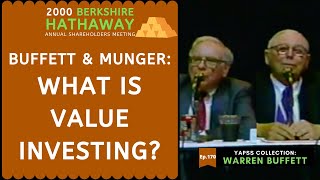
Good morning, Mr. Buffett and Mr. Munger . Uh, my name is Steve Yates. I'm from Chicago. I am a Berkshire shareholder, and this is my sixth year attending this meeting. I want to thank you for your time and advice over all these years. It was wonderful. I also want to thank all the wonderful people who sold Berkshire shares this year for giving us the opportunity to buy more shares of the world's best company at a bargain price.
We will convey your thanks to them. I have another stock that is selling at four times its current annual earnings. We receive a report every quarter. Profits are rising, sales are rising, cash flow is growing, the equity base is expanding, they are capturing market share, and the stock is falling. The company has a 60% annual growth rate over 5 years and is selling at a price that is four times its earnings.
I have two related questions. First, is it a growth stock or a value stock? And could you please give us your definitions of these terms? Secondly, the company sells recreational vehicles. Demographic trends in recreation and leisure—campers, cruises, golf equipment, etc.— seem pretty good. Do you see any opportunities here for Berkshire?
Thank you. Well, we have already covered the issues of growth and value in past annual reports, but these are not two separate categories of business. Any business has a current value. If you knew how much cash it could bring in between now and Judgment Day, you could get an exact figure for its value today.
One element of this may be the ability to use additional capital at a good return, and most companies that are characterized as “ growth companies” have this as one of their characteristics. But in our imagination there is no difference between growth and value. Every business we look at is a value proposition.
Growth potential and the likelihood that this growth will be economically viable are part of the equation in valuation, but they are all decisions about value. A company that doesn't pay dividends but grows 100% per year, you know, is losing money . This is the decision regarding cost. You have to decide what value you are going to get.
In fact, everything is very simple. The first investment textbook, when do you think it was written? The first investment textbook I know of that contained some pretty sound advice was written around 600 BC. Aesop. And Aesop, you remember, said: " Better a tit in the hands than a crane in the sky." By the way, Aesop didn't know that it was 600 BC .
He was smart, but not that smart for his time. Well, Aesop was on the right track, but he didn't complete the thought , because there are a couple of other issues related to it. But this is an investment equation. Better a tit in your hands than a crane in the sky. He forgot to say when exactly you will receive that crane from the sky.
And he forgot to say what interest rates this should be compared to. But if he had listed these two factors, he would have determined the investment for the next 2,600 years. Because a tit in the hands, uh, it's, you know, you're giving away a tit in the hands, which is what investing is. You put out cash today, and then the question arises as an investment decision: you have to estimate how many birds are in the bush.
You may think that there are two or three birds in the bushes, and you have to decide when they will fly out of there and when you will get them. So if interest rates are 5% and you get two birds in the bush in five years, say, instead of one now, uh, two birds in the bush is a lot better than a tit in the hand now.
So you want to give your tit in hand and say, "I'll take two birds in one stone," because if you get it in 5 years, that's about 14% compound interest annually, and the interest rates are only 5%. But if interest rates were 20%, you would refuse to take two birds with one stone in 5 years. You would say that's not good enough because at 20%, if I just leave that tit in my hands and earn compound interest, I'll have more birds than two in the bushes in 5 years.
Now, what does all this have to do with growth? Well, people usually associate growth with a lot more birds in the bushes, but you still have to decide when you get them. And you have to compare that to interest rates and also to other bushes and other, you know, other equations. And that's all investing is.
It's a value decision based on, you know, how much it costs, how many birds are in the bush, when you get them, and what the interest rates are. So, if you pay $500 billion , and we, when we buy stocks, always think about acquiring the entire enterprise, because it allows us to think like businessmen, not like stock speculators.
So let's take a company that has great prospects but doesn't pay you anything . now, and you buy it at a valuation of 500 billion. Now, if you think 10 % is an acceptable rate of return, and you can pick your own number, that means that if it doesn't pay you anything this year but starts paying you next year, it should be paying you $55 billion annually for life.
But if it only starts paying in the third year, then it has to pay you $60.5 billion for life. forever to justify the current price. Every year you wait to get a bird out of a bush means you have to get more birds. It's that simple. And I sometimes wonder if the people who pay $500 billion implicitly for a business by buying 10 shares at a certain price really think about the math behind what they're going to get.
Let's assume there is only one year of delay before the business starts making payments to you, and you want to make a 10% profit by paying 500 billion. That means 55 billion in cash that they should be able to pay you year after year. To do that, they have to earn maybe $80 billion or so before taxes.
You can look around the business world and see how many companies make 80 billion before taxes, or 70, or 60, or 50, or 40, or 30, and you won't find any. So it takes a pretty extraordinary change in profitability to give you enough birds from that particular bush to make it worth giving away the one you already have .
Regarding the second part of your question about whether we are willing to buy a great business at four times earnings. I think I could even get Charlie interested in this. But let's hear it from Charlie. I would like to know what it is . He was hoping you would ask the guy who has all his capital in stocks and who has a limited audience.
Tell us what it is. You have to tell us. We beg you. Do you want a company name? We want a company name. We are dying to know the name. Wait while I get my pencil. OK. It's called National RV, it 's based in California, and they sell motorhomes. Good. OK. Well, you have a crowd of people already holding the tit in their hands, and we'll see what they do with the national RV.
Charlie , do you have anything else to add regarding growth, value, etc.? Keep a close eye on him, people. Well, I agree that any smart investment is a worthwhile investment. you should get more than you actually pay for, and that's a value judgment. But you can get more than you pay for in many different ways.
You can use filters to sift through the investment universe. And if you're holding stocks that are unlikely to be great enough to just put in a safe for 40 years, but they're undervalued, then you have to keep moving. When they get close to what you consider to be their real value, you should sell them and then find others.
So this is an active type of investing. investing, when you find a few great companies and just sit back because you correctly predicted the future . That's what it's really good to be a master at. The film was rated G, although Is That All, Charlie? Okay, we'll move on to the second zone.




Comments 0