원문 보기
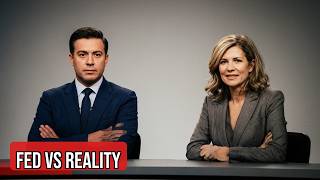
Jeffrey Gundlach believes that the Fed is misjudging the economy, and it is doing so badly. The Fed says the economy is fine, it's a "soft landing," everything is under control. The bond market tells a completely different story. And if Gundlach is right , it is in this gap that your money loses value.
This is not just market noise. This is a person who has predicted this before, saying that the entire narrative is ruined. That's the contradiction. The Fed says about the soft landing, that everything is fine. The bond market says something completely different. It's like a doctor telling you that you are healthy, but the device next to it shows a death line.
Both signals can't be right, and Gundlach is betting that the Fed is wrong. The bond market doesn't embellish anything. It simply shows what is actually happening. Let's be honest, the Fed's arguments are not crazy. Inflation has decreased compared to its peak. The labor market did not collapse. On paper, the soft landing scenario looks plausible.
Many economists still believe that the Fed is on the right track. But here's the problem. The bond market reads a different paper and doesn't try to hedge. Gundlach's entire argument is based on one idea. The bond market is a leading indicator. This is the canary in the coal mine. And now this canary is not just sick.
She is essentially lying on her back. The signals are flashing red, directly contradicting what the Fed is saying. The clearest signal is the yield curve. Typically, long-term bonds yield more. But when investors worry about the future, they buy up long-term bonds en masse, driving down their rates until short-term rates are higher than long-term rates.
This is an inversion. Historically, yield curve inversions in the US have preceded most recessions, although there have been false signals. This is one of those signals that, according to Gundlach, investors should not ignore. Gundlach also points to real interest rates, that is, rates adjusted for inflation .
Roughly speaking, a 5% bond with 3% inflation yields about 2% real return. While the Fed monitors a wide range of indicators, Gundlach argues that real rates provide a weaker implicit signal, and this is important because higher real rates do not stay on Wall Street. Ultimately, they affect both households and businesses.
Growth in the second quarter was 1.5%. It doesn't sound like a disaster until you translate it into understandable language. This is the closure of businesses, a hiring freeze, empty tables in restaurants that were previously full. And when growth slows like this, it doesn't remain isolated. It shows in your retirement account, job security, the promotion you didn't get.
Here is a sensational statement. Gundlach expected two rate cuts this year. After a weak employment report, he is now expecting a third. Think about what this means. The Fed's plan is being rewritten due to data they didn't expect. This is not steering a ship. This is a reaction to the waves that are already flooding the deck.
And all this has its human cost. It's the uncertainty of whether your job will be there next quarter. It's a silent alarm when the news comes on. When signals are so confusing, it's not just the markets that are wobbling. People's sense of stability is wavering. And this is where trust comes to the fore.
Gundlach says that Wash will not be the kind of chairman who hands out "easy money," which contradicts the overly soft policy . But if investors begin to doubt whether the Fed can even properly assess the economy, confidence could disappear. And if that happens, market volatility could increase. It's no longer a question of interest rates.
It's a question of whether anyone is in control at all. So what's the worst case scenario? This is a risk, not a prediction , but here it is. If the Fed truly lags, it could mean a hard landing. Or, in another scenario, a period of stagflation: high inflation without growth. This risk becomes more significant the longer the gap between the Fed and the bond market persists.
So, what to do about it? If the economy is weaker than the Fed thinks. Your savings , investments, and jobs are tied to this slowdown. Growth stocks often become more sensitive when growth expectations weaken. Defensive assets usually hold up better. I'm not telling you what to buy, but the question is, is your money set on the Fed's history or the bond market ?
You can't just invest and forget here. Keeping an eye on this gap—the Fed narrative versus the bond market signals—is your first line of defense. Because if those in charge make mistakes, the responsibility falls on you. So, which signal do you trust with your money? Fed stories about controlling or preventing the bond market? This is a question that every investor must answer.


Comments 0