원문 보기
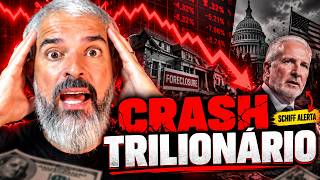
Peter Schiff, the economist who warned about the great housing crisis of 2008, is issuing a new warning. According to him, the US financial system could be dragging along losses of up to, get this, $2 trillion in mortgage loans. And the most terrifying thing is that, this time, families don't need to stop paying their debts for banks to suffer gigantic losses.
We are going to talk about this thesis by Peter Schiff . It is very important. These figures are quite alarming, but first I'm going to talk to those who don't know Peter Schiff. He is a very active economist in the US market. Many people know Peter Schiff because of Bitcoin. He's a big critic of cryptocurrency, isn't he ?
So it has many detractors in that segment; He's also an investor who buys a lot of gold, right? He is a defender of gold. And Peter Schiff became really well known during the subprime mortgage crisis in 2008. He was one of those who warned about the danger at that time before the crisis happened. And a very curious case regarding Peter Schiff, since I admire him a lot, is that I saw a video, a talk he gave, a presentation he made for investors in 2006.
I saw that video in 2013 or 2014, but I believed that the video had been recorded after the subprime crisis, because Peter Schiff was giving very precise details of what had actually happened in the crisis. And when I went to check the date of the event and the recording, I realized it was 2 years earlier.
So, the guy, 2 years earlier, was warning about how that crisis was going to happen, and it ended up happening exactly the way he described. So that really gave Peter Schiff a lot of notoriety . He's a really knowledgeable guy, isn't he? And now it is raising a problem that promises to be even bigger than that 2008 crisis.
Let's understand, then, what this new thesis consists of. In 2008, the problem was that people couldn't afford it. Now , the problem can exist even with everyone paying on time. We are going to understand the funding mistakes during the pandemic. During the pandemic, the US Federal Reserve, like other central banks around the world, brought interest rates to zero.
And you remember that atmosphere where everyone was at home, society stopped producing, and governments around the world started sending out aid packages, stimulus checks, right? This significantly increased the fiscal deficit, right? and the fiscal expenditures of countries around the world. With this increase in the money supply circulating in the economy, people received checks and went out to consume.
And that consumption, consuming the productivity that existed before the pandemic, ended up raising prices and, little by little, we began to see a rise in inflation that lasts to this day. With this fiscal crisis that we see in the United States and in European countries, when central banks tried to reverse the rise in inflation by increasing interest rates, they began to clash with these large government expenditures that were not only during the pandemic, but continued and also occurred before.
So, these deficits are feeling an impact today, but it was during that pandemic period where we felt that strong acceleration of this inflationary process of high government spending around the world and low interest rates sustained by central banks, mainly during that period. So what happened? Banks began financing long-term mortgages with historically low interest rates.
Here in Brazil there are those who today, friends of mine, financed real estate in 2020 with 7% interest. You're not even close to that today, are you? Today, for those who want to finance a property, interest rates of 12, 13, 14% are available, far from that period of the pandemic. In the United States, financing remained close to 3%.
And many of these financings are long-term, of around 30 years. As inflation subsequently skyrocketed, new mortgages and new loans began to demand much higher interest rates, as happened here in Brazil. So , today in the United States, the average of this financing, the "mortgage rate" as they say there, is at 7.5%.
So, whoever financed it back then with 3% got some amazing financing, right? You have a debt contracted for 30 years with interest rates of only 3%. And anyone who wants to enter now has a problem. You have much higher interest rates, and not only the interest rates, because all that inflation during the pandemic period also increased the value of real estate.
So, there you have two difficulties for someone who is entering now. Property prices skyrocketed, some more than doubling in value, and financing became impractical, right? And we're going to bring some numbers here within PTChif's thesis; The mortgages considered in that period were $8 trillion and the average interest rate negotiated was 4.6%.
Look, take that number. Today the new rate, as I said here, is 7.5%. In other words, the banks that lent this money on mortgages have unrealized losses, estimated today at up to $2 trillion. Look at the seriousness of the problem. Look at the seriousness of the problem. It was an excellent deal for the creditor, wasn't it?
For the creditor, the one who obtained the financing, it was an excellent deal , with a rate of 3%, but not for the bank, because if the bank needs liquidity and thinks about transferring this mortgage, no other bank or other financial instrument will buy this bank's security, because today much higher interest rates can be obtained, 7.5%; So, the bank has an accounting loss there on its balance sheet, right?
This isn't a realized loss because he didn't sell it now, but there it is. He cannot; If you need money in the short term, you will have to sell and, in fact, accept the loss. If mortgages continue, if the mortgage rate, the benchmark rate, continues to rise and reaches 8.5%, the estimated losses reach $3 trillion.
3 trillion dollars. Look how dangerous this number is, because this current 2 trillion would be approximately 25% of the total value of the 8 trillion loans that we considered here at the beginning. So, the problem could worsen with further increases in long-term interest rates, right? We are seeing this fiscal crisis in the world with 10 and 30 year interest rates rising in an upward trend, aren't we?
A true bear market for these Treasury bonds with this widespread drop causing interest rates to rise, right? Then we can see these interest rates rising even further, and the banks' exposure to these assets will be distributed not only among the banks themselves, but also among investors and mortgage institutions.
The higher interest rates rise, the less old loans are worth. It's a financial time bomb that could escalate even without a wave of defaults. So how can this loss turn into a banking crisis? Let's understand then how this can explode into a crisis. Banks and other investors hold these mortgage-backed securities.
So, the more these interest rates rise, the more we realize that the value of this security ends up falling. As long as they manage to maintain the assets, they do not necessarily need to realize these losses . But if they face withdrawals or need to sell assets to raise money, they can transform these market losses into actual realized losses.
This pressure on liquidity, capital, and confidence can cause contagion. And that's already happening in the economy today. In 2023, we had a mid-sized US bank, Silicon Valley Bank, that suffered from this problem: low-interest assets that ended up losing liquidity, right? Because interest rates started to rise, and when the bank began to face problems, that risk arose, right?
Investors sought to rescue their investments, withdrawing money from the bank to avoid contagion. The Fed helped that bank, right? And that didn't contaminate the sector as a whole. So, the problem is already happening in smaller banks, but it 's in small banks, although it's also in larger banks. Let's remember that in the 2008 crisis, the big US banks, the so-called "too big to fail" , were incentivized by the Fed and the government to acquire smaller banks that were facing problems, right?
And so it was done. So, we have very large institutions today. The problem today is much bigger. If these institutions face problems like in 2008, the size of the government bailout would really have to be a much larger one. That's why it has that name, right? "Too big to fail", too big to fail. About the real estate market.
Because of this dynamic, it is stagnant, because today whoever financed the property at 3% avoids selling the house and taking out another loan, because of course, if they take out another loan, the interest rates are much higher, they will pay 7% or more. New buyers face high fees; Construction companies today, which also have high construction costs, offer discounts and incentives.
Today, new properties have come to have lower average prices than used ones, even though they are markets with different characteristics. Look at what I 'm saying here, right? When you buy a used property, you usually know that you might find problems, that it needs some renovation or something in the structure that will have to be fixed.
The property has a warranty, but today the average price of new properties is below that of used ones. And why does this happen? Because the construction company wants to get rid of the problem. He sees that the market is stagnant, it's at a standstill, there are no buyers in the face of this difficulty, and he needs to lower the price to try to reach an equilibrium point, right?, so that he can find a buyer.
Meanwhile, the owner of a used property who is not in a hurry to sell now intends to maintain even higher prices, right? Even though the property's value , in theory, has that value, right? Ah, I'm selling this house, it's worth 2 million dollars. It's worth $2 million if there's actually someone willing to pay $2 million .
In fact, that's how it is. If there's no one there, they're not worth it. But older properties tend to stay on the market longer. The American who financed his house at 3% is trapped in excellent debt. Those who need financing now find themselves in a completely different market. And that's where the Fed's dilemma and fiscal risk come in, which could worsen this problem even further , because as we noted, this low-rate dynamic was very good at first, not only for the housing market, but also for banks that benefited quite a bit from lower rates, right?
But the current persistent inflation in the United States reduces and limits the scope for lowering interest rates. And the current US public debt makes the situation even more delicate. Let's go. What's going on today with this increasingly hot inflation, right? Producer inflation was recently released in the United States and came in well above market expectations.
In September alone, there was an increase of 1.7%. It's a very strong number. If you annualize this number, if you multiply it by 12, assuming that every month we had increases of that volume of 1.7 %, we are talking about a producer inflation of over 20% per year. And the producer is a sign that the consumer price will rise next, because the producer will pass the increased cost on to the consumer.
So, in September, consumer inflation was much lower than producer inflation, but that's how it works. First the cost goes up for producers, and then they pass on the prices. So we have a dynamic of increasingly high inflation. Peter Schiff even talks about this thesis, when he argues that his home electricity bill, compared to the same month last year, costs him 23% more this year, right?
23, it was a 23% adjustment in the price, so inflation is much higher than the number indicates, right? This model, which measures inflation not only in the United States but throughout the world, tends to make the count a little lower. Your and my day-to-day inflation is much higher than what this average reports, right?
That average of products that is used to measure inflation. So, the current US public debt makes the situation even more delicate, because with the current fiscal crisis, with the US deficit now reaching 2 trillion per year, interest rates start to rise, and investors begin to demand higher premiums to finance government debt.
And the more these interest rates rise, the worse the financing rate for real estate becomes. So, the trend is for the financing rate for real estate to reach 8.5%, 9.5%. We continue to see this "bear market" in the US Treasury. The world's central banks are dedollarizing, selling their US Treasury reserves, buying gold, rebalancing their portfolios, and primarily easing their exposure to the US dollar .
And this is what is driving this sharp rise in long-term interest rates in the United States, which will put even more pressure on this market and further increase the borrowing capacity of these banks. So, when these banks actually need liquidity, and of course, it starts from the smallest to the largest, we could see a very strong realization of these losses.
There, new financial bailouts could increase the pressure on public finances. And Peter Schiff fears that a banking crisis could turn into a sovereign debt crisis. In 2008, the United States bailed out the banks. In a new crisis, who will finance the bailouts? Peter Schiff is warning of a potentially bigger crisis than the one in 2008, not because there will necessarily be more defaults, but because the cheap money of the pandemic itself created assets that lost a lot of value.
And look at the most important fact, right? In this 2008 crisis, it was easy to identify and explain, because when the defaults began to occur, the banks lent money, they made financing to people who could not pay. And when that delinquency reached 10%, the entire collapse of the American real estate sector occurred .
In this current crisis, even if 100% of debtors continue to pay month after month, it is useless if the interest, if the interest rate continues to rise, this will further pressure the loss of this security. So, it has nothing to do with the 2008 crisis in terms of default, but rather with the value of the bonds.
That's the big problem, because banks in a crisis like this need liquidity. And how does liquidity occur? When the Fed lowers rates, when it starts buying assets, it starts printing money again, and that's what should happen next. According to Peter Schiff, he believes, as I have been discussing here, that the Treasury crisis and the US fiscal crisis will continue to occur.
And this pressure on the banks, this pressure on the financial sector, when it really starts to arrive, will force the Fed to print money again and buy assets. But the huge difference with 2008 is that in 2008 inflation was moderate, below the 2% target, today inflation is at 4%, almost 5% for the consumer.
And with this money printing, if they do again what they did during the pandemic, that will further stimulate inflation. So inflation will start to rise even more. In other words, to put it simply, it is the dollar that will lose strength. So if the Fed actually decides to help the financial market to prevent the collapse of these banks and the US housing system , it will generate even more inflation.
It condemns the US dollar, because the dollar will in fact lose its purchasing power. And that's where the dilemma lies, because inflation is going to rise. If you raise interest rates to combat inflation, you cause a major financial crisis. If you lower interest rates and print money, you get high inflation.
That, my friends, is truly the risk that the Fed is currently facing. That's what I've been saying here, this dilemma that the Central Bank of the United States is currently facing. And that is why this crisis that Peter Schiff warns about here is quite serious and is right there on the horizon. Today it stands at 2 trillion in unrealized losses.
If interest rates continue to rise, the numbers will increase even further until we actually hear news of an affected institution. And as happened in 2008, when any affected institution begins to fall, everything happens like dominoes and occurs very quickly. Peter Schiff's warning is terrifying because we are talking about potentially gigantic losses in a financial system that already faces high rates and an increasingly indebted economy.
And what's most impressive is that, unlike in 2008, a wave of defaults isn't necessary for these losses to become a problem. If long-term interest rates continue to rise, the value of these assets may fall even further. And if banks need liquidity, these losses could end up becoming real damages. The big question is: if the US financial system needs another bailout, who will save the banks?
The US government itself is already facing a fiscal crisis. And that's the bombshell that, I believe, Peter Schiff says is brewing. And it is in a scenario like this that simply getting the macroeconomic analysis right is not enough. It is necessary to know where to invest, when to increase your position, and when to protect your assets.
With the Trade for Life premium subscription, you follow my portfolio, my trades, and my investment decisions. We are in the last places of this opening. If you want to follow my strategy closely, sign up for the premium subscription at the link in the video description here. The selection process for the premium subscription occurs in two stages.
Register now. I'm glad you made it this far . Give the video a "like" and share this content with that investor friend. It's important that more people have access to information like this video. And if you haven't subscribed to the channel yet, my friend, you 're missing out on a lot; Subscribe to the channel and activate the notification bell to be notified when new videos are released . Until next time. Bye bye.






Comments 0