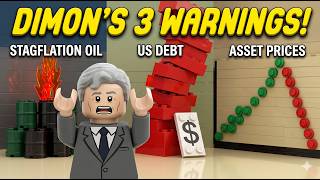
저자: JamieDimon언급—영상출연자미상 · 외국인
요약 보기
중동 지정학 리스크(유가 급등, 호르무즈 해협)와 누적된 미국 재정적자가 맞물려 스태그플레이션과 고금리 장기화를 부를 수 있으며, 국채 금리 상승이 국가부채 이자 부담을 키운다. 현재 주식시장은 실질 경기 대비 과열(쉴러 PE ~40, 시총/GDP 200%+)이라 금리 상승 시 급락 위험이 크다. 개인은 타이밍 예측보다 해자·경영진·안전마진 기준의 바텀업 투자가 현실적이라고 주장.
다듬은 글
For the last decade, the market has operated on a fairly simple assumption. When an economic problem flares up, central banks and governments have the liquidity and the leverage to flood the zone and stamp it out. Jamie Dimon sees a measurable decline in the probability of good market outcomes over the near future.
He argues that we are losing our economic safety net just as two massive forces collide. The first force is immediate and highly visible. Geopolitical conflict in the Middle East has brought the threat of ballistic missiles and nuclear development back into the daily news cycle. The second force is the exact opposite.
It is a slow structural accumulation of United States national debt, a massive deficit that builds quietly in the background year after year. Because humans naturally pay attention to loud, fast-moving threats, the public is hyper-focused on the war. But that creates a dangerous blind spot. By staring exclusively at the immediate conflict, we are ignoring the math of the deficit building right behind us.
And that matters because these aren't two separate problems. The sudden unpredictable shock from overseas is creating the exact economic conditions required to detonate our domestic debt. The connection starts in the energy markets. A localized conflict in an oil-producing region rarely stays local.
It immediately spikes the global price of crude. Looking at this flowchart, you can see how an oil spike acts as a universal tax. It starts at the central barrel and radiates out, instantly inflating costs for transport, agriculture, and manufacturing. Suddenly, producing plastics, shipping fertilizer, or powering factories costs substantially more.
Those costs are passed directly to everyday consumers. When people are forced to spend a larger share of their income just to fill their gas tanks or buy groceries, they dial back their spending everywhere else. As they close their wallets, broad economic growth stalls. This creates a mathematical nightmare.
Growth falls, but inflation keeps climbing. When these two lines cross, you get stagflation, a result Dimon identifies as the worst possible outcome for the US economy. Usually, if the economy slows down, the central bank cuts interest rates to encourage borrowing and stimulate growth. But there's a catch.
Lowering interest rates causes more inflation. With everyday essentials already running hot, the Fed cannot justify a rate cut without making the price problem worse. The geopolitical shock effectively traps the central bank. It strips them of their primary tool to save a stalling economy, locking them into a high interest rate environment just as the system needs relief.
This is where the shockwave hits the vulnerability back home. The United States government currently operates at a deficit equal to roughly 6% of our GDP. We spend far more than we earn every single year. To cover that massive gap, the Treasury has to borrow money by issuing and selling government bonds to investors.
This data scale shows the mechanics of that debt. When the government floods the market with millions of new bonds, the massive supply easily outweighs investor demand. To convince buyers to take on all that paper, the government has to offer a higher return, pushing the interest yield line up. Connect the two forces.
The fast shock of oil has driven general inflation up, forcing the central bank to keep interest rates elevated. Because baseline rates are trapped high, the government is locked into interest yields that exceed any seen in the last decade. The cost of servicing the national debt climbs to a level that consumes billions in tax revenue, pulling vital capital away from infrastructure, innovation, and domestic needs.
What was once an abstract math problem on a spreadsheet becomes a physical crush on the US economy. The deficit stops being a distant worry and turns into an immediate unstoppable drain on national wealth. We don't know exactly how the timeline in the Middle East will unfold. A negotiated diplomatic resolution is the best case.
The worst case involves losing control of the Strait of Hormuz, cutting off major energy routes entirely. But the exact geopolitical outcome doesn't dictate the structural math. Global supply chains are already shifting in response to the threat. Companies are rerouting logistics, securing alternative materials, and baking those higher costs into their operations permanently.
This forms Dimon's final warning to the market. We have entered a prolonged era of stickier inflation and persistently higher interest rates. The era of 0% borrowing is behind us. The belief that governments can run massive deficits without facing consequences simply no longer applies in a world with expensive debt.
It is incredibly easy to let flashy headlines dominate your attention. Volatile oil prices and missile tests capture the eye, distracting us from the structural decay happening in our own Treasury. The sudden geopolitical shock is the catalyst, forcing a violent and unavoidable reckoning with a decade of ignored national debt.
Right now, if you look at the stock market, you'd think we were living in a golden age. Asset prices have been racing upward, pushing into record-breaking all-time highs. But beneath that surface, the macroeconomic reality paints a very different picture. We are dealing with stubborn inflationary forces and escalating geopolitical conflicts like the war involving Iran, which are actively forcing interest rates higher.
This disconnect is exactly what JP Morgan Chase CEO Jamie Dimon is warning us about. He argues that the current euphoria in the markets is completely detached from the structural weaknesses currently building in the global economy. In his recent letter, Dimon points out a concerning metric. Asset prices, like stocks and real estate, are currently more grossly overpriced relative to the broader economy than they were right before the 2008 financial crash.
Investors are now trapped in a paradox. We have a structurally weak global economy temporarily propping up historically expensive stocks. And the pressing question is what happens to your portfolio when that illusion finally breaks. To understand the scope of the problem, we have to look at the rigid nature of US government spending.
Out of roughly $6 trillion in total annual spending, nearly $4 trillion is permanently locked in. These are mandatory obligations like Medicare and Social Security. Because that spending is set in stone, the government is increasingly vulnerable to high interest rates. As those rates stay higher for longer,
refinancing the nation's massive $39 trillion debt pile becomes a punishingly expensive process. New debt is issued at higher costs, eating up money meant for vital infrastructure. This flowchart illustrates a debt spiral. The government must borrow new money just to pay the rising interest on its old debt.
This increases the total debt pile, making interest expenses rise even faster, forcing them to borrow again. And despite the math pointing toward a blowout, there is virtually zero urgency in Washington to actually halt the deficit. Politicians seem deeply concerned about the debt when they're out of power, but they lose that concern the moment they take office.
This brings us to the bond vigilantes. These are large-scale investors who look at this borrowing and simply say, "No." They refuse to buy US Treasuries unless compensated with aggressively higher interest rates to make up for the massive risk. If a large enough group of investors stops buying American debt, those interest rates don't just drift up, they spike violently.
This rapidly destabilizes the foundational layer of the economy, throwing markets into immediate chaos. Which brings us right back to the stock market. With the national debt structure fracturing in real time, how can traders possibly justify bidding share prices up to record highs? This graph tracks a valuation metric called the Shiller PE.
It compares the cyclically adjusted average annual earnings for the S&P 500 over the last 10 years directly to the current stock price. Because it averages a full decade of performance, companies cannot easily fake their true value. Historically, investors pay around 18 to 20 times earnings for the market.
But right now, the Shiller PE sits at 40, making this the second highest point in history, just behind the dot-com crash. We see this overvaluation in a second metric. This visual compares total US stock market capitalization against the country's actual GDP. Normally, anything over 120% is considered hot.
Today, the stock market is over 200% the size of the entire American economy. You have to remember a core rule of investing. Interest rates act exactly like gravity on stock prices. The higher the rates climb, the heavier the downward pressure, making it difficult for stocks to rise or even maintain their value.
So here is the collision course. Stocks are currently priced for absolute perfection. If we get anything less, like a prolonged debt spiral or a sudden rate spike from those bond vigilantes, the market will be forced into a violent, devastating downward re-rating of share prices. The immediate trap for the individual investor is trying to time the fallout.
Guessing the exact month a macro crash will happen or predicting the climax of the debt spiral is an impossible game that almost guarantees you will lose money. The most reliable framework for navigating an overvalued, fragile market comes from Warren Buffett. He ignores the noise of the global economy and focuses entirely on what he can actually control.
Instead of a top-down macro approach, Buffett relies on bottom-up analysis. That means evaluating an individual company entirely on its own stand-alone merits, rather than buying a stock because of what you think the Federal Reserve might do next week. This strategy filters every potential investment through three mandatory criteria.
First, the business must have a rock-solid economic moat to protect it from competitors. Second, it needs world-class management. And third, it requires a significant margin of safety in the stock price, meaning you are buying it for far less than its true intrinsic value. Executing this requires extreme patience.
Often, it means doing exactly what Berkshire Hathaway does, sitting on a mountain of cash and waiting. You have to let the macroeconomy trigger broad market sell-offs before these high-quality companies become cheap enough to safely buy. Protecting wealth in an uncertain landscape relies on anchoring capital to durable individual businesses, the rare companies capable of surviving the gravity of rising rates.




Comments 0