원문 보기
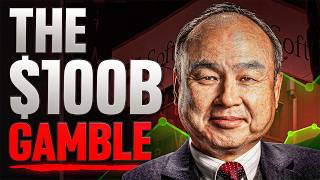
A man sits across from a stranger who runs a small online store out of his apartment. No income worth mentioning, and no real plan for getting it. After 6 minutes of conversation, the man offers him $40 million. This decision, made faster than most people order lunch, would later cost over $200 billion .
This is the most profitable venture bet in history. And 25 years later, it's also the reason why almost no one on Wall Street trusts the man completely. This man who made the proposal was Masayoshi Son. He turned SoftBank into one of the largest investment empires on Earth. And for over ten years now, the market has been doing strange things to it.
Investors look at SoftBank's assets, agree that they are worth hundreds of billions of dollars, and then value the company at a fraction of that amount. Whatever the case, the assets are not in question. Sleep is being put. This is the story of the six minutes that made him successful, and of what all his money couldn't buy: the world's trust in his judgments about the future.
Born into a Jainite Korean family in Japan, a community that was consistently excluded from the country's banks and boards of directors, Son built his first fortune the only way available to him—by moving faster than institutions that would never vouch for him . In 1981, at the age of 24, he founded SoftBank as a distributor of PC software.
By the mid-1990s, the company had become the largest in Japan, a profitable business that made him wealthy long before he was called a visionary. It was with this fortune that he began to take risks. In 1995, he invested about $2 million in Yahoo's annual online directory, and then continued to buy.
For a few days in early 2000, the paper value of his assets made him briefly the richest man in the world. Then, hunting for the next Yahoo, he flies to China, where his team has organized meetings with a number of local Internet entrepreneurs. One of them is a former English teacher named Jack Ma, whose simple company Alibaba is a website for connecting Chinese manufacturers with foreign buyers.
Sleep does not ask for predictions. He listens to Ma for 6 minutes and immediately offers him $40 million . Ma, more cautious than his investor, takes 20— an amount sufficient to give SoftBank about a third of the company. When asked later to explain his motives, Son did not give a single figure. He called it "animal smell." This will be the largest venture capital bet in history.
But it was also made at the height of the mania, just weeks before the dot-com bubble burst. This is the moment when crazy money and genius money look exactly the same. Did Son see something in Jack Ma that no one else saw? Or was he simply pouring money into the Internet at the very moment when everyone could seem like a genius?
After all, the collapse happened in a matter of weeks, wiping out Yahoo's fortune, which had momentarily made him the richest man in the world. SoftBank is selling off healthier assets and taking on huge debts to survive. And in 2006, it took out huge loans to buy the Japanese business of Vodafone, turning into a real telecom operator with stable cash, which Internet rates never brought.
The stake in Alibaba, on the other hand, survived, but it could not be sold without its intrinsic value collapsing. So it remained frozen on the balance sheet for most of a decade. A huge fortune that he couldn't really spend. This freezing is the real problem that underlies everything that follows.
A bet like that, made so quickly, is worthless until you turn it into something the world is forced to take seriously. But even then, it would only prove that Son had become rich. Not that he was right. It is this line that he tries to erase throughout the rest of his career. In 2014, Alibaba goes public, and the freeze ends.
A $20 million investment suddenly turns into $60 billion and continues to grow for the next six years, peaking at $200 billion in 2020. In terms of net profit, no venture capital bet in history has yielded more. But the number on the screen is not money in the bank. And Son learns this twice: he holds the stock past its peak.
I am convinced that the number can only grow. Then Beijing rebels against Jack Ma. This destroys the record IPO of his finance company, Ant Group. Then it takes on Alibaba itself: an antitrust investigation, a record fine of almost $3 billion . Hundreds of billions of market value have been wiped out.
The stake that Son didn't want to sell is falling with the company. By the time SoftBank finally sells off most of its stake in 2023 and 2024, the fortune it feared it would touch at its peak will be worth a fraction of what it was. So, he now controls one of the largest single stock positions in modern financial history and a challenge no investor has ever faced on this scale.
How to spend a fortune that exists mostly on paper. He can't sell them quickly without crashing the price. He can't sell everything at once without incurring a huge tax bill. And he can't just wait either. Not in a market that never fully trusted his judgment. There is one way to spend a fortune that cannot be sold.
Take out a loan for them. SoftBank is pledging its Alibaba shares and raising billions from global banks, which are willing to provide loans secured by one of the world's most valuable companies. Then they act even bolder, entering into deals that receive cash today for shares that will not be transferred for years.
The money is received now, without calling it a sale. You never have to sell your share. It simply has to remain a huge asset, providing loan after loan. He is no longer raising funds, promising the next Alibaba. He takes out loans secured by the first. And it's enough to buy the future of an entire industry in advance.
In late 2016, the financial power built on Alibaba secured Son a 45- minute meeting with Mohammed bin Salman, the crown prince of the kingdom, which is trying to build an economy that will outlive oil. Son's offering is the only fund big enough to buy controlling stakes in technology companies that are about to change the world.
Next Alibaba, found not once, but dozens of times. He is asking for $100 billion . He gets them. Saudi Arabia's sovereign wealth fund is investing $45 billion—a billion dollars for every minute of the meeting. As Son liked to point out later, Abu Dhabi is adding another 15. SoftBank is investing $28 billion of its own funds, raised through Alibaba’s credit rating, with smaller amounts coming from Apple, Qualcomm, and Foxconn.
At the end of 2017, SoftBank's Vision Fund reached almost $100 billion, which is roughly equal to the amount that the entire American venture capital industry had raised across all funds combined over the previous 2.5 years. Son openly talks about increasing the amount to a trillion— a tenfold return on the largest fund raised, a figure that only someone with Alibaba's success story could have voiced.
And he is big enough to realize this ambition in a way no investor has done before. One fund is now too big to compete with. He comes in and offers the founders more than they asked for, at prices that no competitor can match, and makes it clear that the alternative is to watch that money go to their main rival.
The press calls what happens next reckless. Huge checks, insane speed, bets on companies that obviously won't make a profit for years. This only describes behavior. But it does not explain its reasons . Vision Fund is not really a regular venture capital fund. About 40% of its external capital , the vast majority of it Saudi and Emiratis money, is structured as preferred stock with a fixed rate of 7% per annum, guaranteed against any profits for Son or SoftBank.
Once the fund is fully invested, this obligation will amount to approximately $2.8 billion , which must be paid annually to Riyadh and Abu Dhabi. Regardless of the startups' results, this single duty, invisible to the public at the time, is what is really paid for by this boldness. This explains why 80% of the fund is spent in less than 3 years.
Money lying idle still requires payment. This explains why checks start at 100 million and require large ownership stakes. A small successful bet cannot generate enough funds to service such debt. This explains why struggling companies continue to refinance instead of writing off. A write-off makes the loss permanent and public, while a new round creates a new figure to show those who owe that 7%.
What the world perceives as an unwavering vision is actually a payment schedule. A myth sold as insight. The mechanism that works is debt servicing. And for several years, almost no one outside the agreement can tell one from the other. This dependency also directly links Son to those who wrote the checks.
And in October 2018, it suddenly becomes obvious. Saudi agents kill journalist Jamal Khashoggi. Overnight, Saudi money becomes something the business world seeks to abandon. Leaders publicly distance themselves from the kingdom and its dealings. Can't sleep. The $45 billion in his fund is Saudi money, and it is impossible to give it up.
This is the first time that true vulnerability becomes apparent . Such powerful capital has never been completely under his control. The clearest proof that myth has outpaced mechanism is WeWork. SoftBank is investing about 11 billion in a company that leases office buildings for long periods and subleases them for short periods, often at a loss.
A real estate business that called itself a technology platform because technology platforms were 10 times more expensive. Founder Adam Neumann is chasing growth with no real path to profit, while Son barely bats an eye. He tours the company's headquarters for 12 minutes, sketches out a multibillion-dollar investment plan on his iPad in the backseat of his car, and applies the same six-minute instinct that found Jack Ma, now aimed at a much weaker story.
As WeWork prepares to go public in 2019, public investors read reports, losses, self-deception, the lack of a real path to profit, and refuse to buy at a price close to the declared one. The IPO is canceled and the valuation drops from $47 billion to $8 billion in 2 months. When COVID arrives in the spring, SoftBank is forced to admit that the stake is worth even less, less than three billion, and injects another 9.5 billion so that the company does not drag the rest of the empire to the bottom, including paying Neumann up to $1.7 billion just to get him to leave.
WeWork is just the biggest example. The same pattern— huge checks written to companies with good stories but no profits— is repeated over and over again throughout the portfolio. A robotic pizza startup called Zume raises $375 million from Vision Fund in 2018, burns through most of the funding, and lays off most of its staff within two years.
And public opinion is changing. Huge checks, once considered a vision, are now seen as proof that the real vision never happened. Someone can continue to write checks and cover their debts. What he can't do is prove he was right. Financial losses become impossible to hide. The Vision Fund lost $17.7 billion in the year ended March 2020, dragging SoftBank to a total loss of $9 billion.
Three years later, Vision Fund alone reports a record loss of $32 billion. A machine created to confirm one person's judgments became the loudest evidence against them. When Son launches Vision Fund 2 in July 2019, he sets a target of $18 billion. But the cornerstone is already gone. Saudi Arabia and Abu Dhabi, which provided $45 billion and $15 billion to the first fund, are absent from the list of investors, and they are not returning this time .
In the end, almost all of the money comes from SoftBank itself, turning what was supposed to be another global fund into a bet funded largely from Son's own balance sheet. Time tells the best of all things. This happened months before the collapse of WeWork, before the record losses, before all the failures that the world would later point fingers at.
Doubts appeared first. It was partly the fallout from the Khashoggi affair that made relations with Saudi Arabia toxic. But in part everything was easier. The market began to suspect even before the evidence emerged that the first fund's boldness was not the same as prudence. Then the evidence appears, and it only confirms the verdict.
In November 2019, after the fund reported its first quarterly loss in more than a decade, Son took the rare step of publicly apologizing. “My investment decisions were wrong in many ways ,” he tells reporters. A few months later, activist investor Elliott Management buys a $2.5 billion stake and publicly demands share buybacks, restructuring, and real transparency about the valuation of the fund's assets.
This is an almost unheard of challenge for a founder who still controls his own company. No single investment is a threat. The refusal is directed against the most fundamental idea . That Son's judgments, once proven, will continue to attract capital solely on the strength of his reputation. The market stopped trusting him even before the losses became apparent.
And the losses only confirmed that the market was right. Salvation, when it comes, is not at all the result of Son's instincts. It comes from the only asset that has never depended on them. In 2016, SoftBank acquired British chipmaker ARM for about $32 billion. ARM doesn't make trillion-dollar promises.
The company licenses the processor architecture for almost every smartphone on Earth. It's a patient, undemanding, almost monopoly that doesn't require or reward six-minute decisions. This is the least Son-like asset owned by SoftBank. He almost loses it. In 2020, SoftBank is trying to sell ARM to Nvidia for $40 billion to shore up a balance sheet ravaged by the Vision Fund.
Regulators in the US, UK and EU are blocking the deal due to antitrust concerns. In 2022, it falls apart, leaving SoftBank with an asset that is not easily converted into cash. So he lists ARM on NASDAQ. In September 2023, a year after ChatGPT caused demand for efficient chips to soar. ARM shares are rising over the next year.
SoftBank retains about 90% of the company. By 2026, this stake will be worth more than SoftBank's entire market value . ARM did not reward vision, speed, or intuition. She rewarded patience. A quality that was never thought to be necessary for the Son legend. Patience had just saved him. He completely ignores this lesson.
He does not repay debts and does not refuse borrowed funds. He starts again, aiming for something bigger: the physical foundation of artificial intelligence. Chips, data centers, and the electricity to run them. In January 2025, Son becomes chairman of Stargate, a joint venture with OpenAI, Oracle, and Abu Dhabi-based MGX Fund, created to invest up to $500 billion over four years in AI data centers across the United States.
SoftBank is contributing its share and starting construction in Texas and beyond . At the same time, SoftBank is pouring tens of billions directly into OpenAI, becoming one of the largest external shareholders. But this bet is different. Every trick that saved him before—lending against shares, going public when the time was right— depends on an asset that can be sold.
This asset cannot be sold . This is land, concrete and electricity contracts. And if the pace of AI development slows down even a little, SoftBank will be left with the most expensive real estate on the planet, with no clever scheme to save it. Alibaba was once the backbone of everything he did. Now it's ARM.
The jewel in the crown is constantly changing, and each time Son uses it to put the entire company on the line again, which brings us back to the discount that never went away. In 2019, SoftBank's stake in Alibaba was worth more than the entire company on the stock market. In 2020, the company traded for a third of what it had been worth.
In 2026, the stake in ARM will again exceed the total value of SoftBank. Three different decades, three completely different assets. Same verdict. The market will appreciate what Son possesses. He won't appreciate what he can do with it further. Investors even have a name for this gap—the “Sona discount.” Part of it is simple math: Holdings always trade below the sum of their parts, regardless of who manages them.
Part of it is what he deserved himself, and the damage is too great to ignore. But some of it is harder to name. The same instinct that makes a "friend" a visionary often makes a "friend " a player. And Son has been a "stranger" all his life. He was barred from Japanese boards of directors as a Zainiti Korean long before he lost the full trust of Wall Street.
Whether this discount is a verdict on his judgment or his background is something that has never been spoken aloud. Underneath all this lies a question that Son has never been able to answer. Were those 6 minutes that made him successful a skill that can be repeated, or a fluke? Everything he has built since then is an attempt to prove that it was a skill, and a response he still expects from the world after all these years.
Some bets end when the money is counted. This one doesn't end because what she was really trying to prove was n't about money at all. Every empire leaves behind a ledger. Subscribe to see the next one. Until next time, this is Wealth Ledger.



Comments 0