저자: PhilipPanero · 외국인
요약 보기
AI 및 웹3.0(3D 몰입형 웹) 전환으로 엔비디아 시장 점유율·성장 여력이 크다고 주장. 2030년 주가 8,000달러 전망(현 약 800달러). 아마존 2005~2015 사례와 비교하며 AI 초기 단계(1회 이닝)로 규정. 디지털 트윈·GPU 기반 건설·자율주행 확산을 근거로 제시.
다듬은 글
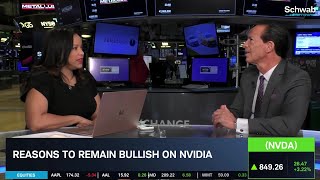
welcome back to morning trade live we want to talk into the biggest player in the AI space that would be Nvidia joining us now for insight on that we've got Philip Panero founder and former CEO Boston Consulting groups plinian philli thank you so much for joining us so we teased into this talking about how you see where you see Nvidia going right we had people putting price Targets on an analyst putting price targets around 800 800 plus it's above that but you have something even higher now my notes say 5,000 but we just had a sidebar chat yes where do you see this thing going so I see it going to 8,000 by 2030 and my perspective is not from a financial analyst perspective or from a chart perspective or a stock picker perspective my my perspective is strictly from a technology perspective and if you take a look at the market there's two key factors that are driving that growth the first is the AI Revolution which everybody says because that's the easiest thing to understand but the second thing which people don't talk about is the transition from web 2 to web 3 and essentially what Goldman Morgan Stanley and City Bank say is that transition is worth 8 to 12 trillion so we'll use the midpoint which is1 trillion so what does that mean web 3.0 is not just the decentralized web it's 3D so basically the more immersive web now web 3.0 has been bastardized with the term the metaverse but all of the things that are run on web 3.0 are driven through gpus so as the market moves from a CPU dominated Market which started in 1960 almost 60 years what you're going to see is a migration of all of the infrastructure for buildings cars factories City municipalities and governments transition to web Point 3.0 and Nvidia drives all of that so what's that worth that's worth trillions upon trillions so uh statistically speaking Nvidia controls about or has captured more than 90% of say the addressable AI market so is the expectation so the expectation is that the growth is going to be even beyond that so actually I'm actually assuming half nidia's growth to get to the $8,000 Target and I'll take you through it so essentially right now it's at $800 a share we'll just keep the numbers even the bottom line is if you look at another stock that as at the beginning of a cycle and I look at Amazon in 2005 Amazon was $50 a share and did around 10 billion in Revenue by 2015 it was over $500 this year 10 times the amount and the revenues were 10 times the amount to 100 billion so that that's parallel to where Nvidia is because if Nvidia was to capture just half of what they capture now in the Ami Market they would go to 600 billion which means their stock price would go to 10 times that which would be 8,000 so that's very very simple math that you can do to see what the opportunity is but what I think people are underestimating I know when uh Sam Alman talks about you know there's a$7 trillion investment in chips required people don't understand that all the infrastructure on Web 2.0 which is driven by CPU and GPU is going to move more towards a GPD environment which is what Nvidia provides but what also people don't understand is NVIDIA not only provides the chips but they actually provide the network the application development right and also most importantly which nobody's valuing they provide digital twins which is basically what's going to happen in the future is we're going to have a digital first strategy so what does that mean that means means you build things digitally before you build them physically it's the complete opposite of what happen today in fact BMW builds their factories as a digital model they run simulations in the Digital model and they train their robots and then they build the factory so all construction all building operation all Building Maintenance is going to be moving to GPU trips so what everyone says the experts in the space say we are early in terms of this AI from here the Gen geni uh space what inning are we in we're in the first inning the first inning the first inning that's it even though when you talk about kind of you talk about some of this stuff has been around since the 60s or 70s so how can it still be considered the first inning so so let's talk about that the what's been around since the 60s is CPU and IBM created CPUs which back in the 1960s and CPUs are single processing MH gpus was created for gaming by Nidia in 2017 189 then people started only beginning to penetrate the use as you could see in Telsa cars Mercedes Amazon using it in their in their factories now what you're seeing is that penetration is like 1 2% I talk to all the CEOs at buildings at factories they barely understand the impact of AI what's going to end up happening is and I'm sure you've spoken to the CEO of Nvidia he actually says that it's a million times the benefit to use gpus as opposed to using a CPU combined why is that I actually will just go with a 100 but the bottom line is that people are going to choose the GPU chip combined with embodied AI to run buildings to run factories to drive cars to drive ships think about the disruption that's going to cost in the economy if you just take the transportation piece right now eventually people are going to move to self-driving cars then you're going to have self-driving boats and you're going to have self-driving trains and self-driving buses and who Powers all of that that's just one segment of the economy which is worth trillions so you can just see that people are completely not looking at the fars from the trees they're looking at a balance sheet so when Financial analysts look at a balance sheet that's like hunting dinosaurs a stock comes out every so often once in a generation where you have to look at the big picture and the big picture is we're only in the first inning of the technology cycle for AI and web 3.0 so what do you say to critics who say Nvidia is too expensive now they're not looking at it from a technology perspective those are the same people who said Amazon was too expensive in 2005 when they didn't understand there was actually losing money Amazon the Vias actually have a 50% margin so when they looked at Amazon they were like this doesn't make sense they're losing money why is the stock like this in 2005 what they didn't realize it was only in the first inning of the e-commerce cycle which now has gone on and on and on and those people who bought that for $50 a share by 2015 it was actually over 600 what sectors of the economy or or or um let's say job market are most at risk by this transformative thing that's happening in the generative AI space so what you should think about is AI as a positive thing you should think about it yeah yes because you should think about is like having Einstein in your basement where you can go to it and get guidance on operating a building on maintaining a building on driving a car I mean bottom line is you should use it as an enabler so if anything it's going to increase the productivity so I know you think that that estimate of 8,000 is actually very high it it seems wild it actually is very low because it assumes that right now the digital penetration of the entire economy is around $20 trillion the economy is around 100 trillion to keep the math simple half of that is what they call they're going to say is going to become immersive okay or basically web 3.0 what we're say so my estimate is based on only keeping 20 trillion out of 100 trillion I believe with a digital first economy where people will build things digitally people will run things digitally that 20% can actually go to 30 million 30 trillion or 40 trillion because I think digital will penetrate more of our lives with AI as an enabler okay AIS the enabler and friend not foe yes and you heard it here first that prediction that Nvidia Nvidia however you want to say it is headed to 8,000 according to Philip Panero all right our thanks to Philip n he's the founder and former CEO of Boston Consulting Group PL tenian





Comments 0