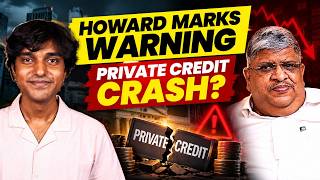
저자: Anand및공동진행자Shashwat · 외국인
요약 보기
하워드 막스의 프라이빗 크레딧 경고 메모를 인용하며 400%p 금리 급등 충격으로 비상장 벤처·사모 크레딧 일부가 취약해졌다고 진단. 인도 스타트업 버블 붕괴(Byju's, Lenskart 등 재무 우려), 미 국채금리 상승과 이자부담의 재정 리스크 제기, AI 인프라 부채(CoreWeave 등 고금리 차입)의 취약성과 2025년 부실 사례, 1929년식 과잉·유동성 불일치 위험을 경고. 구체적 매수/매도 추천은 없음.
다듬은 글
Good evening, and welcome back to Anand Talks. Howard Marks has been writing a memo every month for the last several years. Shashwat and I read them quite often, and whenever something very interesting comes up, Shashwat points it out. The last memo I read in real depth was about a year and a half ago, titled "Sea Change," and it has stayed with me.
What Marks was saying is that nobody in the private industry or among the fund managers was ready for a rise in interest rates of nearly 400%. For the longest time, interest rates were zero. From zero they went to 5.25%, and now they've dropped to 3.75%. But going from zero to one is 100%, one to two is 200%, two to three is 300%, and three to four and beyond is 400%. Going from three to four is a smaller jump, but when you reach 5.25% you've hit a 400% increase. None of the private equity structures were designed to absorb a rise of 400 basis points, and that is exactly what happened.
In India, people don't make this connection, but that 400-point rise ended the private equity and startup mania, and all the private players moved into public markets. Companies that were not healthy enough to come into public markets died. One of the most notable failures is of course Byju's. Some companies have been sold off and are in good shape. The most famous among them is CaratLane. Incidentally, I'm told that today is CaratLane's 18th birthday. It's part of the Titan family, it's profitable, and it's doing well. But if you look at its history over the last ten years, Tata first came in as a financier, then as an investor, and finally bought the company outright. What I'm trying to say is this: when risk appetite is low, capital is easy to find. When rates rise, capital becomes very difficult to find.
Take Lenskart, which is supposed to be a star performer. I looked at its balance sheet and found reserves and surplus of about 8,000 crore rupees. All the expenses it has incurred have been capitalized, and there is an enormous entry of 2,500 to 3,000 crore rupees for goodwill. I don't know what that goodwill is. Even if the company keeps making profits for the next seven or eight years, it will have to write down what it has shown as capitalized expenses, so not much cash flow will reach investors. In most cases, like Zomato and others, companies raised another 10,000 crore rupees from institutional investors, and their promoters have jumped off the ship. I don't think these companies are sustainable if interest rates keep rising. This is a clear example of companies that never expected rates to rise by 400%.
Today Shashwat and I are going to discuss Marks's current memo, which is about private credit. The article comes in two parts. The first part covers the history of private credit, and the second covers what fund managers should do. We'll save the second part for the next episode and focus today on the history.
For many years, there were only two ways to get credit. Either banks lent you money, or you raised money through high-grade bonds. If your company was rated below BB, you couldn't raise money in the market and had to go to a banker. In countries like India we have what's called shadow banking, basically NBFCs, which lend to people who don't have access to banks. And even NBFCs borrowed from banks. High-grade bonds are for triple-A-type companies that can raise money at low rates, and everyone else goes to banks.
In the 1970s, Michael Milken created a category of funds built on junk bonds, bonds rated below triple B minus. These carried very high interest rates, and most of them paid off. They were called high-yield bonds, and a lot of money flowed into them. Milken later got caught in an SEC investigation and was banned from the market for a long time. He still holds an annual conference, which Howard Marks attends. Marks was introduced to credit markets by this man, and that is why, while most people have forgotten Milken, Marks pays tribute to him whenever he can. If you Google Milken, you'll find much less flattering things too.
In the 1970s, money moved into high-yield or junk bonds, and that stayed the pattern until about 2000. Marks eventually separated himself from the banks and created Oaktree Capital, which has since been sold. That is his history.
From 2000 to 2003, the stock market dropped substantially. When markets fall, nobody wants to be in them, so money moved away from public markets for a long period. Private equity investors began competing with banks in lending, and the private equity business was taking shape. That is roughly when private equity and venture capital started becoming what we now call private equity.
So the evolution of private credit looks like this. In the '70s, non-investment-grade debt became accepted. In the '80s, leveraged buyouts became popular and corporate leverage increased; George Soros writes in his book about leveraged buyouts and the conglomerate boom. In the '90s, syndicated loans and tranche securities appeared. In the 2000s, there was a rising trend toward alternative investments, subprime mortgage lending, and mortgage-backed securities. In the 2010s, direct lending expanded during the low-interest-rate period. And in the 2020s, direct lending vehicles began to be marketed to individuals and retirement investors.
After the 2008 financial crisis, banks had to clean up their balance sheets, so they withdrew from lending and direct lending took off in a big way. At first, the capital for direct lending came mainly from institutional investors. Over time, when things were going well, everyone wanted to join the party. Individual investors and retirement accounts came in, and that is how the boom started.
Today, in my view, the companies involved in AI business fall into two groups. The first is the large companies like Alphabet, OpenAI, Microsoft, and Oracle, which have no trouble accessing public markets in whatever currency they want. The second group is small companies, and the company the central banker was talking about when he mentioned AI debt is CoreWeave. That company has to borrow at roughly twice the cost of Anthropic or Google. CoreWeave has investment from Nvidia, and for some of its loans Nvidia has acted as a backstop. Even so, if Intel is paying 5.5%, these companies have to pay double that. This is where private credit plays its role in AI. These borrowers are not the top clients or the top-tier companies. They are at the bottom of the pile, so if any shake happens, they are going to go bankrupt.
In 2025, two companies, First Brands and Tricolor, went under. Then there was Blue Owl, which stopped redemptions. The rules here are very clear. In equity, I can do a fire sale, raise the money, and give it back to the client. But in private credit, when investors start panicking and want to pull their money out, there's a retrenchment, and withdrawals are halted. That way, the investment manager under pressure doesn't have to dump every loan. And to be clear, there is no fire sale liquidation. They have clear rules to stop withdrawals or redemptions, and companies like Blue Owl have put those guardrails in place.
While all of this is playing out in the AI space, what matters greatly is that bond yields refuse to come down and keep rising. That underpins everything we're discussing. For a long time, T-bills and equities did not offer attractive enough yields, so investors wanted to move into private markets. Pension funds wanted higher returns, so they pushed into riskier territory. But today the game seems different. The field has changed. A 30-year Treasury yields around 5.3%, and a 10-year yields about 4.8%. I would rather take 4.8% from Uncle Sam than put money into an unknown software company. That unknown software company that was getting 9% last year now has to pay 12%, and that is moving up very fast. If rates rise further, the United States could end up paying more than 3% of GDP in interest on its bonds, and that is the trigger point. America's nominal growth is not much above 3%, and if you are generous, it's about 3%. When interest payments exceed nominal growth, you have to borrow just to pay interest, because your revenue isn't enough. Tax revenue isn't growing fast enough to service the debt. The counterargument is that governments can move money around and cut spending, but no government is willing to say it wants to spend less, and I don't think that will happen. So the rush will be to pull money out of those who collected it and invested in AI. Investors will move back along the risk curve, and they will take less risk.
The most famous case of this in India is IL&FS. For years, IL&FS funded roads, power plants, and more with repayment periods of 25 to 30 years, while its own liabilities were in 90-day T-bills. Its assets were for 25 years, and its liabilities were for 90 days. That is maturity transformation, and it ran smoothly for nearly 30 years. Then one day IL&FS failed to make an interest payment, and the whole market collapsed. A couple of years ago, Franklin Templeton also got into trouble for the same reason. A fund that was meant to hold very short-term, low-rate instruments was used to buy long-term instruments, and when investors asked for their money back, it couldn't pay.
One thing I've noticed when I give talks on the economy is that people come up and say, "Sir, you talk about bonds and stocks, but I'm getting opportunities with people who are hungry for credit, new businesses that want funding because the formal system won't lend to them or they can't clear the hurdles. They're willing to pay me a premium in yield." My answer is always the same: there's a liquidity risk. Your money is liquid, it's in cash. You transfer it to a businessman and it becomes an illiquid asset. Where does he put it? He puts it into working capital, into raw materials, work in progress, finished goods, or receivables, or he leaves it sitting in a bank without using it. And he is borrowing at a rate higher than the bank pays you, so in none of these cases can you easily get the money back. You're trading something you understand, liquidity, for a few extra percentage points of greed, and converting a liquid asset into an illiquid one, because you're lending to a single person doing business. You don't know his cash flow, whether it's enough to service the interest, or whether it will be enough to return your principal. And if that cash flow fails, how will he pay you back? There is also no real protection. Even if you execute all the documents and get a deed on a real estate property, enforcing it as an individual lender is very difficult. An organized lender can go through the SARFAESI process and sell the property accordingly, but you as an individual cannot invoke SARFAESI to seize the asset. Even if the borrower has pledged the property in writing, you have to go to court and argue he hasn't paid, and the court has to transfer the property to you or hold an auction and sell it to the highest bidder. That is a very inefficient way to recover your money.
This is exactly what happened in 1929. When the land crisis hit, the land offered as security came up for sale and was sold at distress prices. The debts remained real, but asset prices kept falling. Farmers in America were forced to sell their land at distress prices. That's the pattern to keep in mind as we look at private credit today.
1929년 대공황 당시 땅값이 폭락했습니다. 공급된 토지가 필요한 양보다 많이 나왔기 때문입니다. 땅값이 떨어지니 담보로 잡힌 대출의 실질 가치는 올라가고, 자산 가치는 떨어졌습니다. 많은 은행이 그대로 파산했습니다. 앤드루 소킨이 쓴 『1929』라는 훌륭한 책이 있는데, 당시 상황과 아무도 이 폭락을 예상하지 못한 이유를 잘 설명하고 있습니다. 제 손에 그 책을 들고 있으니 표지도 보여드리겠습니다.
당시 신문과 모든 자료를 읽어도 아무도 이 폭락을 내다보지 못했습니다. 위대한 경제학자 어빙 피셔조차 완전히 놓쳤습니다. 지금 우리는 그와 비슷한 상황에 있습니다. AI가 모든 것을 해결해 줄 거라고 생각하는데, AI가 실제로 작동하는 것은 맞더라도 그것이 이 막대한 투자 비용을 갚을 만큼 충분히 작동할지, 아니면 과잉 투자된 부분이 철도채권 때처럼 정리되어야 할지는 모릅니다.
바로 철도채권에서 일어난 일이 그대로 반복됩니다. 이 글에서도 그 얘기를 합니다. 새로운 기술이 등장하고 그 안에 진실의 핵심이 조금이라도 있으면, 모두가 달려듭니다. 광기가 생기고 규모는 점점 커집니다. 그러다 서서히 현실이 찾아옵니다. 맨 위 또는 그 근처에서 처음 두세 명이 배에서 뛰어내립니다. 나머지는 간절히 희망을 붙듭니다. 또 한 번 랠리가 옵니다. 그리고 결국 모두가 이것이 끝이라는 걸 깨닫고, 아무도 버틸 수 없게 됩니다. 큰 조정이 옵니다. 철도는 여전히 남아 있고, 전신도 여전히 있고, 회사 인터넷도 여전히 있습니다. 하지만 살아남은 기업은 극소수였습니다. 여기서도 똑같은 일이 일어날 겁니다.
오늘 아침 엔비디아가 현금 990억 달러를 보유하고 있다고 말씀드렸습니다. 그런데 엔비디아는 7,000억 달러에 달하는 약정을 하고 있습니다. 즉 모든 조건이 충족되어 현금을 지급해야 할 때는 돈을 빌려야 한다는 뜻입니다. 현재 경제학자들의 추정으로는 예상 약정액과 부채를 모두 합치면 약 3,000억 달러입니다. 물론 지원 약정(백스톱) 장치도 일부 마련해 두긴 했습니다. 약정 규모를 점점 키우고 있는 것도 맞습니다. 그래도 990억 달러에서 3,000억 달러면 레버리지가 세 배입니다. 시장이 나빠지고 그 규모가 네 배, 다섯 배로 불어났는데 일이 잘 풀리지 않으면 큰 문제가 됩니다.
내일은 사람들이 돈을 빼기 시작할 때를 다루겠습니다. 1929년 이후 그가 말한 세 가지 조건, 펀드매니저가 해야 할 일, 투자자가 해야 할 일에 대해 이야기하겠습니다. 오랜 시간 함께해 주셔서 감사합니다. 이렇게 긴 팟캐스트를 들어 주셔서 고맙습니다. 저도 즐겁게 진행했고, Shashwat도 즐거웠으리라 믿습니다. 채널을 응원해 주셔서 감사합니다. 구독하시고 알림 설정도 켜 주시면 좋겠습니다. 다시 한번 감사합니다.



Comments 0