원문 보기
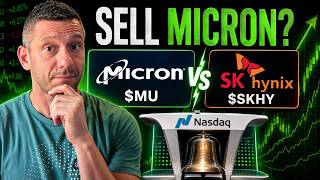
The largest foreign IPO in American history just went public on the NASDAQ, and it's the company that makes the most important component for every Nvidia AI chip— SK Hynix. $26.5 billion was raised , demand exceeded supply seven times, a 14% increase on the first day. So , the question everyone is asking is: should I sell Micron and buy this instead?
So I've gathered all the important metrics from both companies, and I'll break them down with you to let the data decide, because that's what we do on this channel. Remember, this is not financial advice, always do your own research, but let's get started. SK Hynix controls 56% of the global HBM market.
HBM is a memory chip that is installed on every Nvidia AI graphics processor. Without it, the GPU simply doesn't work. Until today, if you wanted to own this company as an American investor, you wouldn't be able to. It was registered in Seoul, currency difficulties, time zones, lack of analytical coverage.
So everyone bought Micron instead. And I also covered Micron in detail . Micron has essentially become a proxy, the only memory stock on the US stock exchange, and it has risen by over 700% over the past year. As of today, this restriction has completely disappeared. For the first time, American investors can own shares of the number one and number three HBM manufacturers on the same exchange.
That's what makes this listing significant. This is not just another IPO, it changes the distribution of investments in the entire memory sector. Now let me quickly address the fears. Micron fell from over $1,200 to less than $950 in two weeks. The entire memory sector has fallen by 20%, into the bear market zone.
That's the mechanics. When a $26.5 billion IPO happens, no new money is created. Fund managers who are already fully invested in semiconductors need to sell existing profitable assets to make room. After a 700% rise, Micron is an obvious position for a cut. This is capital rotation, not a fundamental assessment of the business.
There is a huge difference here. Even Michael Bury opened a short position. His fund has about $250 million, while Micron's market capitalization is over a trillion. It's just noise. Business hasn't changed, and the numbers prove it. Two weeks ago, Micron reported its fiscal third quarter. These numbers are extraordinary.
Revenue of 41.5 billion, exceeding forecasts by 6 billion, an increase of 346% year-on-year. Their quarterly revenue was higher than their entire annual revenue two years ago, which is just crazy. Earnings per share (EPS) $25.11, exceeding the forecast by 24%. Gross margin is 84.9% , a year ago it was 37.7%.
So, the forecast for Q4: $50 billion in revenue and 86% gross margin. Both figures significantly exceed any predictions. Now let's look at structural changes. Micron has signed 16 long-term customer agreements worth more than $100 billion in guaranteed revenue through 2030. Half of their future income is already fixed.
For a business that has historically been considered one of the most cyclical in the world, this completely changes the model. CEO Sanjay Mehrotra said during the report that the supply shortage will continue to be felt beyond 2027. They just announced $250 billion in investments in the US by 2035 and poured the first concrete on the largest semiconductor manufacturing site in US history.
Companies do not spend such money if they expect a drop in demand. Now let 's look at it from the other side. SK Hynix controls 56% of HBM's global revenue . Micron occupies approximately 20–25%. Two and a half times the market share in the hottest semiconductor product category. Revenue for the 1st quarter of 2026 is about 34.9 billion.
Operating margin 72%, net margin 77%. Operating profit for the whole of 2025 reached 31 billion. This is twice as much as the previous year, although the company reported an operating loss back in 2023. Here is the main news that appeared today. SK Hynix CEO Kwak told Reuters that 2027 will be the worst year in the history of the memory industry in terms of supply.
He stated that demand will exceed their capacity even after 2030. These are the words of the head of a company that produces over half of the world's HBM , and he says they won't be able to produce enough for the next four or so years. Jensen Huang confirmed this last month. The memory shortage will continue for years, and SK Hynix will remain Nvidia's largest supplier.
At Computex, he walked up to the booth and wrote, "Please do more." on the HBM plate. SK Hynix is building a $4 billion packaging facility in Indiana, investing $10 billion in an AI solutions company in the US, and doubling its total wafer production capacity within five years. UBS predicts that DRAM will remain in short supply until at least the second quarter of 2028.
Let's compare them side by side. HBM share: 20–25% in Micron and 56% in Hynix. Now quarterly revenue: Micron 41.5 billion, Hynix 34.9. Gross margin: Micron 85%, Hynix 79%. Forecast P/E ratio: Micron 7–10 , Hynix 6. And annualized returns: Micron 700% , Hynix over 600%. Regarding the HBM4 allocation for Nvidia: Micron has about 20%, and Hynix has 50 to 55%.
Here's what should immediately catch your eye. SK Hynix has two and a half times the market share of HBM, higher annual revenue, comparable profitability, and trades at a lower forward multiple. This gap existed because American investors did not have access to the shares. This is the Korean discount.
From today on, this obstacle is no longer there. Now the main argument for SK Hynix is not profit growth, but discount correction . If the multiple simply approaches Micron's, that's significant upside potential even before any fundamental improvements. But look at Micron on this chart. Highest sales growth in the entire S&P 500, lowest valuations, it's also inexpensive.
Both companies may be undervalued. Just for different reasons. Now everyone sees it as a choice between one or the other. This is the wrong question. The HBM market alone is projected to grow from 35 billion to 100 billion by 2028. The content of next-generation AI racks will grow from 15 billion to over 154 billion per generation.
That's a tenfold increase, and both CEOs say demand will outstrip supply until at least 2027, and likely beyond 2030. Both have sold out their entire HBM production. The demand is greater than all three memory manufacturers can physically produce together. This is not a zero-sum game. A manager who sells Micron for SK Hynix today will likely own both within 6 months.
It's true now, memory is cyclical, but companies are aggressively investing in capacity. And if demand for AI slows or supply exceeds demand, margins will shrink. SK Hynix bears the risks of Korean jurisdiction and concentration on Nvidia. Micron, with a trillion-dollar capitalization, needs to constantly perform tasks against a backdrop of very high expectations.
Both grew by 600-700% per year . Shortages support the market, but manage your risks accordingly. In my opinion, the memory layer in AI infrastructure now has two available names instead of one. SK Hynix provides leadership in HBM and corrects the discount. Micron secures a US listing premium, margin expansion, and $100 billion in signed contracts.
They complement, not compete with, each other. So, save this video right now. All the necessary numbers are here. And if you want to see how I analyze the stocks every week, the process, the structure, the results— the link to join the community is in the description. This is not financial advice. Always do your own research. And see you in the next video. Mr. Amut.



Comments 0