원문 보기
Warren Buffett is arguably the greatest investor of all time, and he currently has $82.5 to show for it. Probably as a result of him focusing solely on finding great businesses to acquire through his company, Berkshire Hathaway, he has never had time to write a book about this investing approach. Which is unlucky for all stock enthusiasts out there.
But ... luckily, Warren Buffett has been sharing his thoughts on businesses and investing yearly in his shareholder letter to the owners of Berkshire Hathaway ... and he's been doing that for quite a while now. Even better - Lawrence A. Cunningham has structured these letters into a book, so that I could make this video, which is a ...
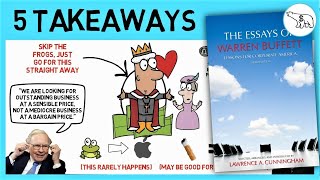
top 5 takeaways of The Essays of Warren Buffett. Written by Warren Buffett himself and Lawrence A Cunningham. Let's dive into the mind of the man who turned $1,000 into a fortune that may last for centuries. Takeaway number 1: Buy outstanding businesses at sensible prices When I was a little kid, I enjoyed the story about The Princess and the Frog.
You know, whom, upon being kissed, turned into a prince? And they lived happily ever after, awwww. Warren Buffett, however, apparently didn't like this tale. Or, well, at least not as a lesson for stock market investing. Sure, if you kiss enough frogs, some of them may turn into princes, but why not just go for a prince in the first place?
Warren Buffett's primary goal in investing is: "To find an outstanding business at a sensible price, not a mediocre business at a bargain price." Frog-like businesses are cheap, but you'll have to buy a whole lot of them before one of them turns into a prince. Instead, go look for prince-like businesses that you can find at a reasonable price.
Many of Warren Buffett's investment principles he got from his teacher Benjamin Graham, but this is a point where they have different opinions. Benjamin Graham went quiet for in his "value investing" approach, and even (to continue the analogies) thought about some of the companies he bought as "cigar butts".
They were really cheap, and probably good for one more "puff". Benjamin Graham definitely preferred buying at bargain prices, and as a result, he mostly bought frogs. However, Buffett found that over time, buying great businesses that reinvested their profits, to compound the returns of shareholders, was a better strategy - even if the price tag was slightly higher.
In fact, Warren Buffett has just three requirements for a stock market investment: Superior economic prospects A reasonable price/valuation, and Extraordinary people in charge. In the coming three takeaways, we will have a look at these three separately. Takeaway number 2: Look for a high return on capital Imagine that your own a lemonade stand.
Would you rather be able to make $1,000 with a stand that you bought for $200, or $300 with a stand that you also bought for $200? Yep, Buffett would prefer the first option as well. More specifically (just because both me and Buffett likes to use confusing accounting terminology), you want to own businesses with a high return on net tangible assets.
That's a fancy way of saying: "earning a lot of money on stuff that the company owns, minus stuff like goodwill and patents and minus the liabilities of the company. And Buffett is not alone in using this approach to measure superior economic performance. Although who would care if he was? He is the greatest of all time, we'd listen to him anyways!
But Joel Greenblatt is on to the same thing in his book "The Little Book That Beats the Market". Check out my video on that one as well. However ... Buffett expands on this concept a little bit further. You want a company that can keep adding more capital and keep earning an above average return. So, going back to our example: We want to make sure that we can keep adding lemonade stands for $200 that can earn $1000 yearly in the future as well.
There's just one problem ... Everyone likes to own lemonade stands that makes $1000 on every $200 invested! Or, well ... speaking in more general terms: High returns on capital attracts competition. So .. there's a third thing that you must look for in your stock market investments and that is a moat.
A moat is a characteristic of the business that makes it so that it's difficult (and in some cases nearly impossible), for competitors to steal parts of the market. For a lemonade stand, that could be: a superior secret recipe, really low operating costs, or perhaps some "special" ingredient that makes your customers addicted to the product.
Widening this moat and extending the competitive advantage is, according to Buffett, even more important than the current year's return on capital. More on this in my summary of the biography of Warren Buffett - The Snowball. A business that possesses a high return on capital, where additional capital can be employed to produce cash at high rates in the future as well, and which is protected by a wide moat is what Warren Buffett wants to see.
However, a good business is not always a good purchase. Although it's a good place to look for one. We must also get the business at a fair price. Takeaway number 3: The intelligent investor welcomes volatility According to standard investing dogma: volatility in the price of a stock is risky, dangerous and may even be fatal to investors.
Warren Buffett argues just the opposite: Short-term fluctuations in the market are meaningless. Except to the extent that they sometimes offer great buying opportunities. Here's where the reasonable price/valuation component comes in. The businesses that fulfill the criteria from takeaway number 2 are often priced at premiums.
Luckily, the market is sometimes fearful ... VERY fearful. At such times even strong companies have low valuations. Benjamin Graham's take on this erratic behavior of the markets is a classic, and if you haven't heard about his "Mr. Market" analogy, I recommend that you head over to my summary of The Intelligent Investor after this video.
If you're going to be a net saver for the next, say, decade or so, you should even HOPE for a market crash, because that means that you're going to be able to continue to buy more great businesses at sensible prices in the future as well. Yet, many investors feel uneasy at times of turmoil, and would rather see their businesses soar.
Even though that must necessarily mean that later purchases will happen at high prices ... or not happen at all. Warren Buffett says that one must be fearful when others are greedy and greedy when others are fearful On an aggregated market level, fear and crashes only happen occasionally. But with individual companies, opportunities arise quite frequently.
You must only act when one of these opportunities present themselves. The rest of the time - just sit still. "Looking for stocks is like looking for a spouse. It pays to be active, interested and open-minded, but it does not pay to be in a hurry". This is easier said than done. But one way to achieve the right mindset is to try to build a portfolio that will have the highest possible aggregated earnings in a decade or so.
This will make you think about long-term business aspects, rather than short-term market valuations - a perspective that is almost guaranteed to increase your stock market returns. "Just as in baseball - to put runs on the scoreboard, one must monitor the playing field and not the scoreboard." Takeaway number 4: Identifying extraordinary management.
According to Warren Buffett, it's quite simple really. You want extraordinary people to handle the businesses that you invest in. And hat characterizes an extraordinary manager? That he or she thinks like an owner in running the business. Buffett and Charlie Munger (his right-hand man) wants the CEOs of their companies to run them like: - They are its sole owner.
- It's the only asset they own - They cannot sell a merger for a century There's simply too much that a CEO can do to make the situation awful for you as an investor in the stock. Here are some red flags to look for: - "Trust me. I'm going to maximize shareholder value". Beware the CEO who often expresses that he wants to maximize shareholder value, yet, he doesn't own any stock in the company personally, the company has never paid a dime in dividends, he has turned his back on share repurchases on multiple occasions when the stock has been cheap, and he has tied the size of his bonus to the size of the company's earnings.
- Financial reports display week accounting. Week accounting often means that there's something to hide. "They're seldom just one cockroach in the kitchen". - Footnotes are impossible to decipher. The same principle applies here ... If you don't understand what the footnotes say in the financial reports, it is often because someone doesn't want you to understand them.
- Earnings projections are trumpeted. It may seem like the manager is doing you a favor here, because it gives an impression of transparency. In many cases, it gives the wrong incentives though. Fudging numbers is quite easy, and managers that always promise to "make the numbers" will at some point be tempted to "make up the numbers".
Instead, look for CEOs who are: - Independent - Business-savvy - Interested - Shareholder oriented. Make sure that they own stock in the company that they are operating. Takeaway number 5: Stay focused You are asked to place bets on some of the fastest runners in history, who are competing during their prime, in a 100 meters race.
You win if the runners that you bet on manage to sprint the distance in less than 9.9 seconds. You have Usain Bolt, Tyson Gay, Yohan Blake, Justin Gatlin and Carl Lewis competing. If Bolt manages to run in less than 9.9 seconds, you get 4x your money's worth. 3.5x for Gay, 3x for Blake, 2.5x for Gatlin and 2x for Lewis.
You have $10,000 at your disposal. How would you split your bets? Split them?? Are you crazy?!! I guess that most of you would place either all your money on Bolt, or perhaps split them among the top three, with more money going towards Bolt than Gay and Blake. In the stock market, all too many investors practice all too much diversification.
But Warren Buffett is very skeptical: why put money in your 20th favorite stock, when you can simply pour more of it into your top choices? If you understand the businesses that you're thinking about investing in, you often have both a higher chance of success in your top picks, COMBINED with a higher potential payout.
Moreover, a diversifying strategy simply can't be practiced, because you don't have enough time to analyze that many companies satisfactorily, and there simply aren't that many great deals to go around either. "Charlie and I decided a long time ago that, in an investment lifetime, it's too hard to make hundreds of smart decisions." Diversification should only be practiced by individuals who do not intend to learn and understand the economics of specific businesses.
Once you've found outstanding businesses at sensible prices, the best holding period is forever. And with such a buy and hold strategy, about one good idea per year is enough. "Frequently, the best decision is to do nothing. There are worse things in life than having a prosperous business that one understands well." That's it for The Essays of Warren Buffett!
Here's the summary: Buy outstanding businesses at sensible prices. Look for businesses with high return on capital (and with moats!). Short-term fluctuations in the market means more opportunities. The best managers run their businesses like an owner. Focus your investments on a few great opportunities that you understand well.
I expect to have a playlist of Warren Buffett books to show up here in the end, but if that doesn't pop up now, you know what you can expect for the next few summaries. Cheers guys!


Comments 0