원문 보기
Bill Ackman manages billions of dollars, but he does something most investors would find uncomfortable. He concentrates. As of July 31st, 2026, Pershing Square Holdings reported about $17 billion in assets under management. And Pershing Square's latest SEC 13F, covering June 30th, showed just 15 reported US securities worth about 19.5 billion dollars.
Those numbers are not the same thing. Assets under management, fund equity, and a 13F measure different things. And a 13F does not show every investment a fund owns. But together they tell us something important. Ackman is not trying to own the whole market. He wants a small number of businesses he understands extremely well.
So today, we're looking at what he owns, what he has been buying, and the real lesson behind the portfolio. Pershing Square says it normally concentrates the substantial majority of its capital in roughly 8 to 12 core holdings. The firm looks for businesses that are simple and predictable, generate recurring free cash flow, have strong competitive positions, limited dependence on debt markets, and strong management.
And then comes the part many investors forget. Price. Ackman can like a company for years and still refuse to buy it. Pershing Square says it tracks hundreds of businesses and waits until the market offers one at a valuation below what the firm believes the business is worth. In other words, great company, wrong price, wait.
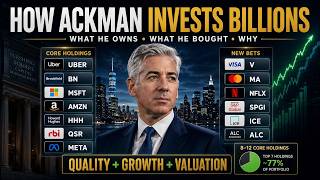
Great company, attractive price, now things get interesting. So what was actually inside the latest US filing? As of June 30th, the largest reported positions were Uber, about $2.48 billion. Brookfield, 2.45 billion. Microsoft, 2.32 billion. Amazon, 2.04 billion. And Howard Hughes, about 1.99 billion dollars across two reported entries.
Restaurant Brands was about 1.87 billion, and Meta about 1.80 billion. Those seven positions represented roughly 77% of the value reported in the 13F. That is concentration. If one of the biggest holdings move sharply, Ackman does not need to check whether it matters. It matters. But the more interesting story is what changed.
During the first half of 2026, Pershing Square established six new investments. Visa, Mastercard, Netflix, S&P Global, Intercontinental Exchange, and Alcon. At the same time, the firm exited Alphabet and Universal Music Group, and later exited Hertz in July. So, capital was not simply being added. It was being reallocated into businesses Ackman believed offered a better combination of quality, growth, and valuation.
And the six new investments look very different on the surface. Payments, streaming, financial data, exchanges, eye care. But underneath, the logic is surprisingly similar. Start with Visa and Mastercard. Pershing describes them as capital-light toll collectors on global commerce. The firm estimates they receive roughly 20 basis points, or about 0.2% of a typical transaction for providing the network, authorization, fraud protection, and other services.
And Pershing says card payments still account for only around half of addressable consumer spending globally. So, the thesis is not simply that people will keep using cards. It is that Visa and Mastercard own critical infrastructure underneath digital payments, while value-added services are becoming a larger part of their businesses.
Then there is Netflix. Ackman owned Netflix before, exited, and came back. Pershing says the new opportunity appeared after Netflix shares had fallen roughly 50% from their June 2025 high. But while the stock price had fallen, the business had improved. Pershing reported more than 325 million Netflix subscribers and operating margin of roughly 31.5% up from about 21% when it first invested in 2022 and free cash flow conversion of about 90% of earnings.
That gives us one of the most important ideas in this entire episode. A falling stock does not automatically mean a worsening business. Sometimes the price changes faster than the fundamentals. Next, S&P Global and Intercontinental Exchange or ICE. These are less famous with everyday investors, but they sit inside financial infrastructure used around the world.
Pershing says more than 80% of S&P Global's profits come from ratings, indices, and Platts. And the S&P 500 is used as a benchmark for more than 20 trillion dollars of assets. ICE owns major exchanges and markets, including the leading Brent crude futures marketplace. Pershing estimates ICE has around 90% market share in Brent crude futures, while its exchanges segment generates nearly 70% of company earnings.
Not exactly a viral consumer app, but trillions of dollars do not care whether infrastructure is exciting. They care whether it works. Then there is Alcon, the eye care company. Pershing highlighted an installed base of roughly 30,000 pieces of surgical equipment. That equipment creates recurring demand for consumables, and the firm believes Alcon's operating margin can rise from around 20% toward 25% or more over time.
Different industry, same pattern. Strong position, recurring revenue, temporary concerns, a valuation Ackman believed had become attractive. Now, here is the part that keeps this from becoming billionaire worship. Ackman does not always win. In the first half of 2026, Pershing Square Holdings NAV fell 12.6%.
Over the same period, the S&P 500 gained 10.2%. That is a gap of more than 22 percentage points. But, Pershing also reported that from the strategy's 2004 inception through August 11th, 2026, it had produced a 15.6% annualized net return versus about 11% for the S&P 500. Both numbers matter. A strategy can have a strong long-term record and still look terrible for 6 months.
Concentration increases the upside when you are right. It also makes mistakes much harder to hide. So, what should you actually learn from Bill Ackman's portfolio? Not this. Bill Ackman owns Uber, so I should buy Uber. That is copying a position without understanding the thesis, the purchase price, or the risk.
The more useful lesson is the process. Study businesses before you need to buy them. Look for durable competitive advantages and recurring cash flow. Separate the quality of the company from the price of the stock. Wait for valuation to matter. And when a better opportunity appears, be willing to move capital.
Pershing estimated that its portfolio companies could grow earnings per share by roughly 20% annually over the next 3 to 5 years while trading at about 19 times earnings. That 20% is Pershing Square's estimate, not a guaranteed result. And that distinction matters because the portfolio is not a prediction that every stock will go up.
It is a collection of calculated bets where Ackman believes the potential return is worth the risk. Bill Ackman manages billions, but the most useful thing in his portfolio is not a ticker symbol. It is the framework. Find a great business. Understand why it is durable. Know what you think it is worth and wait for the price. Apparently, even billionaires like a good sale. Welcome to Market Zoo.





Comments 0