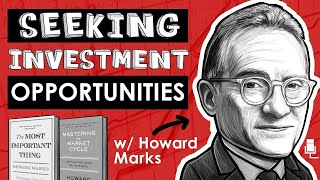
저자: Weronika/주인물HowardMarks · 외국인
요약 보기
Howard Marks의 투자 철학을 소개하는 영상으로, 좋은 투자는 좋은 자산을 사는 것이 아니라 잘 사는 것(적정 가격)에서 나온다는 결론을 강조한다. 핵심 일화: 1978년 전환사채 펀드 시작 후 고수익채권(하이일드) 투자로 전환해 안전하게 수익을 냈다. 가격을 고려하지 않은 채 좋은 기업을 사는 것의 위험을 강조. 군중심리: 투자자는 가격이 오르면 더 사고 떨어지면 판다. 반대로 해야 한다. 버핏의 '남들이 두려워할 때 탐욕을, 남들이 탐욕스러울 때 두려움을' 인용. 경력 교훈: Nifty 50 버블 시기 고평가 대형주에 손실이 컸던 경험, 좁고 깊은 전문성이 더 가치 있다는 교훈. 대형 효율 시장에서 종목 고르기보다 소규모 틈새에서 깊이 아는 것이 유리하다고 설명. 파트너십: 가치관 공유와 상호보완적 기술이 중요하며, 빠른 직관형 Marks와 신중한 사고형 파트너의 결합이 성공 요인. 특정 자산에 대한 가격 전망이나 매매 추천은 없음.
다듬은 글
I went from losing a lot of money in the best companies in America to making a lot of money safely and steadily in the bonds of some of the worst companies in America. So it helped me to two conclusions. It’s not what you buy, it’s what you pay. And good investing comes from buying things well, not from buying good things.
And if you don’t know the difference between buying good things and buying things well, then you’re probably in the wrong business. Hi, this is Weronika! Today we will talk about one of the most iconic investors, Howard Marks. We are going to break down his take on how setbacks lead to new opportunities and that good investing comes from buying things well, not from buying good things.
Howard Marks is an investing legend and multi-billionaire who is the author of two best-selling books, “The Most Important Thing” and “Mastering the Market Cycle.”, and the co-founder and co-Chairman of Oaktree Capital Management, a global investment giant. Since he’s been witing memos to his clients for 35 years, doing that, have made him one of the world’s famous thinkers on investing for his insightful approach on financial markets.
Warren Buffett once said that when he receives memos from Howard Marks in his mail, he can’t wait to read them and he always learns something new. Let’s listen to Howard Marks’ 4 LESSONS ON GOOD INVESTING AND SEEKING OPPORTUNITIES Howard Marks refers to his own experience of starting a convertible bond fund in 1978, which changed his life.
He quickly understood that a sahe and sound investment is not about what you buy, but what you pay. You know I’m a great believer in luck. I’ve been writing the memos to clients now for, I think this is the 34th year. I wrote one, I believe it was January of ’14 called “Getting lucky”. And that one got the most responses of any until lately.
And it was about how lucky I’ve been. I feel I’ve been inordinately lucky, from the timing of my birth, to my position at the front of the Baby Boom, to the fact that I got into Wharton when they said I wouldn’t and so forth. But certainly, having started the convertible bond fund in May of 1978, I got the call in August that changed my life.
It was from the head of the bond department and he said, there’s some guy named Milkin or something out in California, and he deals in something called high yield bonds. Do you think you can figure out what that is? There have always been low grade bonds, but the way they came into existence prior to ’77, ’78 was that they were high grade bonds that got into trouble.
So called fallen angels. What Michael Milken, Drexel Burnham, and some others at the time did uniquely is they had this concept that you should be able to issue non-investment grade bonds if the interest rate is sufficient to offset the risk. Makes perfect sense. But prior to those days, it was impossible to issue a bond that wasn’t investment grade.
Moody’s, in its manual, defined a B rated bond as follows: “Fails to possess the characteristics of a desirable investment.” In other words, it was bad. And that was without reference to price. And this was, if you think about it, the ideal bookend to my experience in the ’70s. I went from losing a lot of money in the best companies in America to making a lot of money safely and steadily in the bonds of some of the worst companies in America.
So it helped me to two conclusions. It’s not what you buy, it’s what you pay. And good investing comes from buying things well, not from buying good things. And if you don’t know the difference between buying good things and buying things well, then you’re probably in the wrong business. He states that the world’s most successful investors keep their emotions restrained and they go counter to the trends that the majority of investors follow.
Emotion is the greatest enemy of superior investing. If you take a look at most people in what they call the herd or the consensus, as the economy does well, as the company’s profits grow, as it reports higher earnings, as the stock rises, most people become more and more and more excited about it. More optimistic, more trusting, and more inclined to buy.
So the higher the price, the more buying they do. Then eventually things stop going so well, the economy turns down, the corporation’s profits contract, three earnings announcements are negative, the price of the stock declines, people get pessimistic and depressed, and more likely to sell. So the higher the price, the more likely they are to buy, the lower the price, the more likely they are to sell.
This is the opposite of what we should be doing. We should be scaling out as the price rises, perhaps when it gets unreasonable, and we should be getting in with both feet when it falls. So clearly most human emotion is arrayed against doing the right thing. And there are a lot of other examples, not just that, but there’s a reason why Buffet said, “The less prudence with which others conduct their affairs, the greater the prudence with which we must conduct our own affairs.
When other people are unafraid, we should be terrified because that means they’ll pay prices that are too high. When other people are terrified, we should turn aggressive because their terror makes things available to us cheaply.” And you’re right. I mean the great investors I know are unemotional about their investing and they go counter to these trends.
Howard Marks started his first summer job at First City National Bank in 1968, becoming an equity analyst the next year, and then Director of Research soon after that. He recollects his memories of how he lost his seemingly dream job in a corporate organization, where he’d go from having 75 subordinates, a $5 million budget, membership of the investment groups and most important committees, to having no subordinates, no budget, no committies, and yet he’d find it exciting, inspirational and better for his career trajectory.
What we can learn from Marks’ story is that expanding your expertise in depth within a specific field can be much more valuable, rewarding and exciting rather than touching on the surface of multiple areas, without a deeper dive and understanding. I’m not sure I recognized at the time how bad the firestorm was.
I thought I was doing okay. It’s just the Nifty 50 stocks that we’re having a terrible time. But yes, I joined the Investment Research Department for the summer at First National City Bank, which later morphed into they now call Citi, I believe was maybe the world’s largest financial institution at the time, riding high.
As were the Nifty 50 stocks that most of the Money Center Banks, we had this expression Money Center Banks, the ones in Boston and Chicago and New York. And most of the Money Center Banks subscribed to this thing called Nifty 50 investing, investing in the 50 wasn’t strictly 50, but in the best and fastest growing companies in America.
Companies that were so great that nothing bad could ever happen. And because they were growing so fast and of such high quality, the official dictum was that there was no such thing as a price too high. And importantly, no price too high. Those four words I think are the hallmark of a bubble. And we hear it said every time something’s in a bubble.
So looking back, I had my first brush with a bubble. And if you bought the stocks the day I reported to work and held them for five years, you lost almost all your money. Why? Number one, they were too high. And many of them carried PE ratio between 70 and 90. And five years later, between seven and nine.
So there’s 90% off the top right there. But secondly, these companies that were so great, nothing bad could ever happen, a lot of them turned out to have feet of clay. Where’s Polaroid? Where’s Kodak? Whatever happened to Simplicity Pattern? Who do you know that makes their own clothes these days? So it shows you the undying devotion to a concept which became a bubble, which became a crash.
The overall investment results at Citibank were so bad that in 1977, they brought it in a new Chief Investment Officer, Peter Vermiliey, and we hit it off well, but he wanted to have his own Director of Research, and I helped him land and a guy named Charlie Porton for that job. And then he says to me, “Well, what do you want to do next?” In retrospect, I think I was lucky not to get fired, but of course in those days, corporate America pretty much involved lifetime employment.
So I said, “I’ll do anything except spend the rest of my life choosing between Merck and Lilly. There are, I believe, more and less efficient markets and the market for the great US big stocks is among the most efficient markets. And I think that to spend your life choosing among them is mostly a waste of time.
And we know that most people who manage money in the biggest stocks, most of them don’t do as well as the index. So that was a good decision on my part. And Vermiliey, who had come from JP Morgan, where they had a very successful convertible bond fund, he said, “I want you to join the bond department and start a convertible bond fund.” Which I did in May of 1978.
And it’s interesting. I went from 75 subordinates, a $5 million budget, in a time when that was a lot of money, and membership on all five of the investment groups, most important committees, to no staff, no budget, no committees. And I was ecstatic. As Director of Research, my job was to know two sentences on 400 companies.
Now I only had to know everything about a few companies. And I was rather than competing in the big stocks where everybody knows everything, I was competing in a small backwater that very few people were concerned with. And the scope for superior performance was much greater and the intellectual excitement of knowing a few things in depth was terrific.
And that really put my career, my life on a great upward trajectory. Marks also shares what is the secret to good and lifelong partnerships, both in business and in life, based on his own experience and what proved to work for him. He sheds light on how valuable is to corporate with someone, who can have different skills than you, but the skills should compliment each other, so not only the result of working together is successful, but also the whole process of the actual work.
And I said, “The secret to good partnerships is shared values and complimentary skills.” And a chicken shouldn’t work with a pig, the buccaneer shouldn’t work with the clergymen. Can you imagine if you had a partner in your business whose view of ethics was different from yours? But Bruce and I share, to the extreme, the desire to operate on the high road.
We are very different people with very different skills. You know you had Kahneman’s book to “Thinking, Fast and Slow”. I’m a fast thinker. I give my reaction to things, often intuitive and intestinal. And Bruce is a slow thinker and he thinks things over. He reaches a conclusion, then he thinks them again, then he thinks them again.
And the combination of the two has been incredibly successful. But the key is I don’t disrespect him for dragging out his considerations and he doesn’t disrespect me for being intuitive. And that’s incredible formulation for a good partnership. That’s it for today! Remember to subscribe to our Daily Newsletter We Study Markets by clicking on the first link in the description below, and subscribe to our channel too!
Thank you for watching! He told Li Lu and me that he wanted us to get together for lunch once a month. He basically pretty much instructed us that, “I want the two of you to meet once a month for lunch”.




Comments 0