원문 보기
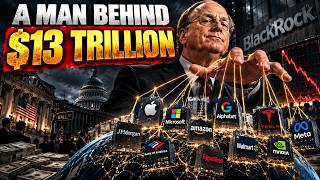
In 1986, one of Wall Street's brightest young stars watched a single quarter erase around $100 million of his bank's money. His interest rate bet went wrong, his reputation went with it. Colleagues stopped sitting near him. The golden boy of First Boston was finished. His name was Larry Fink. And the firm he built from that humiliation now manages roughly $13 trillion,
more than the annual economic output of every country on Earth except the two largest. It's called BlackRock. It is almost certainly a part owner of your employer, your bank, your phone company, and the index fund in your retirement account. Its software quietly monitors tens of trillions more, including money managed by its own competitors.
Governments hire it in emergencies. Protesters burn its name on placards. Most people couldn't say what it actually does. This is the story of the most powerful company most people have never understood, and it begins with the lesson inside that $100 million wound. Before we begin, subscribe to our channel for more amazing stories.
Larry Fink wasn't supposed to lose. A Los Angeles political science grad with no banking pedigree, he'd risen at First Boston by helping invent something that would reshape finance. Slicing pools of home mortgages into tradable bond securitization, the machinery that would later star in 2008. He made the bank fortunes.
At 31, he was reportedly its youngest ever managing director. Then came 1986. His desk's hedges assumed interest rates would keep rising. Rates fell. The losses around $100 million turned the prince into a pariah. And Fink later described the humiliation openly. He was, in his own telling, treated as a leper.
But inside the wound was a diagnosis. He had lost not because he took risk, but because he couldn't see it, the tools to measure what his positions would do under different futures simply didn't exist. Risk, he concluded, was the product nobody was selling. In 1988, Fink and seven partners founded a new firm inside the offices of the private equity house, Blackstone, with a $5 million credit line and a heresy for a mission statement, put risk management, not star trading, at the center of investing.
When the venture later split from its landlord, Blackstone's founder let the junior firm keep a confusingly similar name. BlackRock was loose. Its secret weapon wasn't a trader. It was software the partners were building to x-ray every bond in a portfolio, a system they named Aladdin. Hold that name because a catastrophe was coming that would turn it into the most important machine in finance.
Through the 1990s, BlackRock grew steadily bonds, pensions, a 1999 stock market listing, but its reputation ran ahead of its size for one reason. When other institutions' portfolios blew up, they called BlackRock to analyze the wreckage. Aladdin asset, liability, debt, and derivative investment network could stress test holdings against thousands of scenarios.
Rates up, housing down, currencies sideways. BlackRock began renting the machine to outsiders, including direct competitors, the arms dealer selling to both sides of every portfolio war. Then 2008 detonated the crisis built in part from the very mortgage machinery Fink had helped pioneer decades earlier.
And the US government, staring into portfolios nobody could price, made a remarkable phone call. It hired BlackRock to manage and unwind the toxic assets of fallen giants. The Bear Stearns and AIG rescues ran through BlackRock's analytics. The firm that measured risk became the state's crisis surgeon along with a permanent controversy.
Critics asked how one private firm could advise the government, run its own funds, and see everyone's books at once. And in the fire, Fink made the deal of the century. Britain's Barclays, desperate for capital, sold its investment arm, including a then niche business called iShares to BlackRock in 2009 for about 13.5 billion dollars.
iShares was the leader in a sleepy product category, ETFs index funds you trade like stocks. What happened next turned those three letters into the heart of modern markets. As evidence piled up that most expensive stock pickers failed to beat cheap index funds, trillions migrated into passive investing, and BlackRock owned the biggest toll booth on the road.
Overnight in hindsight, the risk boutique became the largest asset manager in human history, which created a problem no company had ever had. Here's the strangeness of index money. It buys everything automatically forever. So, BlackRock plus its passive peers Vanguard and State Street, the big three became among the largest shareholders of nearly every major American corporation simultaneously.
Airlines and their rivals, every bank, every oil major, and every solar firm. Academic studies found the big three together cast roughly a quarter of the votes at S&P 500 annual meetings concentrated, permanent, and conflicted by design ownership that antitrust scholars are still arguing about. That position dragged the index giant into every culture war at once.
When Fink's annual letters urged CEOs toward climate awareness and purpose, the political right declared war. Multiple US states pulled pension money, accusing BlackRock of weaponizing other people's savings for ideology. The left attacked from the other flank, too big to exist, a housing market villain, and still a top owner of fossil fuels.
By the mid-2020s, BlackRock retreated from climate alliances and softened the language proved that when you own everything, every side considers you the enemy. Meanwhile, Aladdin kept swallowing the back office of world finance. By widely cited accounts, the platform risk monitors on the order of $20 trillion
across hundreds of institutions, rivals, insurers, sovereign funds. One firm's software is the nervous system of global capital. Regulators have openly debated whether BlackRock is a systemic institution like a mega bank. It has fought the label banks hold your money. BlackRock, it insists, merely manages it, fee by tiny fee.
So, where does an everything owner grow next? The answer, unveiled in a buying spree, reveals the next act of capitalism itself. In 2024 to 25, BlackRock spent tens of billions acquiring its way into private markets. A $12.5 billion deal global infrastructure partners owner of stakes in airports, ports, and pipelines.
A multi-billion purchase of private credit giant HPE's. A data firm Preqin to map the private world the way Aladdin mapped the public one. The logic, public market index fees race to zero while the financing of physical reality energy grids, AI data centers, toll roads commands premium fees for decades.
The firm that owns slices of every company now wants the infrastructure those companies run on. The era's signature deals made headlines on their own. BlackRock launched the dominant US spot Bitcoin ETF in 2024, which became, by many measures, the fastest growing ETF ever launched. A stunning reversal for a CEO who'd once dismissed crypto.
And in 2025, a BlackRock-led consortium agreed to buy dozens of ports from a Hong Kong conglomerate, including terminals at both ends of the Panama Canal, a transaction so geopolitically charged amid US-China tension that its fate played out in diplomatic headlines for months. An asset manager negotiating what amounts to canal geopolitics, the index fund had become a foreign policy actor.
Succession looms. Fink, past 70, has run it since 1988, and rivals, regulators, and politicians circle. But the chessboard he built may matter more than who plays next. So, what is BlackRock? Finally, not a bank that holds no deposits, not the shadowy owner of your neighborhood the conspiracy version mistakes it, something stranger.
The plumbing. It is the default shareholder of capitalism, the risk software other managers think with, the government's crisis contractor, and increasingly the financier of the physical world's rebuild, all running on fees measured in hundreds of a percent multiplied by $13 trillion. And and the whole empire still traces to one bad quarter in 1986.
Fink lost a hundred million because he couldn't see risk, so he built the machine that sees it for everyone, then let the age of index funds pour the world's savings through his pipes. The man Wall Street shunned responded by making Wall Street a customer, which leaves the question for the age BlackRock built.
When one firm quietly owns a sliver of everything, votes at every table, and runs the software everyone else trusts, who, exactly, watches the owner of everything? If this series keeps decoding the machinery behind the modern world, subscribe. There's plenty left before we begin.





댓글 0