저자: PeterSchiff · 외국인
요약 보기
결론: 피터 쉬프는 미국 경제가 2008년보다 훨씬 심각한 금융 붕괴를 겪을 것이며, 금·은과 해외 저평가 주식으로 자산을 옮기고 달러와 미국 고평가 기술주를 피하라고 주장한다. 거시 진단: 연준의 저금리·양적완화가 자산 버블을 키웠고, 이 버블은 이미 터지기 시작했다고 본다. 인플레이션은 '일시적'이 아니었다는 입장이다. 인플레이션 근거: 소비자물가 상승률이 정부 발표(약 7%)보다 실제로는 높다고 주장하며, CPI 산출 방식이 의도적으로 물가 상승을 과소평가한다고 말한다. 무역 근거: 2022년 12월 무역적자 1,010억 달러로 사상 처음 1,000억 달러를 넘었고, 연간 상품 무역적자는 1조 달러를 넘었다고 언급한다. 정책 비판: 2020년 팬데믹 시기 통화·재정 정책의 조합이 최악이었다고 평가하며, 재정지원금이 생산 없는 수요를 만들어 공급 부족을 낳았다고 본다. 금리 전망: 연준이 금리를 올려도 인플레이션(3% 이상)을 따라잡지 못해 실질금리는 하락하며, 정상 금리로 돌아가면 은행 파산·주가 폭락·부동산 붕괴·미국 국가부채 디폴트 위험이 있다고 본다. 연준은 결국 인플레이션을 용인할 것이라는 전망이다. 투자 조언: 버블은 이미 꺼지기 시작했고 과거 주도주 다수는 50% 이상 하락했으며 더 하락할 것이라고 본다. 고PER 기술주 대신 유럽·아시아의 배당주와 저평가 해외주식으로 이동하고, 달러 자산을 매도하며, 금·은을 매수하라고 권한다. 금 전망: 2001~2011년처럼 금이 약 5배 오르는 랠리가 다시 올 가능성이 크다고 예측한다. 은행·구제금융: 이번에는 TARP 2.0 같은 구제금융이 없고 대형 은행들이 파산하도록 허용되어야 하며, 그 충격은 2008년보다 클 것이라고 주장한다. 리스크: 영상 설명란은 엔터테인먼트 목적이며 금융 조언이 아니라고 명시한다. 과거 대비 현재의 설명(이미 하락, 이미 올랐다 등)은 예측이 아니다. 출연자 전망: 쉬프는 2008년을 넘는 경기 침체, 금 강세, 기술주 약세, 달러 약세를 전망한다. 시청자에게 그의 예측이 맞을지 여부를 묻는다.
다듬은 글
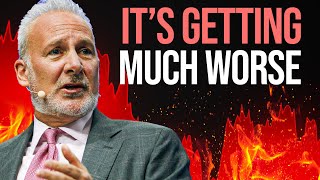
Peter Schiff, an economist and gold fanatic, frequently has a lot to say. Schiff stated in an interview that he thinks the United States will experience a financial catastrophe worse than the "Great Recession" of 2008. Since the United States now owes a lot more money than it did in the past, according to Schiff, the economic downturn in the country "is going to be a far worse problem when the defaults start." During this market meltdown, the majority of investors haven't even bothered to peek beyond the surface, thus they are completely unaware of the massive rotation that is already in motion.
The introduction of inflation will result in a fundamental shift in the financial environment, drastically altering the dynamics that have prevailed for investors over the past ten years—basically everything that has worked. This bubble was being inflated by the fed, but it won't last since air will eventually escape from it.
Despite the Fed's best efforts, We believe they have already popped the bubble, and there is virtually nothing the Fed can do to stop it from popping. Let's start by addressing the first part of the stagflation equation, which is that we certainly have a major inflation problem that has endured for more than 10 years.
Inflation hasn't manifested itself in a way that was problematic for the fed or investors because it was raising asset values rather than consumer prices. Consumer prices increased, but not much enough to raise alarms, especially given the government was able to mask the true rate of price growth using the cpi.
Which, Peter believes intentionally, does a poor job of correctly representing what's happening in the market and materially underestimates the pace of price growth. Due to the Fed's capacity to continue inflating under the pretence of quantitative easing, stimulus, and zero percent interest rates, the government's ability to pretend that inflation was below two percent allowed the Fed license to do so.
However, this money mostly went into financial assets while also contributing to a record rise in the US trade imbalances. In fact, we learned that the trade deficit in December set a new record of 101 billion dollars, making it the first time that the trade deficit exceeded 100 billion dollars. For the entire year, our trade imbalance and products exceeded one trillion dollars, an amount that has never before been attained by any country.
These are goods traded for merchandise. Even though we experienced a 7% increase in consumer prices, according to how the government monitors inflation, a portion of that actually helped keep the price of goods under control. If our trading partners had not pushed a trillion dollars' worth of goods onto our market, just think how much higher consumer prices would have risen.
How did we pay for everything, exactly? We didn't. The products that the rest of the world created were exchanged for the money that we printed, and Americans didn't even make a lot of the money that they spent. The government just provided it to them in the shape of stimulus payments or other rescue funds.
And from where did that originate? Well, it was printed by the federal government. When we initially entered the pandemic march of 2000, we enacted the worst conceivable blend of monetary and fiscal policy because, instead of acting appropriately and cutting the money supply with the economy so that demand would decline along with supply, we did the opposite.
The Fed and the government worked together to create the worst monetary and fiscal policy in human history. Everyone received checks in the mail from the government to replace their paychecks, but the important thing to remember is that when you earn a paycheck, you are being productive and aiding in the production of goods and services.
As a result, you are rewarded with pay and can now enjoy some of the goods and services that you assisted in creating. Less consumption is necessary when you are not working. However, the government did not want that to happen because it would have meant worsening the recession. Therefore, it shouldn't have come as a surprise that there are severe shortages now that the government has paid everyone money to spend on goods and services that they weren't generating.
We had all this extra demand because of the government and the federal reserve, and we haven't even started to feel all the effects of that inflation. It is an evident result of a failure to create when there is a lack of goods. Peter believes that a substantial portion of the inflation that we saw in 2021 was a delayed effect of the inflation that occurred before 2020.
"I don't even think we've caught up to that inflation yet which is one of the reasons that we're going much higher not only wasn't inflation transitory but it's going to be far higher than it was during that supposed transitory period. I said the fed was lying about that. I said that inflation was as transitory as the subprime market was contained." In 2007, when the subprime market exploded due to the mortgage market, that is exactly the falsehood the Fed told us.
The damage was restricted to one niche of the mortgage market, the Fed assured us, so there wouldn't be an issue. The housing market as a whole would not be impacted. It wouldn't have an impact on the economy, and of course, the 2008 financial crisis happened. The Fed continues to intensify this inflation issue since it is actually adopting a more stimulative stance while appearing to tighten.
However, if inflation gains momentum, which it will most likely do, real interest rates will be falling even as the Fed marginally raises nominal interest rates. The main issue, however, is that the Fed was only able to defend these unnaturally low-interest rates and quantitative easing on the grounds that there was no inflation, which gave them the freedom to do so.
The Fed can no longer support keeping interest rates artificially low since even if they raise them by 2%, they will still be low given that inflation is now treble or more than 2%. Since our massive debt bubble was the only thing keeping us afloat, the Fed could only maintain rates at such low levels.
The financial crisis would be much worse than it was in 2008 if interest rates were allowed to return to normal. All of the large banks that we bailed out would fail. There would be a stock market crash. If the Fed allowed interest rates to reach a natural level, the real estate market would implode and the private sector would struggle to pay its debts.
The United States government would likewise find itself in a difficult situation, possibly worse. It would be necessary for the US government to make a national debt default. In actuality, the federal government is in a difficult situation. Fighting inflation while allowing interest rates to rise and everything to fall is a poor decision.
The worst course of action would be to keep inflating in order to prevent that and delay the effects of hyperinflation. but regrettably, that is probably the decision they will make. What should investors do in light of this new reality given that, despite the Fed's continued provision of cheap funds, those funds won't be sufficiently low to maintain the bubble, which is already losing air due to the Fed's recent announcement of minute rate hikes?
The bubble has already burst. Many of the equities from the boom are already down by 50 percent or more, and they will keep declining. Even more so if you look at value stocks, we are currently witnessing enormous rallies in dividend-paying stocks in Europe and Asia, stocks that have been written off for years, and equities that were exploited as a means of raising money.
In an inflationary market like the one we're in with firms that trade on a dream, high PEs, or no ease at all, people are now picking up those stocks as they sell off these overvalued assets because they can't get out of overpriced U.S. equities right now. As a result, people sell these equities since the impetus has passed, and they only trade on anticipation and hope.
So what happens after you exit overvalued US stocks? You must invest in international stocks that are underpriced since doing so basically enables you to achieve two goals. You should sell your U.S. stocks and put the money into higher-valued companies that are profitable right now by making and selling products, making money, and paying dividends.
As soon as people realize that the Fed is helpless to stop inflation, which will continue to depreciate the currency, you should sell all of your US dollars. The true cause of this recession is inflation, which will raise living expenses to such a high level that Americans will spend a significant portion of their disposable income on items such as food, energy, rent, insurance, and health care.
They won't have any money left over for discretionary expenditure, which will result in joblessness for those who depend on that sector of the economy for their livelihood. You must dump the currency and invest in inflation-hedged securities. The prices of gold and silver will undoubtedly increase significantly.
Peter predicts that we will experience another leg like the one from 2001 to 2011 when gold increased by nearly five times. It's very likely to occur once more. Ignore tech stocks; they are outdated. They were successful in the past, but they won't be successful moving forward. What worked in the 1970s will still work today.
The inflation will increase significantly. Since we can't raise interest rates because the government is insolvent, which was not the case in 1980, the economy will be significantly worse than it was then, and regretfully we won't be able to stop it as we did. In 1980, when we were still a wealthy creditor nation with trade surpluses and low debt to GDP ratios, America was the exact opposite of what it is today.
But this time, according to Schiff, the country's banking behemoths won't be bailed out. The economic expert said: "When they fail, it’s going to be a lot worse, except with inflation too high and the Fed fighting inflation. There’s no TARP 2.0. All these banks are going to have to be allowed to fail." What do you think of Peter Schiff's views and comments on the economy?
Do you believe Schiff will be right in his forecasts, or do you believe he will be wrong? The content in this video is for entertainment financial advice. . With that we have come to an end, See you in the next one.



Comments 0