저자: NubeSellingOptions진행자 · 외국인
요약 보기
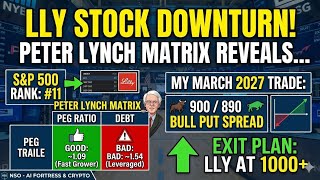
일라이 릴리(LLY)는 GLP-1 약물(마운자로·젭바운드) 성공으로 급등했으나, 노보노디스크와의 가격경쟁·시장 규모 우려·신약 규제 지연·인수 등으로 조정을 받는 중. 피터 린치 기준 분석: PEG 약 1.09(통과), 부채비율 1.54(미달), ROE 77%(통과), 월가 인기 종목이라 숨은 가치 없음(미달). 발언자는 행사가 890달러 근처 강세풋 스프레드(순수익 502달러, 최대손실 498달러)를 보유하며 1000달러 도달 시 익절 계획을 밝힘. 종목 방향에 대한 가격 예측은 명시하지 않음.
다듬은 글
Welcome back to the Nube Selling Options Channel everyone. Today we're diving deep into a stock that's been on an absolute tear, but has suddenly hit a wall, Eli Lilly. After a truly incredible unstoppable climb, it's now facing some serious pressure. So, what on earth happened? Let's get into it. Okay, first things first, let's just appreciate the sheer scale of this company.
We're looking at Eli Lilly, ticker LLY, and it's the 11th largest company in the entire S&P 500. We're talking about a market cap of nearly 870 billion dollars. This isn't just a big pharma company. It is one of the biggest corporate giants on the planet, period. So, here's our game plan. We're going to start with just how massive this company is, then we'll unpack why it's been dropping.
After that, we'll run it through a classic investing framework from a legend, look at a real-world trade example, and then wrap it all up with the big takeaway. And to really put its size into perspective, Eli Lilly doesn't just lead the healthcare sector, it completely dwarfs it. I mean, the distance between it and the number two company is literally hundreds of billions of dollars.
That level of dominance is absolutely central to this whole story. For the last couple of years, the stock's chart looked like a rocket ship. It had the spectacular parabolic run-up that you usually only see with something like crypto. But, that crazy momentum has hit a snag. And here's the thing, when a stock has priced in nothing but perfection, even the tiniest crack in the narrative can cause a huge shift.
And that's exactly what's happening. The reality check is here. So, what's causing this reality check? Well, it all circles back to their blockbuster GLP-1 drugs. You know the ones, medicines like Mounjaro and Zepbound, which have been just revolutionary for diabetes and weight loss. It was kind of like a perfect storm.
Four things hit all at once. First, a price war started heating up with their main rival, Novo Nordisk, getting aggressive on pricing. Second, Wall Street started getting nervous, wondering if the total market for these drugs was really as big as everyone hoped. Third, a promising new pill hit a regulatory speed bump.
And finally, they made a big acquisition that the market saw as a defensive move, not a sign of strength. All of that together, it was enough to really shake investor confidence. Which, of course, brings us to the million-dollar question, or in this case, the billion-dollar question. When you see a stock like this pullback, is it a falling knife you should stay away from, or is this a rare chance to get into a phenomenal company at a much better price?
To try and answer that, let's borrow a tool from investing legend Peter Lynch. He had these great checklists for different kinds of stocks, and we're going to apply his rules for what he called fast growers. Now, this is a really key point. Eli Lilly's whole DNA has changed. For decades, this was a stalwart, as Lynch would say, a big, slow, steady company that paid a nice dividend.
But the GLP-1 phenomenon has completely transformed it into a fast grower, and that means we have to play by a whole new set of rules to evaluate it. All right. First up is Lynch's all-time favorite metric, the PEG ratio. All this does is it compares the stock's price-to-earnings ratio to its growth rate, just to see if the price makes sense.
With a PE around 27 and growth of 25%, LLY's PEG is about 1.09. Lynch loved to see a PEG of one or less, so this is actually a pretty fair price for this level of growth. We'll give that a solid pass. But, when we look at the balance sheet, the story changes. Lynch was a fanatic about low debt. LLY's debt-to-equity ratio is 1.54.
His target was less than 0.6, so from a conservative, Lynch-style point of view, this is a clear fail, no question. Okay, but now look at this. This is where the company just blows you away, its profitability. Lynch wanted to see a return on equity, basically how much profit you get for every dollar invested, of over 15%.
LLY is delivering a staggering 77%. I mean, that's what you expect from an elite software company, not a century-old pharma giant. That is a massive pass. And finally, Lynch's strategy was all about finding great companies before the rest of Wall Street did. Well, LY is the exact opposite of that. It is a true Wall Street darling owned by almost every major fund.
The so-called smart money is already all over it, which means there's no hidden value here. In Lynch's book, that's another fail. So, what do we do with this? The Lynch test gives us a totally mixed bag. On one hand, we have jaw-dropping profitability and a fair price. On the other hand, we have high debt and everybody already owns it.
Given all that, how could you actually, practically, approach the stock? So, let's shift gears from theory to practice. I'm going to walk you through a specific, defined risk trade that I actually put on myself. The whole idea here is to play to the company's strengths while putting a hard limit on the risk from its weaknesses.
The strategy is called a bull put spread, but you can forget the jargon. All this is, in simple terms, is a bet that Eli Lilly stock will stay above a certain price. In this case, that price is around $890, and the bet is for the next couple of years. If the stock just stays above that level, the trade makes money.
Simple as that. Okay, here are the numbers. For every one of these I do, I collect $502 in cash right up front. That's my maximum possible profit. Now, the most I can possibly lose is also capped at $498. So, it's almost a one-to-one risk-reward. For the trade to be a winner at the end, the stock just has to close above my break-even of about $895.
And my personal plan is to take my profits and get out if the stock rallies back to a thousand bucks. So, why this strategy? Why does it fit so well? Well, first, that capped risk is huge. It protects me from a sudden disaster, like bad clinical trial data, which is always a possibility in pharma. Second, the stock doesn't have to go to the moon again, it just has to hold its ground.
And finally, giving it a long time horizon lets those incredible fundamentals, like that 77% ROE, work their magic and overpower all the short-term market drama. All right, let's zoom out and put a bow on this. What is the big strategic takeaway from this whole exercise? You know, this approach isn't about getting greedy.
It's all about being disciplined. Having an exit plan at that $1,000 psychological level is about taking profits when the conversation is likely to get messy and emotional again. It's a clear plan. Get in, capture the value, and get out before the next round of market panic sets in. And that's really the heart of it.
This whole thing is a bet on the company's powerful financial engine winning out over the negative sentiment. By giving the trade a long runway, you're giving those fantastic numbers enough time to prove that all the short-term panic is just that, noise. And this really leaves us with the core question that applies not just to Eli Lilly, but to so many of these amazing growth stocks today, is a fair price really enough to make you overlook a flawed balance sheet?
That is the multi-billion dollar debate that investors are grappling with right now. So, that's my breakdown of Eli Lilly. I really hope this explainer was helpful for you. If you got some value out of this analysis and you want to see more like it, please do me a favor and hit that like and subscribe button. Thanks for watching and I will see you in the next one.


Comments 0