원문 보기
If this risk premium is not there, Bill, I wonder what exactly equity investors would have to rely on to justify entering this market. Well, I think, Romain, they have something to rely on, you know, maybe AI and the potential productivity gains across the economy. At this point, we don't know for sure what it is.
Additionally, they would be counting on a stronger economy that can continue to grow, as opposed to the recession that many expect . That's what they would rely on. I would have chosen a different path and given up on this. I would give up, and I mean we know from past conversations with you, as well as your other public statements, that you gave up on that a long time ago .
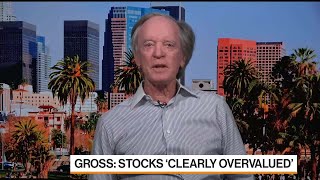
I mean, what are you relying on right now? Well, um, let me explain it this way. I think P/E ratios are going down. Um, Katie explained it in terms of the equity risk premium being closer to, well, you know, basically, um, the bond market, which means there's, um, little risk on equities compared to T- bills or short-term Treasury notes.
Um, I would put it this way. Give me 30 seconds for an example: um, P/E ratio of 20, um, let's flip it as an E/P ratio, um, by five. So, the profitability ratio is five. Um, the P/E ratio was 20 a year and a half ago , and since then, the real yield, as Katie pointed out, has increased, you know, by a good 350 basis points.
If, and I'm not saying this will happen, but if, um, the rate of return, the E/P ratio, goes from five to eight percent, then the PE ratios will fall to about 12 or 13. That's, you know, a little old-fashioned. This is Gordon's dividend discount model, but it indicates the direction in which PE ratios could move if we see a situation with a real yield of 2.40%.
Now let's analyze what we saw from the point of view of nominal returns. As you mentioned, real yields are very high, and they've really been the main driver if you think about the rise in the 10-year yield. Tell us, however, about break-even levels. Do you think inflation expectations should be higher given what we are seeing in the energy market?
Yes, I think it has, and you know, the break-even rate for the 10- year bond is amazingly stable between 2 and 2.3% today. I think it's about 2.34%, and that's the inflation expectation. I would say it's more like three percent. Going down to two is going to be very difficult in the future, and so, you know, to me that means nominal Treasury bonds will hit 4.75 or 4.8 for the 10-year again.
Nominal Treasury bonds are largely based on the expectation of a federal funds rate of 3% in the long term. There is a stock risk premium that you mentioned . There is also a term premium for bonds of about 1 to 1.25 percent because that is the risk of owning a 10-year paper compared to a Treasury bill.
And so if federal funds stabilize at about 3-3.5 percent, you know, 5% for the 10-year Treasury bond—that's a good value. This is not a great value. So what is great value then? When you think about 5% for 10- year Treasury bonds, we haven't seen that in over 15 years. If that's not great, then what is great?
Well, that's better. There is no doubt about it. But 5% again—this is a normal term premium for bonds of about 1.25% given inflation expectations of 3%. So that's acceptable. And I know corporate spreads have widened a little bit , and that makes them attractive. But what I think has happened, Kathy, in the last few weeks is that the market is starting to realize the supply of Treasury bonds, you know, coming out of a $2 trillion deficit.
They're starting to realize, you know, basically the Fed's bond sales as part of quantitative easing (QT). they are also beginning to realize the policy of "higher rates for longer term". So, these two factors were important for the current growth. What I saw last week is that the bond avengers, to the extent that they are now private individuals who own, you know, billions and billions, hundreds of billions of bond ETFs, they were spooked in the last week or so by their ETFs dropping two, three, four percent.
And so I think they're joining the general crowd in selling and we're seeing a slightly oversold market heading towards 5%. It's definitely oversold, but I'm worried, Bill, about some of these external events. Of course, there was a lot of buzz yesterday about the Speaker of the House losing his position, and whether it was a symptom of dysfunction in Washington.
You mentioned the federal debt. We know that the cost of servicing the debt for the government has gone from less than 2%, I think, to now somewhere in the range of 4 to 5% on average. To the extent that this ultimately becomes a factor in investment decisions , can it be ignored? Well, I don't think it can be ignored.
You know, in 30 days we'll see the moment again where they have to vote, and I assume we'll have a new speaker. But to me, it indicates a breakdown in the process, additional obstacles, given what we've seen, because 10 Republicans, 10 conservative Republicans are actually running the House, and that will increase volatility in all markets, and is certainly a negative.
Well, and yes, I mean, we can blame these 10 Republicans, but there really has n't been a major player for quite some time, at least when it comes to fiscal conservatism that is listened to, and I'm talking about both sides of the political spectrum. So this is not just a party issue. It seems that any desire to resolve the fiscal situation, at least for now, seems to have completely disappeared.
Well, yes, the fiscal situation is very negative. I mentioned the $2 trillion deficit, at least for this particular fiscal year. And the incredible thing that you pointed out earlier is that the higher level of interest that the Treasury has to pay is going to further increase this deficit in the future.
So, we don't have much hope for budget spending. After all, you would think that the fiscal side would step in and start spending money if we had a recession or a significant slowdown. So deficits as far as the eye can see, that's what I see, and that creates obvious supply pressures going forward, probably twice as much as in the last year or two on Treasury obligations.
So Well , then I'm curious, Bill. What will happen? Yeah, well, that makes me wonder, Bill, about the whole " bond watchdog" ideology. Does such a concept even exist in the current conditions? Is there anyone or any group of people who still have that much influence on the market? No, no, Romain. I used this term conditionally because, you know, at one time, the "bond avengers" that Yardeni spoke of had some control over the situation.
Today, to say that an individual owning an ETF represents a “ bond avenger” is a bit of a stretch, as I’ve already noted. But I have seen significant ETF selling over the past week or two. The trading volumes of AGG or BND, which are hundred-billion-dollar funds, were quite significant. So I see these "small avengers " joining the Treasury and the Fed, creating negative pressure on bond prices and upward pressure on their yields.
A simple question to understand the context: if it's not the Avengers, what do you think is driving the market in the long term? Think about the 10-year Treasury yield rising 80, 90 or 100 basis points over the past few months. What is the driving force and what can cause it to decline? Yes, I think it's important.
We talk about our forecasts for the 10-year bond, but it's also worth discussing the shape of the yield curve. As you noted, long-term yields are rising, short-term yields are not as much, and the yield curve is becoming less negative, which I think is important for the markets. So, what is the driving force?
I think that in a way, selling ETFs that have long-maturity bonds in their portfolio , rather than short-maturity ones, is important. I think the composition of future Treasury bond sales also plays an important role. Next week we will see the placement of 3-, 10-, and 30- year bonds worth about $100 billion.
So the long end of the curve is being pressured by supply and expectations of a stronger economy than was projected 3-6 months ago. By the way, yesterday you tweeted about a 30- year mortgage at 7.7%. This effectively brings the housing market to a standstill. And on this occasion, Bill, it seems that everyone here is dissatisfied.
Sellers cannot sell, and buyers do not necessarily want to buy in such a market. I think that's true. This indicates the state of the secondary market. What I meant, as well as construction in the housing market, new housing projects, etc. And it's hard to understand, you know, despite the relative success of developers' shares over the past few months, how you can sell new housing with a mortgage at 7.7% per annum, to which, perhaps, certain commissions are also added.
So, you know, typically the housing market, Katie, is about 6 months ahead of the economy. And so we're seeing a relatively stable housing market, but at 7.7%, you know, that's doubling , and in some cases tripling, the monthly mortgage payments that a homeowner could expect, say, a year and a half ago.
Yes, definitely, Bill. But I'm also curious about this . If we're talking about the secondary market, and we apologize to our viewers if you hear the phones: a national testing of the notification system is currently underway, covering the newsroom and other locations. Don't worry, Bill, you weren't the only one whose phone rang.
I'm curious, when we look at spreads, you mentioned corporate spreads earlier, but I also looked at mortgage-backed securities (MBS) spreads, and they've really widened significantly, I think probably to some of the cheapest levels we've seen at least since the collapse of the great housing bubble a few years ago.
I wonder what we can extrapolate from this . If we have such a tense situation in the housing market and no one is making money on mortgage securities , then what is the point and what will be the consequences? Well , I think you're right. The spread between a 30- year mortgage, the index of which you can see on your Bloomberg screen at 7.7% or so, this spread relative to a 10- year Treasury bond is quite significant.
In my opinion, this bodes well for the fact that a narrowing of this spread in the future will bring significant benefits to mortgage investment trusts (mREITs) such as Annaly or AGNC. They have a yield of about 16%. This particular sector is currently thriving with a less negative yield curve, and it is also thriving with lower market volatility in the Treasury bond market, which we hope we will continue to see .
So, is a 16% mortgage trust yield a safe bet ? Not necessarily. Payments have been cut before if these mortgage trusts were over- leveraged, but I think they've learned their lesson. I think we can enter this sector and get both yield and maybe 10% price appreciation if the mortgage spread narrows. Bill, I wanted to change the subject in the few minutes we have left and ask you about something from your investment forecast.
You wrote that one of the best bets right now is arbitrage on mergers and acquisitions. You specifically mentioned Microsoft's purchase of Activision Blizzard. I'm curious, do you think this is a feature of this particular deal, or has merger arbitration in general become more attractive now? Well, they've become more attractive in the last week or two, as liquidity in the markets—both stock and bond—has decreased in some places , as I explained to my wife over dinner yesterday.
You know, you need margin to support these positions . So, in my opinion, ATVI (Activision) has 7 days left until approval by the British regulatory commission. This means that the price will increase from 94 to 95. That's a whole point. That is 1.1%. Is that a lot ? That's a lot in 7 days. There are also other examples, like Capri, which owns Jimmy Choo and other brands that were acquired by a private investor , and they are now being sold at a discount of 10, 11, 12%.
So, there are situations, not many, but they do exist, where arbitrage can yield returns significantly higher than what we have seen in the stock market over the past few months.





Comments 0