
원문 보기
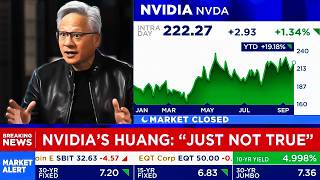
The Super Bowl, here in Santa Clara, right in Nvidia's backyard, and we are joined now by the company's founder and CEO, Jensen Huang. Brad Gerstner is, of course, still with us, as well, and I can't tell you how happy we are to have you. Thank you. Thanks. It's great to be here. Welcome to Santa Clara.
This is our backyard, I'm a mile up the road. Yeah, I was going to say, you couldn't actually walk over here, but you're here, and you said you've never been here before. Well, I've been not like this. Not like this. Look at all these tents. It's incredible. It's going to be a festival. So, it's an interesting time to have you, obviously, which anytime is, but especially given what's been happening within the market.
Today looks a lot different than the last couple of days have. The market obviously concerned with what's happening on the spending side of the the hyperscalers and this big build-out in AI. What's your take from that, the way the market continues to react to this? Demand is sky-high, and there's a fundamental reason for that.
We're in the once-in-a-generation infrastructure build-out. This is the largest infrastructure build-out in human history, and there's a fundamental reason for that. Artificial intelligence is going to fundamentally change how we compute everything. Everything from database processing, the way we do search, the way we do recommender systems, the you shop, the way you watch movies, and of course, these new agentic systems that are being that are that are being developed and evolved.
Last year, this last year, we saw an inflection point in AI. AI became super useful. No longer hallucinating, it's generating informed content, it's reasoning, it's thinking, it's doing research, it's able to use tools. All of a sudden, AI, over the last couple of years, went from being curious to super useful.
The inflection point also came with it, profitable tokens. Anthropic is making great money. OpenAI's making great money. If they could have twice as much compute, their revenues would go up four times as much. I mean, literally, these guys are so demand so compute-constrained, and the demand is so incredibly great.
The number of enterprise users, the number of consumer users, the number of startups have been built on top of these companies is just going through the roof. So, when you see numbers that are frankly remarkable, that $660 billion this year will be spent by the hyperscalers as we continue to learn like we did from Amazon last night, you sit back and think to yourself, that's completely justified based on what you see.
It is appropriate and sustainable. And the reason for that is because all of these companies' cash flows are going to start rising. You know, people are comparing it to the cash flows. One of those numbers are wrong. It's just the cash flow is wrong. We are addressing the largest software opportunity in history.
For the very first time, software is not just a tool. A tool is like Excel. Now, software uses tools. So, these AIs use Excel. And so, I think the the the opportunity to to for this new new era of software is incredible. And we're seeing it already uh moving the earnings of Meta. Nobody uses AI better than Meta.
And so, if you look at the way that they're using AI, AI went from a a classical recommender system running on CPUs to now a generative AI agentic system that's making recommendations. Everything from the way they social media works and the way they they recommend ads and help uh advertisers create content has fundamentally been changed.
And their earnings show it. And that's the reason why they're investing so hard. They see just a much larger future potential for it. And that's just one company. This is going to affect AWS's shopping and the way they recommend goods. This is going to affect how Microsoft's enterprise software works.
Every single company has has seized the same inflection point, and that's why everybody's leaning in so hard. like that's the point that you were It's an interesting point. It sort of turns the way you you need to think about these businesses on its head. That if you're just fixated on the spending side as you were talking earlier about, oh, they're spending such a huge portion of their free cash flow, you're kind of missing the story.
The market needs to get its arms around that. Do you as well as an investor? Yes, I if you turn the clock back, Scott, to 2008, 2009, right? Amazon could have taken their profits and sent them back to us by way of dividends. Instead, Jeff Bezos said, I'm going to invest in this thing called AWS. Think of it as digging a gold mine.
You have to spend a lot of money to dig the gold mine before you get the money before you get the gold out. These guys are digging the biggest gold mine in the history of software, right? But it costs something up front. Now, the question is, do you believe Andy Jassy and Mark you know, Mark Zuckerberg and Sundar and Jensen that this opportunity is that big, or do you have a special insight that causes you to understand there's no gold in the bottom of the gold mine?
As an investor, I'll just tell you this, I want my personal net worth, I want my funds net worth leveraged against AI because all human progress is going to be derived from machines helping humans think and augment human thinking. And so, whether it's owning Nvidia, which is our largest public position, or whether it's Anthropic or OpenAI, all of these companies are going to be tremendous beneficiaries.
And they're doing it at scale. There are increasing advantages to scale, right? And so, I think it's hard for people to get their arms around now, just like it was in 2008 and 2009, but thank god Jeff Bezos did that. Now, it's a $140 billion business generating $30 billion a year in annual profits that people criticized him for investing in back then.
How can just it's incredible that OpenAI and Anthropic are $20 billion run rate companies prof generating profitable revenues and accelerating growth all at the same time. These are extraordinary things, and it makes perfect sense from where we sit. How can we be so certain that the amount of compute we think we'll need and that we continue to hear from CEOs like you that we will need is actually going to come to fruition.
Isn't it inevitable that we're going to at some point overdo it, but we're not going to know that until it's too late. It's not like roads. Roads, [clears throat] once you lay it down, it stays fairly useful for a long time. The way computers work is you build up the infrastructure, but then you start replacing it 5 6 7 years later.
And so I think it's going to take us some 7 years 8 years to build up to the level that we have to sustain and after that we're going to be refreshing and slightly growing. And so we've got several years of build out ahead of us. The The important thing is this. You have to go back to first principles.
Computing has fundamentally changed. It used to be pre-recorded. Excel and PowerPoint and all these tools and all the software is pre-compiled. They compiled it and they send it to us. The way software works now, because it's contextually aware, every single time you use it, it takes into consideration the context, who you are, what you're asking about, what's happening to the world, what other information you give it, the context.
And every single context is different and every single response is different. So from now on, every single pixel, every single beep of a sound, every video that comes out of the computer is generated in real time. And that's the reason why we need computers to operate software at such a large scale going forward.
And all these tokens are what we call intelligence. And for the first time we have we're generating something of tremendous value, intelligence as numbers. And these things we as I mentioned earlier this last year, we went through an inflection point because these tokens became profitable. And so we just have to make more of it.
Can you blame in some ways investors who have PTSD from the the time tech went through this revolution and evolution I at the same time for seeing certain things that remind them of then and worry that they'll happen again. It's good to always reflect on history. Um, history informs us, but history doesn't repeat.
And so, you have to take into consideration what's actually happening. Always go back to first principles and think about what is actually happening. Right now, the fundamental difference, a huge difference between now and um, some things that happened in the past with the internet, there was a ton of dark fiber.
There is no There are no dark GPUs. 100% of the GPUs are rented. In fact, GPUs that we sold 6 years ago, the prices are going up. It's not like it's antique. I mean, it's incredible. It's like a fine wine. The demand is so high that GPUs I sold 6 years ago are going up in price. And so, I think the demand is just incredibly high for the reasons that I just said.
One, we went through an inflection point. AI has become useful and very very capable. Two, the adoption of it is incredibly high. And three, because these AIs are thinking, the amount of computation it needs is great. And so, to the extent that people continues to pay for the AI with, you know, and the AI companies are able to generate a profit from that, they're going to keep on doubling, doubling, doubling, doubling.
You get asked about the bubble question all the time. But to Jensen's point, back then, you know, you're wrapping fiber around the earth five times and you realize, well, that was a little too much. How are you thinking about that question relative to how we answered it? It turns out that fiber had 7% utilization.
We called it dark fiber because we knew when they were putting it in the ground, it was it was dark. It wasn't It We're building for the future. And we were borrowing money to do that. And we only had 30 million people connected to broadband internet. Today, we have billions of people who are using using this, getting benefit daily.
But But what One of the things I I say, Scott, is one of questions here, Jensen, is okay, if you accept that all of this needs to be built, there's a lot of chatter. Andy Jassy said last night on the Amazon call, yeah, but we have an inference chip that's 40% you know, costs 40% less. There's a lot of talk about all these other chips.
So how are you confident that Nvidia is going to continue to maintain your share, right? The leadership position in terms of all of this build out as you look forward? Nobody develops the technology more advanced than ours at a pace higher than ours and at a scale as large as ours. We have the largest supply chain of than any computing company in history.
We have a giant supply chain and and so so our technology is the best. Now that translates to the lowest cost tokens because when your performance is 10 times your cost is 30% higher, then your token cost is maybe 1/5. And so that advantage is the reason why people adopt our technology. Our demand, Nvidia's demand in AWS is incredibly high and so we're we're just super excited about the the build out that we're doing with them.
We're going to we're going to have a very significant build out this year and the next couple of years. You know, AWS is doing great. They're great partner of ours. Consumption of Nvidia through AWS is gigantic. Brad raises a really interesting question. As this these all relationships are so unique in that these companies that are spending all of this money, they are customers of yours and they're competitors of yours and they continue to make it clear that they want to be bigger competitors of yours.
Andy Jassy and Brad was alluding to what he said on the call, quote, customers are starving for better price performance and typically and understandably the dominant early leaders aren't in a hurry to make that happen. They have other priorities. I mean Alphabet's making its own chips, too. These companies love you, they need you, but they're coming after you, too.
It's okay. You know? None of that bothers me. I'm the We're the only company in the world that takes our road map and all of our secrets, and we share it to our customers who are also building their own chips internally. That's how much confidence we have. The reason for that is because Nvidia's the only platform and software likes platforms.
Software are built on platforms. If it's built on Nvidia, it runs best on Nvidia. There are tens of thousands of startups around the world, developers all over the world who build on Nvidia. And so, by definition, it runs best on Nvidia. We're the only architecture that's in every cloud. We're in AWS, we're in Azure, we're in OCI, we're in GCP, we're everywhere.
We're exposed to AI that is well beyond just the things that we're talking about here. Look at the stuff that we're doing in digital biology and life sciences, our big partnership with Lilly. They're building a AI supercomputer. The physical AI, we're the only company really addressing all of the world's autonomous vehicles and, you know, all the robotic systems and all the physical sciences.
The world of AI goes well beyond language. It represents, you know, probably 60% of the world's AI activity. The rest of the other 40%, that's practically all Nvidia. And so, our exposure to AI is broad, we're on every single platform, we're in the cloud, we're on the ground, we're in autonomous vehicles.
I mean, we're just simply everywhere. And the key is just we have so many developers, when it's built on Nvidia, it runs best on Nvidia. Who do you consider to be your biggest competitor? Well, the thing that we worry about most is just making sure that AI is effective. It has to work. The technology is has great promise, some enormous breakthroughs.
ChatGPT was a breakthrough. Uh OpenAI's 01 was a breakthrough this last year Uh just recently cloud code is an inflection and then now chat GPT 5.3 codex another inflection. You know, we want to make sure that AI continues to be incredibly effective. We want to make sure that protein AI is chemical AI is physical AI is robotics AI self-driving car AI is open model AI is all of these different AI Industries have to flourish because the world is gigantic.
Remember AI is not a technology only. It's a five layer cake. It's energy. It's chips. It's infrastructure. It's models and ultimately its applications. We need to make sure that all of the world's applications are revolutionized because of AI. When that happens then demand will continue to grow and we would be successful in helping the world reinvent computing for the first time.
And so our focus you see my focus all the investments that we make all the partnership that we make it goes across all five layers of the cake. It goes across all the different domains of applications because you know, it's going to is it going to take the whole planet to change the computing infrastructure for the world.
Okay, speaking of that the whole planet are the Chinese competitors there their customers they they want to be customers. You'd like them to be bigger customers than they are now. Aren't they competitors? Of ours? No doubt. I think the the way to think about that is that we got competitors United States has competitors all over the world.
And if you break down AI and think about AI as a five layer cake, the US has to win at every single layer. We have to win at the energy layer. This is an area that quite frankly we've got a lot of work to do and we're going to have to work hard to make sure that we win the energy layer the chip layer.
We have to make sure that every software company in the world uses American Tech Stacks so that our chips are the best in the world. We have to win at the model layer. We have to win at the application layer, so on so forth. Every single layer has a battle and nobody could take it for granted. Everyone Everyone of the layers have to go win on their own.
We want to win win together, but every layer has to go win. Do you worry about Brad and another deep seek moment that the Chinese to Jensen's point they're not sitting back idle and suggesting, "Okay, US, you win. We're playing now for second place." They're playing to win. No, for sure. And in fact, I I hear disturbing things all the time about the Chinese stack making great inroads in the Middle East and in the Southern Hemisphere, etc.
because frankly, they're working really quickly to put their chips and their models, their open-source models, deep seek, Kimiko, K2, Quen, etc. and exporting those to the world. So, Jensen was an important part with David Sacks, our our our AIs are of putting forth an American agenda to accelerate AI stack around the world.
We're still not going fast enough. We need to accelerate and make that go faster. You're absolutely right about that. And I think with respect to China, listen, there's a lot of fear that why would you give China any chips? Why would you They already have chips. They already have incredible AI. The US wins when the world runs on American technology and I think we need to focus on running the fastest race we can possibly run, right?
And if we do that, then just like the internet, our values will be embedded and imbued around the world in the in in the US AI stack. But the But make no mistake about it, I think the Chinese are out in front and we got to up our game. We got to get faster in Washington and we got to get out there. And thank God we have Nvidia and the leading technologies in the world in the United States, right?
That just didn't happen, right? We create the culture and the climate for innovation and entrepreneurialism. We're sitting here in Santa Clara. AI has occurred in San Francisco, in Santa Clara because of the great innovations we have. We got to make sure we protect that and accelerate it. some of the the criticism that's been around, should we sell chips to the Chinese because they they want to kick our butts in in AI.
To to that point China is a very large market. It makes no sense to forfeit, to concede a large market if you would like to win globally. The American chip industry should do everything we can to win all over the world, including in the Chinese market. We have to compete. It's their home turf, they got all kinds of advantages, and so we have to go compete hard, but there is no question conceding half of the world's markets make no sense if you want to win globally.
So when someone like Dario Amodei from Anthropic says it's crazy, those are that's his word, for the US to allow companies to sell there that that they're an adversary, you you wholly disagree with that? I completely disagree with that. Of course, we would never allow Chinese military to use American technology, but that's that's that export control is well established.
Of course, we would like to then go and compete in the marketplace. We want, of course, also for Anthropic and Open AI and all of our American companies to succeed. They've got to work hard, they've got to go run fast. We make sure that we offer them the best of all of our technologies, we give them all the advantages that we can, but in the final analysis we've got while we're helping them succeed, we've got to go win around the world and not forfeit markets to anybody.
You mentioned Open AI, and I got to ask you cuz this has been a week, hasn't it, with the the back and forth of, you know, some of the criticism that had allegedly come from the Open AI side about you and maybe some about from you about them in a couple of reports, which you've addressed and you did the other day with with my colleague Jim Cramer.
Um but are we really to believe that there's no there there, that there's no friction between the two of you, there's really no drama between the two of you and in any point. No, there isn't. Yeah, there just isn't. Um the the the new AI models uh [snorts] at OpenAI needs a lot more compute capability than our last generation Hoppers.
That is for sure. The amount of computation it needs, the model's 10 times larger, the amount of compute it thinks 10 times longer, and so it needs a lot more computation than our last generation, which is exactly the reason why Grace Blackwell NVLink 72 was invented. And their latest generation model 5.3 Codex revolutionary, trained on Blackwell NVLink 72.
And so they need our new generation of technology, that that goes without saying, and that's the reason why Nvidia's moving so fast. You know, every single year we're coming up with 5x, 10x more capability, and we just got to keep that pace going. Nobody else in the world could do this like we do because as as you know, these are not chips only, these are AI infrastructure, and we're revolutionizing, innovating AI infrastructure at a scale nobody's ever seen, at a pace nobody's ever seen.
And all because the amount of computation necessary for AI is growing so fast. But otherwise, the rest of that stuff is just fake news. You know, I think there was a moment Scott when everybody thought that there was going to be like exclusive partnerships. Like Amazon was going to be Anthropic and you know, Microsoft was going to be OpenAI and Nvidia would stay in one of those lanes and pick a winner.
It's too big. Everybody's going to be everywhere, right? These guys are going to and you know, be have OpenAI models, they're going to have Anthropic models, they're going to have Deep Seek models running on, you know, on their chips. And I think when you look at this next round of funding, right? Nvidia and Microsoft just invested in Anthropic, right?
OpenAI probably's going to get investment, there's a lot of rumors out there from, you know, from Amazon or others. Like, none of that should surprise anybody. If you want to be in the game of AI, these are the two frontier labs in America, two leading labs. Put x.ai in there as well. It's going to be fascinating what they do with Starlink and data centers in space.
And you're also I'm a big investor in them. and partner in in [clears throat] partners there. So, I think you should expect that as the new normal. And, you know, like we like to make a lot out of these things because, of course, they're competing. Everybody's competing to make sure they're the lead in those investments.
But, I think here's the thing that I think it tells you. Everybody had this idea the last couple months, OpenAI's dead and Anthropic to the moon, right? OpenAI just launched another incredible model yesterday with Codex. They're going to raise a lot of money. I can tell you there's a lot of money that wants to invest, strategic money, financial money, etc.
And the good news for your for your viewers is both these companies are going to be public over the course of the next 12 to 18 months, and retail investors are going to get to participate. this is an interesting being large early investors in Google, Amazon, and Meta. Incredible. Insane. And that's what we're looking at.
All right, I hope you're all doing great today. Thursday night, we got both Amazon and iron earnings. Amazon announced 2026 CapEx guidance of $200 billion. AWS accelerated, growing 24% year-over-year. CEO Andy Jassy told us that new capacity is being monetized as fast as it is installed, and they're investing aggressively to meet strong customer demand.
AWS backlog came in at $244 billion, which is up 40% year-over-year with many additional deals in the pipeline. Those are real orders from paying customers. As I've said many times, this AI revolution is fundamentally different from the dot-com bubble for multiple reasons. One major difference between the two eras is that in this AI revolution, the demand is immediately present, and new use case development at scale is immediately possible.
This is because the internet is already here this time, making new use case development and mass adoption of the technology immediately possible. That substantially reduces the risks of both long digestion periods and overbuilds of capacity like what we saw during the early days of the internet. And in Jensen's interview with CNBC on Friday, he mentioned that we still have several years of build-out ahead of us.
We are still in the early stages of this tech cycle and supply is nowhere near enough to meet the demand. After Amazon's earnings, we have officially heard from each of the hyperscalers this earning season. All of them spoke about being supply constrained in the face of very strong AI demand from their paying customers.
And each of the hyperscalers revealed very large year-over-year increases in capex. Meta guided 2026 capex in a range of 115 to 135 billion dollars. Alphabet guided capex at 175 to 185 billion dollars. Amazon guided 2026 capex at 200 billion dollars. And while Microsoft didn't give us a specific number, their capex in their first two fiscal quarters points to roughly 150 billion dollars in capex for the fiscal year.
And while these companies are making efforts to develop their own chips and seeing some success in that regard, they all still rely heavily on Nvidia and most likely will for multiple years. The point I want us all to take away from this earning season is that the hyperscalers are already seeing a clear ROI on their AI investments.
They are all supply constrained and they're investing heavily in an attempt to meet very strong demand from their paying customers. Now, I want to restate what I said about Iron's earnings in Thursday night's video because some people misunderstood what I said. Let me be abundantly clear. Iron's earnings for the quarter were bad and that's why we saw the stock trade 20% lower in after hours.
However, while the earnings were bad, the progress update that Iron provided on the transition from Bitcoin mining to AI cloud was fantastic and everything is still on schedule. Reported earnings and progress updates on the transition are two completely separate topics. The earnings were bad. The progress update was very good.
Let's not confuse the two. And I'm not invested in Iron because of their current fundamentals. I'm invested in Iron because of the clear fundamental growth that is ahead and Iron is executing on the transition to AI cloud extremely well. from the earnings call. Iron announced a new 1.6 gigawatt data center campus in Oklahoma bringing their secured power up to roughly 4.5 gigawatts.
Power at the new Oklahoma site is scheduled to ramp from 2028. Iron has secured $3.6 billion in GPU financing for their Microsoft contract and interest rate of less than 6%. That along with Microsoft's prepayment covers 95% of GPU-related CapEx. The 140,000 GPU expansion is still on track to deliver an AI Cloud ARR of $3.4 billion by the end of 2026.
As for the 23,000 GPUs that are supposed to be operational by the end of Q1, roughly 80% of them are already contracted with remaining contract negotiations supporting over $500 million in ARR. So, in other words, the 23,000 GPUs are still on track to be operational by the end of Q1. Iron is seeing the strongest demand environment to date with CEO Dan Roberts saying quote, "Demand is not the constraint for us.
There's plenty of demand for the capacity Iron is building." The $3.4 billion ARR target represents utilization of only 10% of Iron's power portfolio, meaning that there is room for significant expansion long-term beyond 2026. Iron had $2.8 billion of cash as of January 31st. Energization of Iron's Sweetwater one site is still on track for Q2 of this year.
And Iron's power is absolutely secure even as there are concerns about new batching rules in Texas. Iron expects initial revenues from the Microsoft contract to start showing up in their results in Q2 of calendar 2026 and to ramp throughout the year. That echoes what I've been saying recently that Q2 of calendar 2026 is likely when we will start to see a notable increas.
And as for the 40,000 GPUs that are scheduled to come online at two of Iron's British Columbia data centers this year. Iron leadership told us that customers are willing to make significant prepayments on that capacity. That is very good news. Also, CEO Dan Roberts said on the earnings call that Iron is currently negotiating a multi-billion dollar contract wherein Iron will have to provide a software solution.
He mentioned that Iron does have a software offering for customers even though they don't speak much about it. As I said in Thursday night's video, I thought we would eventually look back on Iron trading in the low 30s as a gift. I told you that I viewed the dip as an opportunity . In my opinion, a share price in the low 30s that is ahead .
I did not say to focus on Iron's current fundamentals. I specifically said to focus on the fundamental trajectory. I've been saying this for months, and the fundamental trajectory over the next year is very clear. I continue to be bullish on Iron over the next 1 to 2 years . We also need to remember that short-term fluctuations in a company's stock price do not change .
Iron's ARR guide of $3.4 billion by the end of 2026 implies quarterly AI cloud revenue of roughly $850 million starting in Q1 of 2027. That's more than 4.5x Iron's total quarterly revenue in the quarter they just reported. Ignore the noise. Focus on the signal. .



Comments 0