
저자: JensenHuang외블랙록·골드만삭스·블랙스톤등금융사CEO패널;영상진행자FinVid해설 · 외국인
요약 보기
엔비디아가 골드만삭스·블랙록·블랙스톤·KKR·아폴로·브룩필드 등과 AI 인프라 조달을 위해 약 5000억달러 규모 파트너십 발표. GW당 500~600억달러 비용, 독립 장기자본 조달 구조. 발언자들은 AI 컴퓨팅을 자산 클래스로 보며 수요가 공급을 초과한다고 주장. 진행자는 엔비디아·마이크론·SK하이닉스 주가에 긍정적 반응을 기대하며, 8/26 엔비디아 실적 발표 예정 언급. 과거 실적·매출 성장(앤트로픽 연매출 등) 근거 제시.
다듬은 글
Welcome back to Closing Bell Overtime. This afternoon we have important news regarding the development of infrastructure for AI. This information surfaced a little earlier today, but now we can officially confirm it . Nvidia works with the most influential Wall Street players to secure financing for its clients.
Jensen Huang is with us now to discuss these developments. He is, of course, the founder and CEO of Nvidia. David Solomon— CEO of Goldman Sachs. Larry Fink is the CEO of BlackRock. John Gray is the president of Blackstone. Volodymyr Zelinsky is the global head of digital infrastructure at KKR. Jim Zelter is the president of Apollo, and Bruce Flatt is the CEO of Brookfield.
Gentlemen, we welcome you all today. It's just incredible to see such a company at the same table, and Larry, that you joined us remotely. But we have to start with this news. Jensen, this is a really big event and a huge amount. Half a trillion dollars, and even more, in financing. We understand that this is an expensive project, but tell us a little about how it was created and what exactly it means.
Well, first of all, I want to thank all my partners for being with me today. I think this is the first time this has happened, and I can't imagine a more appropriate time for it. Today we are announcing six partnerships. These partnerships will allow for the attraction of independent long-term capital to finance and build AI infrastructure.
These are extraordinary times, as for the first time in 60 years, the computer industry is experiencing a fundamental shift : from how software was created in the past to how it will be done in the future thanks to artificial intelligence. Essentially, the difference between this field and this approach to computing is that the computer is now part of the infrastructure, like electricity or the internet.
So you have to treat it like infrastructure and build it accordingly. Every company will probably work on this base, every country will build on it. So we are talking about extremely large-scale infrastructure construction. This AND with a very significant price tag. This is a really big amount . Each gigawatt costs approximately $50-60 billion.
This involves energy, land resources, and, of course, the computing component. This is certainly also an important milestone for our company. We used to create chips for sale, these are technological components that people buy and use. But now Nvidia's AI factory platform is truly an investment asset.
Infrastructure asset. And the reason is that it is productive and generates profit. It is interchangeable and used by almost every cloud service provider. It runs any artificial intelligence model, any algorithms. Therefore, it has a very wide reach and many consumers. For us, this is a great opportunity to build infrastructure, to take advantage of an investable asset that is durable and productive.
Thanks to the partnerships we have here, we can support the development of a very broad ecosystem. John, I must say it's very unusual to see you all in one place. Most of you compete at one level or another. But you often also work together on joint projects. How did it all come together? How did they all come to you?
David, I'll start with you. Well, Jensen reached out to us, and we have deep faith in NVIDIA and what they're doing, we have a lot of confidence in them. We deeply believe in the possibilities they have. We, like all the partners at the table, have spent a lot of time raising capital and thinking about what kind of capital is needed and how to best provide access to it to those who need it to move forward.
I think one of the advantages of Goldman Sachs is our extraordinary distribution network. So, of course we provide capital, but we also offer a very unique distribution network. When Jensen came to us with this idea, we said we would be happy to discuss it. We deeply believe in the chosen direction and the opportunities that open up for the next three, five, seven, ten years.
As Jensen emphasized, this is a large-scale infrastructure build, and capital markets are signaling that there are ample resources to support this. We're trying to find every possible way that we, as an organization in partnership with other great firms, can help direct capital to the right places to expand or accelerate the development of this infrastructure.
I described it before like this : If I buy a GM car, I can get financing from GM. And here you involve outsiders to say that these partners will handle the financing. You know, that's really enough and, by the way, it's not Nvidia's money that will be used for this. That's right. This is all third-party, independent, long-term capital that my partners will help us raise.
This is truly extraordinary. This is a phase shift in how people perceive computing. It used to be, you know, technology, and now it's infrastructure. And I would say that's exactly what David explained. This is a call to action for everyone. Yes. This is American exceptionalism, the exceptionalism of what Nvidia has created over the last 33 years, which is coming together right now.
But this is a call to all, because computing is now truly an asset class. And when we think about the last 100 years, the last century of water, energy, and utilities, in 2026 and beyond, in the next decade, the United States will lead this process. This is a global imperative, but it is also an imperative for the United States.
And as I said, it's really a combination of all the efforts, not just one stock market, or one bond market, or one bank, but everything together. This requires everyone. American exclusivity means you'll be building with American companies like Nvidia and others, but it's funding that can spread worldwide.
Without a doubt, the depth and breadth of US markets as a whole is the envy of the world. Nvidia is one of the envy of the world because of what they have created. And what you see here is this consortium of partners , and yes, we compete, but we also co -fund huge amounts. Ultimately, this will benefit the US economy as a competitive tool for development for the next decade.
Larry, let me plug you in since you're not at the table today, but I'd like to get your thoughts on this. Will this be new money that is planned to be spent? Have you already raised these funds? Are these funds that you planned to put into AI anyway, and are they simply being redirected to certain partners?
Well, first of all, hello everyone. Jensen, thank you. Thank you for the trust you have placed in BlackRock. We have some capital now, but we are going to raise significantly more. As Jensen noted, each gigawatt costs between $50 billion and $60 billion to build . And we're talking about the fact that in the United States alone, we're going to need over 70 gigawatts of capacity to power that .
And if you add everything else in the world, it will be a huge financial opportunity. As Jim said about American exceptionalism, it has to come through American capital markets, because that's the biggest source of capital. But there is another aspect that I think is very important and that we need to understand: there is a lot of negativity around AI and data centers right now.
But let's be honest, it will create a huge number of jobs. Just think, even 100 megawatts of data center capacity requires up to 3 million man- hours of work. So this should be seen as a great opportunity for the United States to grow, which will contribute to development around the world. And most importantly, we need to raise this money as quickly as possible and put it to work, because I think it's extremely important that the United States be a world leader in AI.
We must be leaders in implementing this technology everywhere. That's why this is so critical, and I applaud what Nvidia has done by bringing all these companies together for a common goal. We need to raise $500 billion. Of course, this is an unprecedented amount, but we will have to raise trillions of dollars in the coming years, and I believe this will be a fantastic investment.
In fact, I think it will be such a great investment that over time you will see more and more allocations to this asset class. Jim talked about computing as an asset class, but importantly, I'm looking at data center financing. This is just the beginning, as it was when I started working in the mortgage securities market in the 1970s.
And I see this as the next future for financial engineering. Okay, let me ask a question. Larry, David, you guys might be able to speak a little bit about this too . And John, I think you do too. About the very idea of how much money needs to be raised. Is there enough money in the public and private markets?
Are public funds needed to do this? I mean, if you think about the national highway system, when it was built, it had to be public money. Is there enough money in our capital markets to handle this? And is it profitable for investors? Who wants to start? John, why don't you start? Of course. First of all, I will say that I am very happy to be here.
What Jensen built is incredible. I would say that our markets are large, and that is one of the main advantages when we talk about America. If you look at our ability to finance $700 billion a year in the automotive sector or several trillion a year in the housing sector, I think we'll see a similar dynamic.
And what supports this is supply and demand. Today, in our companies, we are seeing a sevenfold increase in demand for large language models over the last 6 months. However, the amount of computing power cannot keep up with this. Data centers, energy, chips. So you'll see people start to realize: this is an asset class that can be financed.
When you think about your home, you know, when you buy a house, the bank checks you out, but they also look at the value of the house itself. Mhm. When an airline buys an aircraft, it looks at the company's credit rating, but also at the aircraft itself. I think historically the limitation has been that investors have said, "Oh, I only want to have a limited stake in this hyperscaler or maybe this basic model company." I think when people realize how powerful and valuable this computer is, no matter who uses it.
And in Jensen's case, they have very interchangeable and flexible capabilities thanks to their GPUs and CUDA software. So , I think the markets recognize this opportunity. If the scale becomes very, very large, and it does , pricing could expand. But I believe that over time, the realization of the imbalance between supply and demand, and the value of computing, will attract capital.
Can I add just one thing? Of course, we'll go here and here. Okay, let's talk about Brookfield in particular, what you do. Look, with Brookfield, we've been building infrastructure since the company was founded. And in the beginning it all started with huge amounts of energy. Solar, wind, gas. We moved into data centers, and with Jensen, we're now moving into compute.
We are engaged in both financing and developing these computing capacities. And we can't build enough energy capacity. We can't build enough calculations for the demand that John is talking about. So it's not a matter of whether too much funding is being allocated. The thing is, we can't build it fast enough.
The question is always whether demand will remain at this level? And, Jensen, you see it. You see further than anyone else what is happening here. Is there a point where we can't make it now, but demand will change? Look, I think Jensen would have a very valid point about this, but in our industrial plants, we're just scratching the surface of using AI, and the productivity gains that it gives us, we don't even know how to use yet.
But the productivity gains it gives us are incredible. And that's precisely because this foundation is laying the groundwork in the world for the next evolution of business and wealth creation, because it's so revolutionary that it will change everything we do in the world. And that's why it's so important, and that's why when Jensen raises capital, I was going to go back to what John was saying: we're at a point where the situation is that there was no format for investors to invest in this.
And we , David in particular, have to create structures, and Jensen is leading this, to create structures, because there are hundreds of trillions of dollars in the world. What do these structures look like? They have low funding, they actually get a seal of quality from Nvidia: these are the customers we work with, to whom we provide our limited supplies.
And the architectures of the systems will be defined in such a way that as we learn what they are deploying, we can continually improve them. We can add all sorts of interchangeable and flexible AI models to them. And if something happened, someone else could take over and manage it. And this is very important.
And it's also important that it will be used by someone, even if said players run out of cash at some point. There will always be a customer for this computing platform. And the reason for this is that, as you know, Nvidia's architecture is pretty universally accepted. And last week, Jensen and I announced a deal in Korea.
He invests a billion dollars, and we invest nine billion dollars. Naver is going to use computing, and it's a system that can now be systematized. We need to take this and implement it around the world and across companies to be able to systematize and deliver more computing power to the market. This is disturbing, and I want to move on to Waldemar in a moment, but it raises an important question.
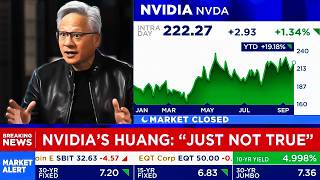
There were a lot of huge numbers that were being handled . What are you doing with SK. There was an article in the Wall Street Journal recently that suggested you could secure $250 billion in financing for an OpenAI plant in Ohio. This is a lot of money. That's a lot for your balance. This is not true, as this is not money that Nvidia supports or guarantees in any way.
And these two things are not about that either. In the case of SK, as you know, we are one of the largest memory consumers in the world. We are the largest computer company in the world. So we use a lot of memory, and our partnership with SK is multi-year, and most of that is about memory consumption and partnerships in that area.
That's what it is, that's what SK is. Regarding OpenAI, I will not comment on rumors. However, today's partnerships are actually aimed at expanding beyond a wider range of ecosystem partners. But you have $200 billion of free cash flow. You have a great balance. Is it your right to say, "Look, we're not going to put our balance sheet on the line for all this, because you can't.
You have other things to do, and that's why you're bringing in external financial partners?" No, it's actually because there's a phase shift happening right now in the way we think about computing. And my partners here have always spoken very eloquently about this. This is the first time that technology chips have become an investment asset class.
This is a very big concept. This is a big concept because these computer systems are not our PCs or our phones. Now these are income-generating assets. They are productive. They are durable. They are interchangeable. They are flexible. You can use them for all sorts of different tasks. So you have the opportunity to support a huge ecosystem of consumers, NVIDIA developers, cloud AI services, partners, and enterprises around the world.
And it's incredibly profitable. Does this change your attitude towards investors coming into this space or how you value it on the balance sheet? Capital markets always—I mean, it's simple, and you did it yourself early on when you talked about financing GM cars. Capital markets have long been markets for asset-backed financing.
You raised the question of access to capital. We are trying to find different ways to raise or participate in raising the huge amounts of capital needed to finance this infrastructure. And you're already starting to see, to some extent, asset-backed financing for this infrastructure. This is not surprising, because these are real assets, they have real value.
They can be given a tangible monetary value. And there is a lot of capital in the market. You know, I always think about the fact that there are $9 trillion in the US capital markets . That's $9 trillion in U.S. money market funds. That's over a hundred trillion dollars in U.S. equity capital. There is indeed a lot of capital.
Our job as capital markets managers, and as asset management firms looking after other investors' money, is to find the best way to use it . Will this path be direct? No. Will there be times, as John said, when spreads widen and it feels like everything is happening too fast? Yes. Will the profits from all this be sufficient?
Of course not. There will be winners and losers. But that's what capital markets do, and they're pretty efficient at putting everything in its place. Adam, let's talk a little bit about your work as Head of Digital Infrastructure at KKR. You've been doing this for a long time . What has changed? What has changed?
And why are these announcements, these memoranda of understanding so important? Yes, I think these are exactly those memorandums of understanding. How does this change the approach to what you have been doing for so long? Thank you for inviting me, this is an incredible panel of experts. And Jensen , thank you for the partnership.
We are obviously developing a partnership with Helix Digital Infrastructure, which is a really innovative way of building the entire value chain— from energy, from, as we say, the molecule to the token, which is what we're all talking about here. I think the speed has changed. If we recall the development of the Internet over the course of 15 years, several gigawatts of power were consumed , mostly centralized.
The cloud is the next stage of development, 10–15 years, maybe three times as long. Today, we are adding an incredible amount of capacity every quarter, and funding this requires the efforts of all market participants. So, we look at it as capital and opportunity. And this is something we at KKR know well.
We have known this for quite some time. We are big investors in data centers and energy, and I think we see this as a truly generational investment opportunity. I want to touch on one point, which is what John mentioned, the intrinsic cost of the computational layer. So I think we strongly believe that there is an integration and centralization of computing that is happening, which requires the development and interchangeability of computing power.
Of course, Nvidia is an incredible innovator. We just talked about Vera Rubin and its implementation, and the efficiency of token production per watt of energy consumed is a jump function, which means rapid reduction in the cost of computing and even faster growth in its implementation. That is why the token price has fallen by 99% and will likely fall to cents.
This means having a very efficient way of financing, which I think is a matter for the parties here, and also building this infrastructure at scale. At scale, which means speed to market and innovation. What's really interesting is the A100, right? You would think that in 6, maybe 6 or 7 years, there would still be a market for them.
You still generate profit, as Jensen pointed out. The usage of these chips is very high, the price per chip is very high, so you really get revenue from it. So you can think of this as a revenue stream that can be securitized or effectively spread that risk and sold to investors who want to participate at any level of that stack.
And that's what excites us: moving up the chain, and also owning a significant portion of what Jensen calls " land, energy, and shell." Jim, just a few weeks ago, or rather a few months ago, you and Blackstone did your own deal that was quite similar to this financing. It seems like it was $35 billion for Broadcom.
How is this different and how do you generally view such things? I think this is another example of what Jensen was describing a few minutes ago: this whole ecosystem with compute and GPUs becoming a financial asset that can actually be financed. I think it's becoming mainstream, and because all of us at this table have been doing this for three or four decades, we're seeing a constant evolution of capitalism , and David is right.
There will be excesses, there will be setbacks, but what I think makes the situation different in '26 is that we used to think that this was financed either through the stock market or through a narrow private lending market. As I said before, this is a call to all, but we have seen that in the stock market, people are not averse to making concentrated bets .
By engaging more ecosystems and diverse memorandums, we reduce concerns about concentration on one company or one counterparty. What John described is value not only between the company, but also between infrastructure assets. This will also attract more capital from around the world. So we are now at a point where not only is the global industrial renaissance at its peak, but we also have a situation where more people in the world need long-term retirement solutions.
So , regardless of how it's done— institutionally or globally—that's going to be the key to bringing it all together. So . David, let me ask you one question about this. We had Steve Eisman, famous for the movie The Game, who was on Squawk Box about a week and a half ago. He came and said, " Listen, AI trading is the whole market right now." He said that could be both great and bad, but added: "Everywhere you look, there's growth, and it's not just chip stocks, it's not just hyperscalers, and it's not just infrastructure companies that are doing all this ." He talks about banks because they also finance a significant part of this.
Is he right? He said, "Listen, this could be really great, or it could be a little bit confusing because of the high concentration on this moment." Do you agree with him on this, or do you see other sectors in the economy right now that are the driving force? Well , let's take a step back. You know, earnings growth within the S&P has been excellent across the index.
One of the things that my colleague John Walldron talked about, I think, on Squawk earlier this week, was momentum and earnings growth. So you had really strong earnings growth across the S&P. There are many things that fuel the market. The economy is in very, very good shape. Is there much to be gained from this vast array of possibilities?
Certainly. Um, I'll go back to what I said. Whenever there is such an acceleration that attracts a lot of capital into the markets, the markets do not always act absolutely correctly. Capital will be allocated to things that don't work perfectly, but capital markets deal with that too . And, you know, they deal with it relatively effectively.
I am enthusiastic about this opportunity in the future. I'm not smart enough to tell you what will happen in the markets next week, next month, or, say, 3 months from now. But when I think about 3, 5, 7 years ahead, about the productivity gains in the economy, the position of the United States in the world, the possibility of real economic growth and its acceleration as this technology is introduced into the economy—this is a huge potential .
We're going to see it permeate all areas, and, you know, it's not going to be a straight line, but in ten years we're going to wake up and these benefits are going to be real. And I think this is a very exciting time for that reason. And, you know, our job is to play a role in trying to, well, for lack of a better term, be a facilitator in that as asset managers or capital markets participants, but there's a lot of reason for optimism as you look ahead.
And this will affect literally every single operation. And the reason for this is that, fundamentally, we are going through a platform shift in computing. There is no industry, no company, that is not fundamentally influenced by computing technologies. And, of course, we are talking about artificial intelligence, the digitalization of intelligence.
There is no company, no industry, no person that is not influenced by intelligence. So, in every way, when you say that every company, every industry is affected by the AI trend, it's not surprising, and on first principles it makes perfect sense. Yes, and there will be, there will be winners and losers.
That is, there will be large companies, just as there were in other super-technological cycles. There will be big companies that win, and there will be big companies that don't turn out like people expected. This is part of the capital markets. One of the things that makes the US so exceptional is that people, Americans, want to invest in the market, they want to take risks, you know?
And that's one of the things that makes our capital markets so special. And of course, it won't be perfect, there may be people on both sides of the deal, but I look 3, 5, 7, 10 years out and I'm very optimistic about what this can do for the productivity of the economy and how it will ultimately help everyone.
And I would just say, you know, Dave is right. Ultimately, it all comes down to revenue and cash flow. This is truly what matters, and Nvidia has certainly proven it. But in our 42 years, the American economy has gone from being the same age as you. From 3 trillion to 33 trillion. I believe this growth is likely to accelerate in the next two decades.
And if you believe in it, there will be winners and losers. So Steve is right that there will be winners and losers, but this is accelerating the global economy in a way we have n't seen before. And one more thing. If you think about it, Becky, businesses never become early adopters of technology. As of today, AI is mostly consumer applications, right?
Just enter a query and get the result. In generative AI, I think the use cases will be simply amazing. And I believe, as Jensen mentioned, it's not a vertical destroyer. This is a horizontal destroyer for everything. And that's actually very difficult to quantify. And I know it's a little scary as an investor because you're trying to assess the risk and scale of the investment.
But I mean, we see it in our portfolio companies, and what Bruce mentioned earlier, you see the returns become really significant when we start to systematically implement AI, even though we're still in the very early stages. And that's because it covers many industries. That's right. The fact that we have a platform that is universal for all industries really reduces investment risks and makes this infrastructure much more attractive for investment.
Larry, I want to hear your thoughts on this . From the perspective that you probably represent individual shareholders who also want to get access to this. To some extent, it was disappointing for them to get this access because many large companies had remained private for too long. What, what, what does this mean?
What does this opportunity mean for people looking at pension funds, and how do they access it? Well, we will be engaging in both private and public funding of this in all directions. We will collaborate with pension funds around the world. So, I believe that access to these types of bond issuances will be much broader.
And so, I think we will see a significant expansion of the circle of participants. As David said, $9 trillion in money market funds. This will be a very attractive opportunity to move from short-term money market returns to long-term returns. So I see this as a real long-term opportunity. I also see this as an opportunity for those who have invested too much in stocks.
They will also move into this asset class. This will only expand opportunities to invest in high-quality credit instruments with long-term profitability. However, there is one thing we cannot escape: we need to make sure that this is not just good for America and our investors. We need to make sure it's beneficial for everyone.
We need to make sure we broaden participation in the field of AI. One way is to invest in these AI-related securities. But it is important that each of us explain why this is beneficial for each community. And this is obviously a big discussion going on right now. Yes, in our state, the governor has imposed a moratorium on data centers.
And so we need to make sure that we tell this story correctly, showing that this will work effectively. I am confident that we can prove that this works for more and more workers. But we must show why this is not only a good investment opportunity, but also a benefit to all Americans. Becky, I would just add a few things.
I completely agree with what Larry said. You know, there's so much negativity around AI, but in reality, we're in for a blue- collar boom. We will see advances in healthcare that people cannot even imagine. I know you spend a lot of time in this area, but what AI can do with visualization, comparison, and collection of different information will radically change the results.
This will enable a huge number of people to become entrepreneurs. This is critically important to America's national defense. There are many things that have their own value. I also want to note: I don't think it's a coincidence that most of us here work in private equity, because in the early years of developing this area, there is no profit.
When that stabilizes, when these products start to generate revenue, it will be easier to sell them in public markets, but having this strong private market helps a lot. And ultimately, a lot of this migrates. By the way, we've seen companies evolve that didn't have a high credit rating, well, look at CoreWeave, which Jensen backed early on, we did a bunch of financings.
Today, the cost of their borrowing has dropped significantly as they have gone public. When Anthropic and OpenAI go public, the cost of their funding will decrease. It all starts with our private capital, which we all have access to, then we enter the public markets, and this virtual cycle continues.
I agree, not everything will work out, but it is a powerful thing that will change society and certainly markets. Bruce The only thing I would like to finish with is that energy is what drives all of this. Access to energy Yes, access to energy, and we need to build faster, and there is a system for financing energy.
It's not news what Jensen is doing with computing. Computing will come where there is energy. Yes. So you have money? There must be physical underwriting, and we have 14 nuclear power plants in M-m. which are currently in various stages of construction. Wow. And there will be 40 more, and then another 100.
Oh, we will finish them. And this is the first time in a long time that market forces can build the sustainable energy needed around the world. This is incredible. So you don't need government. Without government funding, it's all driven by the market. We are building them, and they will be built all over the United States.
And remember, we bought Westinghouse out of bankruptcy 7 years ago. Nobody built nuclear power plants. And today, there's a renaissance happening in the United States under the leadership of Westinghouse, which is incredible, mainly because it's carbon-free, baseload, and it's the energy of the future.
For example, today everyone is worried about today, but if they knew there would be more, that's the reason why it takes 5 years to build a station. But if you know what's coming next, you can consume more of your energy security reserve . So, are these concerns about whether we will be able to meet this demand exaggerated at this point?
What do you think, Jensen, from your perspective, is the level of demand and how we're building around it , is it going to be okay? Everything will be fine. We will be limited for a while and in almost everything: from chips to memory, packaging, systems, photonics, connectors, land, energy, builders— everything.
The entire supply chain from start to finish, both upstream and downstream. And this is happening at a time when AI has become useful because it is starting to do productive work, and this is happening all over the world, and AI tokens are profitable, incredibly profitable. When you have something profitable, everyone wants to do more of it.
Yes. Huge demand, huge profitability—the conditions are perfect for the work we're doing now. Jensen, why these companies? And have you approached any partners who refused? No one refused, but these are six of the world's leading institutional infrastructure financiers. These are the best of the best.
John said you're less likely to raise public capital now because a lot of these companies aren't making money yet. Is he right, will large banks and other institutions emerge to take on this role? In a few months, you will realize that these companies are extremely profitable. These are the fastest growing technology companies in history.
Do you mean your customers? That's right. These are the fastest growing technology companies in history, and the tokens they generate are incredibly profitable. You know, if the wafers we buy from TSMC are incredibly profitable, then there is a huge demand for them. I will want to buy a lot more of them.
By the way, who are we talking about? Your customers, which customers will have access to this? AI labs, AI labs. AI labs, yes. So these are the ones you consider profitable, but will this funding go to them? AI startups, well, as you know, in the last 6 months the world has invested about 500 billion in AI startups.
Mm. $500 billion is probably the largest investment period in modern history. And these companies need computing power. So now we have a means to do that . When will we see the first deals? It depends on these guys. We need to , you know, we really need to hurry . There is already money at work. It seems like yesterday, yes.
I think they have enough work. Yes, quite enough at work. Demand is not the problem . Now we must hurry up and complete all our arrangements. Good. You said that in the next few months we will see the profitability of these companies, AI labs? Well, when they go public, they will be the largest IPOs in history.
Yes. Okay, I hope you're doing well today and staying calm in this market . Monday was a mixed day in the market: many hardware manufacturers' stocks fell, while most software stocks rose. We also saw a steady rise in oil prices, which put additional pressure on the dynamics. I'll cover the big Nvidia news from Monday in a moment, but first, let's quickly review other important developments.
First, TSMC's July earnings report showed growth of 5.6% month-on-month and 44.7% year-on-year. In the first 7 months of the year, revenue increased by 37% compared to the same period last year. This is a solid increase, indicating that the long-term trend remains stable. Also on Monday, we learned many important details from Micron's chief commercial officer, who spoke at the KeyBank event.
I'll quickly list the important points that I remember. Micron's chief commercial officer said that demand signals from customers have increased even more since the company's latest earnings report. He noted that the shortage is large-scale, but most acute in data centers. He said Micron can often provide no more than half of what data center customers need.
Customers are increasingly telling Micron that their main limitation is DRAM. He also reported that HBM4 is already in active production and that Micron is developing special HBM4 SKUs. This is very interesting, given the rumors I discussed late last week about Nvidia possibly offering multiple Rubin Ultra variants with different amounts of memory.
With that in mind, Micron's chief commercial officer also said that customers are downgrading the specifications of some RDIM modules in the server market due to supply constraints, not price. He added that even with such adjustments, overall demand continues to grow. As I mentioned last week, even if we see Ruben Ultra variants with less memory per GPU, that doesn't automatically mean that memory manufacturers will have less pricing power or lower overall bit supply volumes.
It's not that simple. Micron's CFO also added that since the last earnings report, the company has signed additional strategic agreements with customers in addition to the initial 16. Most of these agreements are valid until the 2030 calendar year. They provide for “take it or pay ” terms, and customers have no contractual recourse.
Keep this in mind the next time you hear someone claim that Micron's (SEA) agreements are the same as the long-term agreements ( LTA) of past memory cycles, as there are key fundamental differences between them. Also over the weekend, the Wall Street Journal reported that Apple has begun testing DRAM from Chinese company CXMT in several product lines and has held preliminary talks about potentially using CXMT components in some products sold in China.
The report also claims that HP and Acer have started using CXMT memory in devices sold outside the US. This news is likely the main reason why Micron shares opened lower on Monday . It is important to remember that the same Wall Street Journal article notes that CXMT has exhausted production capacity for this year and is prioritizing domestic customers such as ByteDance and Xiaomi, limiting additional supplies to Apple or foreign manufacturers in the near term.
Nevertheless, market participants are currently extremely sensitive to any news that they perceive as a potential threat to the pricing policy of memory manufacturers. Also on Monday, Zuckerberg announced that Meta would open up access to its new Me U Spark 1.2 model. He also announced that Meta will launch a new family of open-source models called Me U Glimmer, which are designed to work on peripherals.
As I've said many times, open source models are not bad for infrastructure AI companies like Nvidia. In fact, they contribute to increased consumption throughout the ecosystem, which ultimately leads to an increase in demand for computing power, not its decrease. Open models—this is great for Nvidia, and there is a fundamental reason why Nvidia is a leader in open source models, as it should position the company very favorably in the future.
Ultimately, more consumption increases the demand for computing. Now let's move on to the important news about Nvidia on Monday. Nvidia announced partnerships with Apollo, BlackRock, Blackstone, Brookfield, Goldman Sachs, and KKR to create AI computing infrastructure financing platforms to raise over $500 billion in third-party capital .
These new funding platforms transform Nvidia's computing power and full infrastructure stack into an investment asset class for global capital. A quick digression: As I've said many times , now is not the time for Nvidia investors to worry about market share. There is plenty of room for success for many chip manufacturers.
At the same time, Nvidia is in a league of its own , far ahead of its competitors. And now Nvidia computing power is an investment asset that provides the lowest token cost, highest income, and longest lifespan thanks to the largest installed base and rich ecosystem on the Nvidia CUDA platform. Memoranda of understanding have been signed with six financial institutions to create partnerships aimed at establishing first-of- its-kind large-scale platforms for computing financing.
Nvidia will partner with these institutions to create targeted pools of capital at significant scale at attractive rates for Nvidia customers. Let me briefly simplify things in case anyone is still not up to date. These are new platforms designed to eventually mobilize over $500 billion in external capital for AI infrastructure.
The idea is to create large funding pools that Nvidia customers can use to build Nvidia-based AI factories. It is important that Nvidia itself is not investing this $500 billion . These are third-party funding platforms. Nvidia did not disclose the amount of capital investment or the schedule for its use.
I think this news has some market participants worried, given all the talk about cyclical financing in recent months. Despite this, this will likely be a very positive factor for Nvidia. We are talking about hundreds of billions of dollars of outside capital that will eventually be leveraged to finance the construction of Nvidia-based AI factories.
This is positive for Nvidia. Jensen Huang joined CNBC and partners on Monday night to discuss this news. In that interview, Jensen said, and I quote : "AI tokens are incredibly profitable." And speaking of AI labs, Jensen said, “I believe that in a few months you will realize that these companies are extremely profitable.” And the tokens they generate are incredibly profitable.
That's really nice to hear, because I've been saying this for many months. I think the rapid growth in revenues of leading laboratories, as well as their profitability, them realize that investments in AI infrastructure have a clear payback. I would really like OpenAI and Anthropic to be public companies now so that market participants can see it.
This is something worth waiting for , as it is already on the horizon. Let me remind you that late last week, in a piece about building AI capacity for SpaceX, SemiAnalysis noted that servicing inference tokens is incredibly profitable for companies developing advanced models, stating that OpenAI and Anthropic could generate over $100 billion in revenue per gigawatt per year by selling inference APIs on the GB300 cluster.
This is significantly more than the cost of renting a GB300 cluster for one year at Neo Cloud's current prices. When market participants realize that investments in AI infrastructure yield incredible returns. I think we will see a very positive reaction from the shares of companies like Nvidia, Micron, SK Hynix, and other partners in the Nvidia ecosystem.
This is something investors should hope for, and Jensen believes it will happen within a few months. Looking ahead, we have Nvidia reporting later this month, on Wednesday, August 26th. that in years to come Nvidia will be worth significantly more than it is today. Recently, when Jensen was on Lex Friedman's podcast, he seriously suggested that Nvidia could become a $3 trillion possible that Nvidia's market capitalization could what Jensen is hinting at when he talks about Nvidia becoming a $3 trillion company.
I think the question then will be what multiplier the market sincerely believe that Nvidia will be worth much still has a shortage of middle of the 2028 calendar year. In a computing power they can get their hands on. Today, there is no GPU sitting idle due to lack of demand, unlike fiber optics, which was unused during the peak of the dot-com bubble.
Back then, companies laid fiber optics in the hope that demand for services would emerge later. Today we observe a completely opposite pictur tim experiencing a shortage of computing power, which means that supply is not keeping up with demand. New capacities begin to be used as soon as they are put into operation.
Hyperscalers monetize capacity immediately after launch. Each of the hyperscalers noted in their latest earnings reports that they are limited in supply. In addition, many cloud providers build infrastructure for already expand because they have signed contracts and sometimes significant subscription turning point compani corporation data extraction.
tipping point in demand for data inference. This is why the revenues of leading AI labs are growing rapidly. It's a shame that Anthropic and OpenAI aren't public companies so everyone can see their revenue growth. Anthropic's annual revenue reached $47 billion, significantly more than the $9 billion it was projected to be at the end of 2025.
OpenAI is also showing rapid growth. I think the jump in revenues of leading laboratorie market's attention and make it realize the clear return on investment in AI infrastructure. I think the growth in revenues from these labs will also convince investors of Nvidia's long-term growth, because these revenues directly depend on n fact, it's shortage of computing power .
Therefore, despite short-term fluctuations, , remain forward-looking, just Nvidia's growth." has positioned itself to benefit enormously from it. for local real-time data output through ithout a connection , positioning itself as the fundamental foundation for it all . Over 2 million developers are already working with .
Regarding production ramp-up , Blackwell Ultra is being produced quickly and has consistently high demand. Rubin is scheduled to launch in 2026. Next, we expect the release of Nvidia Grock 3 LPX in the second half of 2026 . inevail even close to a point where the bubble will burst. With that said, growth potential years to com brief note before concluding.
All selec. Sometimes these same montage you for watching Finvid. I am grateful for of the above said, I hope you have a great rest of your .



Comments 0