원문 보기
Your investing strategy has fallen behind. The market's newest winners keep climbing while your rules look painfully slow. Should you quit before things get worse? Changing course creates another trap. Investors often discover a strategy after it wins, then abandon it after it loses. Joel Greenblatt's Little Book begins with an uncomfortable possibility.
Temporary failure may be the price of following a process that cannot look brilliant all the time. The Little Book That Still Beats the Market does not say to trust every losing idea. It gives you something better to test. Does the strategy still have a sound economic premise? Are you following the rules accurately and across enough companies?
And can your finances and temperament tolerate the losses the method can produce? Greenblatt's official guidance warns that anyone unable to commit for at least three years or unable to risk market losses should not use the system. Persistence begins with understanding, not faith. Under the formula is a simpler lesson.
A stock is a piece of a business. Imagine buying a neighborhood shop. You would ask how much cash the shop can earn, how much money must they tied up in counters, inventory, and equipment, and what price the owner wants. A ticker does not erase those questions. Greenblatt's method translates them into key rankings.
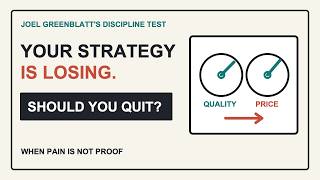
One asks whether the business uses capital well. The other asks whether the whole business is available at an attractive price. The so-called magic formula is a sorting machine with two dials. The first is quality. How effectively does the business turn operating capital into operating earnings? The second is cheapness.
How much operating earnings do you receive relative to the price of the entire business? Neither dial is enough alone. A wonderful company can be overpriced. A statistically cheap company can be economically weak. Greenblatt ranks both, then looks for businesses that score well on the combination. The magic is discipline, not mystery.
Quality is represented by return on capital. Picture two companies that each produce $10 of operating earnings. One needs $100 of working capital and equipment to do it. The other needs only 40. All else equal, the second business has more productive economics. It may have more room to grow without constantly asking owners for fresh money.
The measure is imperfect, but the idea is powerful. Do not admire earnings without asking how much capital the business consumed to create them. Cheapness is represented by earnings yield. Greenblatt compares operating earnings with enterprise value, the market value of equity plus debt, adjusted for excess cash.
That matters because a business means taking its financing with it. A low share price alone tells you little if debt is enormous or earnings are temporary. Earnings yield asks what operating return the current total price appears to offer. It is not a promise. It is a consistent way to compare the price tags attached to different businesses.
The formula does not declare one ratio universally good. It ranks eligible companies on quality, ranks them again on cheapness, and combines the positions. Company A might be the best operator, but only moderately priced. Company B might be extremely cheap, but merely decent. The combined list forces consistent comparison and reduces the temptation to move a cutoff for a favorite.
But the result is relative to the available universe, not a certificate of safety. A ranked list is not portfolio. Greenblatt spreads the idea across roughly 20 to 30 companies, adds positions over time, and refreshes holdings systematically. Diversification matters because one company's numbers can mislead.
Staggering matters because one purchase date can be unlucky. A repeatable replacement rule matters because stories become emotionally sticky. The objective is not one heroic winner. It is to express the quality and price idea across many decisions. Now, the opening problem returns. If a formula worked every month, everyone could follow it comfortably, and competition might erase the opportunity.
Greenblatt argues that underperformance pushes people away. The challenge is not to celebrate losing, it is to decide in advance how long the premise deserves a fair test, then avoid rewriting rules from embarrassment. Discipline is part of the logic. Without it, the investor owns the formula only during its easy periods.
Simplicity creates blind spots. Earnings may include unusual items. A cyclical company can look cheapest near peak profits. Asset-light businesses may not fit a traditional capital measure. Data can be stale, while taxes, costs, liquidity, and different definitions change results. Independent research has questioned how much historical performance came from quality versus cheapness.
A screen is a starting point, not a guarantee, recommendation, or permission to stop thinking. When should you change course? Repair the process if you used inconsistent data, skipped diversification, or changed rules midstream. Recalibrate if assumptions, costs, or your risk capacity changed. Retire the strategy if its economic premise no longer survives evidence.
This three-part test is an interpretation, not Greenblatt's checklist. It separates discomfort from disproof. Staying forever is not discipline. Quitting because another strategy just won is not evidence, either. The book's lasting lesson is larger than two ratios. Know what economic idea your rules capture.
Apply the same standard when emotion wants an exception. Spread uncertainty across independent decisions. Keep looking for evidence the model is wrong. For your strategy, write down four things: its premise, expected hard period, invalidating facts, and the losses you can tolerate. A formula can organize decisions, only understanding and honest limits can help you stay with it wisely.


Comments 0