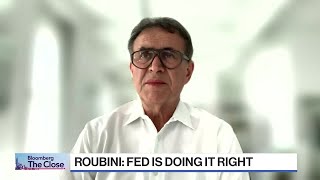
저자: NourielRoubini · 외국인
요약 보기
연준은 인플레와 성장 둘 다 고려해 금리인하를 기다리는 게 옳다는 입장. 성장 둔화로 노랜딩 위험은 줄었으나 지정학적 에너지 쇼크가 최대 리스크. 프랑스 총선은 시장규율로 극단적 정책이 제약될 것이며, 트럼프식 관세는 인플레를 높이고 글로벌 무역전쟁은 주식시장에 부정적이라고 봄.
다듬은 글
Tony. Chris says he was talking about sort of the Fed is in risk management mode. Are they doing this right? Yeah, I would say they overall are doing it right. On one side, they're still worried that the surge in inflation occurred in the first quarter may be slightly more than temporary, even if the latest number suggest a softening of that core B.S.
But now there's also something of a slowdown of the economy, something of a softening of the labor market. There is job creation, but the unemployment rate has ticked up towards 4%. So there is better violence and there is a slowdown in the economy. So based on their dual mandate, they have to worry about the inflation and worry about growth as well.
So I think they're right in waiting until they start cutting rates. Nouriel, do you think that the risk should be more on the inflation side or the growth side in that the risk is higher inflation or lower growth? Which camp would you be on? Well, until recently, I would have argued that the biggest risk was upside on the inflation side.
But now economic growth has slightly moderated. Consumption is slowing down. There is some slackening in the labor market. So I think that the Fed that wants to achieve a soft landing, but not this substantial landing, that they want to go to the same way, maybe even a short, shallow recession. And therefore they have to start thinking about the downside risk to economic growth.
Are we out of the woods yet in terms of we can avoid a recession at most will get a soft landing? Yes, with one caveat. You know, a year ago, everybody worried about their real hard landing. Then there was a risk of a soft landing. Then people said, no, we're going to achieve a soft landing. But recently, there was both that growth above potential and inflation above target.
So there is was that actually economy was growing too fast and it will be in a no landing situation and no landing will lead the Fed to stay high for longer or even higher for longer. That was the risk. While I would say that right now, this softening of the growth and labor market side suggests that maybe the risk of a no landing is reduced and we are going towards maybe something closer to the goal of the side that is a soft landing in terms of global economic risks and what might keep you up at night.
I know that you worry about a lot of things and a lot probably keeps you up at night. But globally, when you look at what's going on in the Middle East or when you look at what's going on with Russia and Ukraine, what's happening in Europe with those elections taking place in France and the U.K. or China, what is the single biggest concern for you as it relates to how the Fed proceeds?
Well, the biggest risk would be some kind of geopolitical shock that will lead to some spike either in energy or broader commodity prices. The initial brutal Russian invasion of Ukraine led to a spike in energy prices, but also food, fertilizer, industrial MANPADS. If there was a worsening of the conflict between Israel and Hamas, an escalation that includes Hezbollah and Iran, of course there could be a spike in oil prices like the one we saw in the saturation episode of 7379.
And the conflict with China is more of a slow motion. A buildup of a Cold War is getting colder. Restart protectionism. And of course, what's going to happen on the trade side depends very much on whether Trump is going to be elected or by some other Democrat as well. So I would say all central banks worry about some geopolitical shock that spikes in their energy or other commodity prices.
That will lead to an increase in addressing inflation that could eventually lead to a cycle and on the back of an increase in core inflation and really stagflation and shock that this increasing inflation reduces growth in a way that would make the really hard that the goal of central banks to achieve a soft landing.
Putting aside the US election for a second because we will get to that. What is the risk that we should put on the French parliamentary second round election and the result of that? Well, there is certainly a risk that the party of let them reach as an absolute majority. Their fiscal problem, the problem about Europe is really, if implemented fully, something would be dangerous not just for France but also for Europe.
However, I feel that even if they were to come to power, they'll be moderate, that they'll be moderated because that constrains coming from the European Union, from the ECB. They'll be in a competition. Macron And most importantly, there is market discipline. If they were to follow a reckless fiscal policy, there would be a massive widening of the.
Sovereign spread the fall in the stock market, a weakening the Europe that would force them to adjust. So we know what happened in the U.K., where the US is not survive more than 44 days. When the bond vigilantes came into action. So I would say that the biggest constraint to a radical economic and fiscal policy in France comes from market discipline, and that's going to lead them probably to moderate if they come to power.
If they want to stay in power. Now, turning to have a hung parliament is not much better because that parliament implies a minority government. One is going to be subject to a vote of no confidence, eventually cut a bigger government and talk policy and political chaos as well. So either way, the risk in France, but that thing, that market discipline is going to constrain whatever is going to be in power from doing things that are too extreme.
The rise of Le Pen indicates the rise of populist parties. Are there instances where populist parties are good for markets and for the economy? I think it depends, as some of these populist parties start from a, I would say, very populist economic agenda, and then they moderate. In the case of Italy, Meloni when she came to power, they're worried is that with a loose fiscal policy, there'll be a reversal of structural reform that did not occur.
And some do hope that can be the way to put it, to be meloni's that that one's power is going to moderate. There are differences between Italy and France. The program is much more to the right of the want of Meloni. Italy had the card out of €200 billion of low cost loans or grants from the EU. And Draghi played the role of that of the, say, paternal guidance.
And it gives a melody that is not, say the same figure in the case of France. So they are not I don't think that France will get to under Le Pen fully meloni's, but they're going to moderate compared to what they are right now, come to power. Nouriel, when it comes to a lot of the policies, particularly towards China, Biden and Trump actually see eye to eye more than they are facing off against one another.
But what you are pointing to is really the threat of increased sanctions and more protectionist policy, isn't it? Yes, it is. Of course, Democrats and Republicans want to be tough on China, but by then restraints on their view of creating what they call a narrow yard with high fences and concentrating on some critical technological factors in sanctions.
While the plan of Trump, at least at face value, is one of imposing a 10% tariff on all the imports coming to the United States, even from friends and allies like Europe, Japan, South Korea, you name it, and up to 60% on Chinese goods. So I would say that the big question mark is going to be where is going to head that and do that or whether it is going to offer some carrots and sticks.
I mean, for example, Europeans at least spend more on defense or if they change some of their trade policies, they may be subject to exemption from the 10% tariff. Same thing for China. If they gradually increase the tariffs every month to reach eventually 60%. But if China does certain things, maybe it stops short of that.
But the point is that any tariff is a regressive form of taxation, which increases import prices and it causes a higher inflation. What they could alternatively do and people have discussed it, is the idea of instead of a generalized tariff for a start, other countries accept the depreciation of the dollar in appreciation of their currency, something equivalent to that.
What happened with the plaza or the global agreements? People talk about the Mar a Lago agreement on currencies, but that would be similar in terms of impact on inflation to a generalized study as well. So Nouriel, believe the dollar out for a second. What is the asset class that you think is going to have the most exposure to the volatility of the election based on the policies that we do know?
Bond market, equity market. I would say that protectionism is going to lead to a gradual increase in inflation, and that will be something that will be of concern certainly to the bond market. But an escalation of trade friction or a generalized trade war with the rest of the world because our trading partners might also imposed tariffs against the United States, is also a threat to their stock market. A global trade war is not going to be good for the stock market.





Comments 0