
원문 보기
Within that tech universe that you cover, there are a lot of ways to play it. You can do it at the index level, you can pick the individual stocks. Your job is to pick stocks. So, which ones go on the top of the shopping list? look, on the chip side, we've taught me it continues to be Godfather by AI Jensen and video.
You look at AMD. I mean, Victoria talked about I think Micron in terms of look, this is a memory supercycle that's going to continue play out. But then the hyperscalers, you look at Microsoft in terms of where I view that. Oracle is another name that I think continues to be oversold relative. And look, now it's spreading.
Second, third, fourth derivatives across AI. Every dollar spent on Nvidia chip, there's an eight to ten dollar multiply across the rest of tech. That's why it's third inning. This is your bailiwick. This is your wheelhouse. You cover many of these tech companies. This tech momentum, there have to be standouts there that continue and others that may tail off peel off.
What exactly are the ones that you think are the most positioned and what parts of that thematic trade are going to have the most legs going forward? Look, the chip supercycle's going to continue. And look, and I've seen it firsthand in Asia. I mean, demand and supply is 12 to 1 for Nvidia chips. And what that means, it's bullish for AMD, bullish for obviously all the memory players and everything that we're seeing play out.
But I continue to think if you look what's happening on the hyperscalers, that's where I think you want to continue to be focused. Amazon, Google in particular as well as Microsoft. And look, the SaaS apocalypse as we've talked about many times, it was it was a growth trade that was way overdone. You can't paint them all with the same brush.
You know, Stephanie and Ryan talked about it all the time. And I think now you're starting to see second, third, fourth derivatives what Stephanie talked about. It's going to be happening across the board. Infrastructure, energy, chips, software. It's a Look, we're talking about four trillion that's going to be spent in this AI revolution.
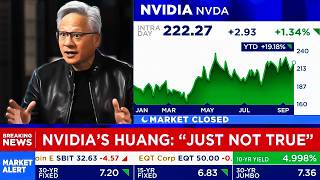
I can't stress enough how important the keynote was by Jensen Huang. This stock, by the way, is still not back to where it was at 348 last week. been writing about relevance and because they they they botched the they botched this realignment with one one of the industry's companies and there was no buyback at the time for video so it just collapsed and people thought there was really something wrong but one of the major emphases by Jensen was listen, we're not just about the hyperscalers.
Although he did point out that the big partners are indeed the big three SpaceX and Anthropic and open AI. But I thought he may went out of his way to say look Indonesia, France, these are the countries they're going to be fighting for our chips and it really was a very subtle shot at Amazon and Google for their chips which he just says basically will cost you a lot and not run hot and not help.
Yeah, no I thought that we've been waiting for them to maybe swat back a little bit at these frenemies in Amazon and Google. To bring you up to speed the company is jumping into the PC space by unveiling this new and one X processor alongside Microsoft. It'll be incorporated into a new RTX Spark superchip debuting in the fall on a fresh line of Windows PCs from companies like Microsoft, Dell, HP and Lenovo.
Here's Jensen at the keynote. This is Taiwan's Computex earlier today. There is no question this reinvention of the computer is as big of a deal as the reinvention of the phone into what we now know as the smartphone. And so this is the beginning of that journey. This is the beginning of a new line and so we have a road map for this.
This is a brand new product family for us. Every single generation of architecture we will have a desktop, a laptop, a workstation and then a desktop, a laptop and workstation. And the thing that I'm just incredibly pleased, incredibly honored is that a of the world So you got HPQ up four, you got Dell up, you got Arm and Intel.
Okay, I should say AMD and Intel lower. Yes, well this is an Arm base revolution. The PC will be based on Arm. Obviously all the other stuff is based on Arm already. You need this is an agentic base PC of which you know it's they can do agentics that needs Arm. A direct slap by the way on on AMD and Intel having a PC chip that just doesn't work.
It doesn't work really as well, but I think one of the biggest surprise besides Arm cuz we all knew that Renee Haas is having a a talk with with Jensen on Tuesday was this tie with Microsoft. And it was hinted at in some tweets on some postings on Friday, but holy cow I am Glenn remember I was concerned that Microsoft and of course Salesforce were were both going to be forgotten by Microsoft.
Well Salesforce is now up 35. So obviously that one was money good. But this Microsoft oh my this is big because I had not thought of Microsoft as being as important, but don't forget Microsoft's Azure they have their own Amazon web like Amazon web services and and like Google Cloud. I don't know if I were Google and and Amazon I'd have to respond.
Have to respond. Yeah. This would have been a good day to reiterate Nvidia you know they have a very big buyback that has to end at 350 and then the huge wave of selling came in and they knocked it back to 211. Everyone thought there was something wrong. I ruined most of Friday night trying to figure out what's nothing wrong till I was wrong till I realized it was just a really bad index.
For more on Nvidia's big move let's bring in Gil Luria managing director at DA Davidson. Gil it's great to have you. Can you help contextualize how big a deal this is? It's a very big deal. Nvidia is coming at the CPU market very hard. They started by telling us that they already have this $20 billion market in just the data center CPUs and now they're saying we can do this in PC as well and displace AMD and Intel.
The conversation had been for a while about how Intel is going how Nvidia is going from having all the data center market to having encroachment by AMD and Broadcom. And now the conversation is turning to no, Nvidia is now coming after other companies' markets. And it's especially striking given AMD's trading at 40 times, Intel's trading at 100 times, and Nvidia is still trading at a market multiple in the low 20s.
So, Nvidia is is really driving home the point that they can come after the CPU market in the data center and now in the PC. Right. Does that net deal doesn't make them a more consumer-facing company and is there any risk or volatility along with that? Well, the origin of Nvidia, let's not forget that they used the GPU started by being a graphics card in the PC.
So, they're very familiar with the consumer market. It's just they they let it go because the data center market was so much of a bigger opportunity. But they're telling us something else now as well, which is they do think that a lot of AI can be done on device, on a computer, and in a handset. If they're they're going to release a desktop that can handle a trillion parameter model that can handle a lot of the things that consumers use AI for and remove some pressure from data centers while increasing the value of the handset and PC.
So, they started off in consumer and now they they see a lot of value there because they can extend the AI the power of AI into consumer devices. Does it make sense that ARM would be up three times as much as as Nvidia? It's been kind of a pattern lately. Yeah, what's it's from a smaller base. Nvidia over 5 and 1/2 trillion dollars.
So, it's easier to add value elsewhere. But yeah, they're using the ARM technology and that's a big tailwind for ARM and they're very leveraged to that as well. So, it is good news for ARM as as Nvidia. That really, I mean, it's they started with Grace and the Grace Blackwell. Now, they're doing the Vera and the Vera Rubin.
That is all based on ARM technology. So, there is a big benefit to ARM. You talk about this notion of having AI data stored more locally. What do you think it does to the discussion about cloud compute, the need for data centers, and all of the accompanying demands on energy and water and so forth? The demand for computers is so much outstripping outpacing supply that we still need all those data centers at least for the foreseeable future.
Putting some of the AI capabilities on a PC or handset doesn't mean that for all the more intense calculations, the more intense thinking we're asking the artificial intelligence to do, we still need those data centers. So, this long-term may take some pressure off, but not anytime soon. I asked about ARM, Gil.
What about the Intel, AMD, Qualcomms, and and what their market share here looks like, which originally sold off on this news? Does this really threaten it? the CPU Yeah, the CPU market's getting competitive. Let's not forget Amazon and Microsoft, the two biggest customers of data center CPUs, make their own CPU.
Now, Nvidia's coming in. That is a big challenge for AMD and Intel, which again is makes it harder to understand how those multiples can be so high while in memory, Micron, even with today's run, is only still trading at 10 times PE without competition from Nvidia or really any new competition coming to DRAM, at least not outside of China.
So, the CPU market does look more challenged. Nvidia is, you know, it's it's as strong as there's a drink. And yet, the stock hasn't made the kind of moves that a lot of these other names have. You look at uh uh where they are now, PE for this year, next year, next fiscal year after that, next fiscal year after that.
This conceivably is the one of the cheapest, if not cheapest, stock in the market. You're pounding the table on it right now, aren't you? Absolutely. Uh you know, it's it's right now, you know, we're chasing a lot of the semiconductor names that had really not participated. Remember, Nvidia had a huge run before the other semiconductors like AMD and Micron even started this move.
And so, we've seen a again, a very big gamma chase in these smaller names. This is just, you know, basically a mechanical buying that's occurring in some of these other names. Nvidia hasn't participated in that right now, but they're the ones that actually have the fundamentals and really the moat when we talk about AI and storage and semiconductors and that type of story.
So, anytime you get a decent pullback on Nvidia like we have right now, uh in fact, we'll be looking to add to our position that we've had We've had Nvidia forever. We'll be adding that position on this pullback. So, February 4th, Jensen Huang said that uh AI replaced that AI replacing software was, quote, "the most illogical thing in the world." But think about it, right?
The software stocks rebounded for a couple of days, then they resumed their free fall. So, the question right now, he essentially said the same exact thing less than 24 hours ago, but today it's acting like rocket fuel. Uh joining me now, Ayako Yoshioka, she's the director, senior investment strategist at Wealth Enhancement Group.
And Ayako, what's the difference between now and February? I mean, obviously, these stocks are acting better, but what's the main difference now? Hi, Charles. So, you know, I think from uh our standpoint, I think the washout in software stocks is sort of uh been played out. And I think from a valuation standpoint, many of these software names look very attractive on a go-forward basis.
So, of course, Nvidia stole the show at Computex over in Taiwan, but uh you know, and and we know it's it's been it's been sparking the the stock here higher. You still like it here. Is this Is this the maybe part of a move I I hate to say it's been an underperformer, but a whole lot of names have overshadowed it here recently.
Absolutely. I think many people feel that GPUs were the base for the large language models, and now that AI has really entered the inference phase, that there's been other ways to sort of make money within AI, but we think that with Nvidia, it's still a core position that you want to own for the long term.
& in the market and a red day for many stocks, but it was a notable green day for both Nvidia and many software stocks. I'm going to talk about Jensen's GTC keynote in a moment, but before I do that, let me quickly cover some other important news stories. Today, Anthropic announced that they have submitted their draft S1 to the SEC to go public.
Anthropic going public could potentially be short-term negative for Nvidia and other megacap stocks if those stocks are used by market participants as a source of funds. But, Anthropic going public would overall be positive for Nvidia for a few reasons. First, there's Nvidia's investment in Anthropic, which Nvidia should see an even greater return on if there's an IPO.
Second, Anthropic going public and raising capital means that they would have more money to spend on compute, which is of course great for Nvidia. And third, and I think this is probably the most important, Anthropic going public would allow the public to see the company's surging revenues. As I've said previously, I wish both Anthropic and OpenAI would go public so that the public could see the ramp in their revenues.
If market participants could see these labs' surging revenues and realize that , then that would probably help calm investors' worries about seeing an ROI on AI infrastructure, and it could help assure investors of the longevity of Nvidia's growth since f they lso, over the weekend, it was reported that the US Commerce Department moved to close a potential loophole that may have resulted in companies exporting Nvidia chips to subsidiaries of Chinese companies located outside of China.
I don't expect thi. Demand around the world continues to far outpace supply. Even if Nvidia is not allowed to sell to certain Chinese subsidiaries, a lack of demand is not the problem for Nvidia. Also, Jensen hosted a Korean partner night dinner in Taipei with executives from SK Hynix and Samsung, among others.
Nvidia's relationships with memory partners are crucial given the memory bottlenecks throughout the industry. This piece of news is far more important than it may seem at first glance. All right. Now, I'm going to cover some of the highlights from Jensen's GTC Taipei keynote. I'm just going to rapid-fire multiple points that stood out to me.
Jensen reminded us that tokens are now profitable units. Because it's profitable, AI companies want to build out more. Jensen said that a big breakthrough is agentic tool use. He reiterated that the fears about agentic AI replacing software companies are largely overblown. Jensen pointed out that with AI agents, the world is no longer limited by the number of people.
Therefore, those agents are going to use more tools than ever before. And he said, "Quote, this is actually an incredible time to be a software company." Jensen's comments helped many software stocks trade higher on Monday. Jensen said that Nvidia's CUDA libraries are Nvidia's treasure and they're able to present CUDA X libraries to agents that are able to use them even more effectively than humans.
CUDA X libraries are tools for agents. The AI agents of the future are going to be very sophisticated tool users and CUDA X libraries are going to be incredibly popular with AI agents. Jensen reiterated that Nvidia is no longer just a GPU company. They're now an AI infrastructure company operating at massive scale.
Jensen said that 100 gigawatts of AI factories will come online before the end of the decade. Jensen spoke about Nvidia's DSX reference architecture, sharing a slide of DSX ecosystem partners. Jensen made the point that this is not a computing ecosystem. This is an AI factory ecosystem downstream of Nvidia.
Jensen said that right now, a 1 gigawatt AI factory costs about 50 to 60 billion dollars. And soon, it will cost 80 to 100 billion dollars per gigawatt. Jensen made the point that it must be done right, and it must work right away due to the large cost. Jensen reiterated that compute is revenue, and customers must choose the right architecture since they are power constrained.
Jensen pointed out that Nvidia's time to first inference is much faster than their competition. Nvidia's throughput per watt is world-class, and if your AI factory is limited by power, then you need the highest throughput per watt. Jensen took a direct swing at custom ASICs by saying, "Quote, performance per watt is your revenues.
Choosing the wrong architecture just because the chips are cheaper doesn't translate, doesn't make sense." Jensen pointed out that software changes rapidly every few months. And if you don't have a flexible architecture, then you cannot predict the useful life of your system. He's hitting directly at custom ASICs from the hyperscalers, by the way.
Speaking directly to those developing custom ASICs, Jensen said, "Quote, you cannot predict how long your system can last. I can. Nvidia's architecture is the most flexible in the market, meaning it can easily adjust as software changes." Jensen said, "Quote, if the life of the asset is long, the total cost of ownership is low.
Today, Nvidia's total cost of ownership is the lowest in the world by X factors, orders of magnitude, thanks to extreme co-design. That's great for companies like Iron, by the way. Iron's upcoming Sweetwater site should be a flagship Nvidia DSX AI factory." I'm going to get back to the GTC highlights in just a moment.
Very briefly, I'll mention that Iron announced on Monday that it closed 3.65 billion dollars in GPU financing to support the delivery of its contract with Microsoft. This is the same financing package that Iron announced earlier this year. As you can see from this earning slide that was released back on February 5th.
On Monday, Iron announced the closing of that financing, and we learned some of the specific details. I'm not going to spend much time on this right now. The main takeaway is that Iron has secured a large investment-grade rated GPU financing package at a relatively attractive cost. Now, let's get back to Jensen's keynote.
Jensen told us that Vera Rubin is in full production. The supply chain for Vera Rubin is twice as large as that of Grace Blackwell. And what used to take 2 hours to assemble one Grace Blackwell rack. Now only takes 5 minutes. The industry is far more prepared for the launch of Vera Rubin than they were for Grace Blackwell.
Jensen spoke at length about the Vera CPU, mentioning that with agentic AI, low latency is incredibly important. Vera was purpose-built for agentic AI and Nvidia is already the world's largest CPU maker. The Vera CPU serves three main purposes inside the Vera Rubin rack. There are two CPUs handling things like orchestration and management of the GPUs, managing the KV cache, and dealing with the software that runs inside the rack.
The Vera compute is used for the harness, the orchestration of the AI models, tool use, and accessing the database. And Vera Blue Field is the fastest storage system the world has ever made. This is important because agents are accessing memory so incredibly fast. Vera is a new CPU architecture built from the ground up that is purpose-built for agents.
Vera is world-class and the number of CPUs is going to be quite high. In the past, CPUs were built to be used by humans. Now, CPUs are being used by agents. With billions upon billions of AI agents, we're going to need a lot of CPUs. Speaking of the Vera CPU, Jensen said, quote, "This is going to be our new major growth driver.
The reviews are already coming out and it's pretty good." Later in the keynote, Jensen said that the orders already are going to make Vera the fastest and most successful product launch in Nvidia's history. Jensen said that every company will run agents and they're all asking Nvidia how to run agents safely.
Jensen shared the Nvidia agent toolkit for enterprise AI. There are four things companies need in order to build agents as a service or build agents to operate. First, you need large language models. Nvidia is determined to be the leader in open-source models, by the way. Second, you need a harness to orchestrate the whole thing.
So, think of Nvidia's NeMo Cloud, for example, or other harnesses like Open Cloud. Third, you need tools and these tools come with skills. Nvidia's CUDA-X libraries are going to be amazing tools for agents in the future. And fourth, you need a runtime, the operating system that holds it all together, such as Nvidia's Open Shell.
Nvidia has it all. Jensen also announced Nvidia's new NeMo Tron 3 Ultra open model, which is five times faster and 30% lower cost than the world's best open models. And Jensen said that Nvidia is currently working on NeMo Tron 4. As a reminder, Nvidia being a leader in open-source models should lead to a very advantageous position for Nvidia, wherein many popular AI applications are built on Nvidia's own models.
Open-source models drive greater consumption throughout the ecosystem. Greater consumption results in greater compute demand. And of course, Nvidia sells the compute. Jensen said that Nvidia and Microsoft are reinventing the PC. Agents are going to run in AI clouds, they're going to run in enterprises, and they're also going to run on PCs.
When I'm talking about personal AI agents that run continuously and get work done. Jensen announced Nvidia RTX Spark, consisting of Blackwell RTX GPU, consisting of 6,144 CUDA cores, a custom 20-core Grace CPU, fused by NVLink, 128 GB of unified memory. And in close collaboration with Microsoft, a Windows platform for agents.
It starts with Nvidia RTX Spark. Jensen showed some laptops and workstations on stage. He also showed us images of Nvidia RTX Spark laptops from many of Nvidia's partners, which said that the laptops will be available this fall. And he also showed the long-rumored N1X chip built in partnership with MediaTek.
Calling it a quote, "The most amazing chip the world has ever built. 100% of Nvidia's software stack runs on this chip. Every single application Nvidia has ever created and every single application that Windows has ever run. Nvidia and Microsoft worked meticulously, so this chip runs everything the world has ever created, plus it now runs agents." Nvidia and Microsoft announced three new Windows machines covering desktop, laptop, and workstations.
100% Windows compatible, 100% CUDA, 100% Nvidia AI Tensor Core. Jensen says he can imagine that in the future, it will be commonplace for many households to have their own AI supercomputers in the house running all of your agents, doing all kinds of things for you all the time. And in time, it becomes more like R2-D2 to you, like a personal assistant, more than it feels like a computer to you.
This is a new product family for Nvidia with a dedicated product roadmap. Jensen told us that with each generation of new architecture, Nvidia will have a new laptop, a new desktop, and a new workstation. So, this is not just a one-off product launch. This is a multi-year, multi-generation family of products.
Jensen mentioned that NVIDIA has built computers that run just about everywhere. And he said that while today NVIDIA is largely in the center, in the future there will be tens of billions, hundreds of billions of agentic systems running around the world. Jensen also announced NVIDIA Cosmos 3, which is an open frontier omnimodel for physical AI.
NVIDIA is actively working to be the foundation of physical AI. Jensen also announced Alpaca My O 2, which is an open model for self-driving cars. Jensen shared a graphic of the brands that are building NVIDIA Hyperion cars. These manufacturers represent about 80% of the world's cars. Jensen told us that approximately 97% of the world's mobility services are connecting with NVIDIA.
So that when NVIDIA deploys Alpaca My O on the Hyperion runtime with a Halos operating system, they'll be able to connect to all of those services across the world. Jensen also announced the NVIDIA Isaac Groot reference humanoid robot. This platform runs NVIDIA's new Thor and NVIDIA's entire software stack.
Whether it's NVIDIA's Drive Hyperion, Thor DSX reference architecture, CUDA libraries, or Vera Rubin pots. NVIDIA consistently takes a holistic approach and they work to establish everything that's built on top. All right, so those are some of the things that stood out to me from the keynote. I'm still processing through everything we learned, so please forgive me if I missed anything or if I got anything wrong.
I'm sure I'll have more to say in the days ahead after I've had more time to process everything. I think what stood out to me the most from this keynote is that Jensen is now talking about useful personal AI running on edge devices that people benefit from in their daily lives. As I've often said, one of the things I love about listening to Jensen speak is that he quite literally tells .
Jensen mentioned that he thinks in maybe 10 years from now it could be normal for households to have their own AI supercomputers with agents performing all sorts of tasks. That's crazy to think about, but it honestly makes a lot of sense in my mind if we're about to have a physical AI renaissance that starts taking off in about two or three years from now.
If physical AI starts taking off and ramps at scale, then at some point in the future we're probably going to have many different types of robots that are useful and helpful to us in our everyday lives. And if that's the case, then it makes sense that many households would eventually have their own AI supercomputers running agents that complete tasks, running appliances, managing robots, and completing monotonous everyday tasks.
Of course, we're talking about long-term prospects here, but still, it's really interesting to think about the future possibilities. In the near-term, standalone CPUs are Nvidia's next multi-billion-dollar business, thanks largely to the rapid adoption of agentic AI. The Vera CPU is purpose-built for agentic AI because Nvidia saw this coming years in advance.
Jensen was talking about agentic AI years ago, and now here we are. I don't know what's going to happen in the short term, but from a long-term perspective, I am very confident that Nvidia will be worth much more in future years than it is today. When Jensen was on the Lex Fridman podcast not that long ago, he was very seriously raising the possibility of Nvidia becoming a three trillion-dollar revenue company in the near future.
If that happens in the coming years, then it is very plausible that Nvidia could one day be worth tens of trillions of dollars in market cap. That might sound crazy, but that's what Jensen is implying when he raises the possibility of Nvidia becoming a three trillion-dollar revenue company. the question at that point is what multiple the street will be willing to give Nvidia.
I don't know the answer to that question, but I truly do think that Nvidia will be worth much more in future years than it is today, based purely on the fundamental growth of the business. I'll be completely honest with you. I don't know what will happen in the short term, but based on everything I'm seeing, the world is still compute constrained, and I expect that it will continue at least through the first half of calendar 2028.
On Nvidia's most recent roughly 20% year-to-date, and A100 rental prices are up nearly 15% year-to-date. Yes, rental prices for GPUs that launched six years ago are still rising because there is simply not enough supply available. In a compute constrained environment, developers will use whatever viable compute they can get their hands on.
. Back then, companies were laying fiber in the hopes that use cases and demand would eventually show up. Today, we are seeing the complete opposite. As I've said many times, when market participants compare this AI revolution to the dot-com bubble, they ignore the fact that the internet is already here this tim are immediately possible.
We don't have to wait years for it to show up. It's already here. The world is compute constrained, which means there is not enough supply to satisfy demand. New capacity is utilized on their most recent earnings calls. Alphabet CEO specifically said that they are compute constrained and would have higher cloud revenues if they had more supply.
Additionally, many of the clouds are building out into contracted demand. They're not blindly building in hopes that demand will eventually show up. No, they're building out because they have signed contracts and in some cases significant prepayments nd 2026 will be a systems in the world's leading enterprises.
The leading AI labs revenues are surging right now. Agentic coding and the implementation of agentic systems in large enterprises are new use cases that are why we're seeing an inflection in inference demand. It's why we're seeing the leading AI labs revenue surge. I wish both Anthropic and OpenAI were public so the public could see the ramp in their revenues.
Anthropic's ARR has surpassed $47 billion up from $9 billion just at the end of 2025. OpenAI is growing rapidly as well. I think the leading labs surging revenues may be the initial proof point that grabs market participants attention and causes them . I think the leading labs surging revenues will also help assure investors of the longevity of Nvidia's growth since f they .
Demand is not the problem. The problem is a lack of supply to meet the demand. As I've said previous, possibly longer. a ind 3 to 4 Twit. .



Comments 0