
저자: CNBC출연자들및FinVid진행자 · 외국인
요약 보기
젠슨 황의 Computex 발표 후 엔비디아 6% 상승. 엔비디아의 PC용 칩(RTX Spark, Arm 기반 CPU+GPU) 진출이 로컬 추론 확산의 신호로 평가됨. 델·HPE 급등과 Cisco 강세 언급, 소프트웨어주 반등. 앤트로픽 IPO 신청, 중국 자회사 수출 우회 차단 이슈는 영향 제한적으로 봄. 진행자는 AI 인프라 수요가 2028년 상반기까지 컴퓨트 부족 상태일 것이라며 엔비디아의 장기 성장을 낙관. 2026년 H100·A100 임대가 상승 언급.
다듬은 글
We have this Nvidia news today. How big a deal is it this chip that they're making for the PC? And I mean to see Nvidia shares up 5% is really something. Well, from Nvidia's perspective, you know, that the stock is essentially in line with what the Nasdaq has done over the past week and that's an important piece to keep in mind.
I think separately as we got a little bit of this on their May 20th earnings call when Jensen talked about what they're doing in CPUs. That of course is related more towards VR Ruben VR Ruben, but it does have an impact in terms of what's going on on the on the the PC side and that of course is that the impact of this is probably adds this type of these type of arrangements they're having with Dell and HP could add like five maybe 10% to their business.
So it is measurable. It's it's not going to be a game-changer. We're not talking about like physical AI for example could add 30% to Nvidia's business. In the case of these they're they're relatively small. But I think what what is most important the biggest takeaway from today related to if we look at Jensen's comments with software and then look at the announcement on the CPU side.
The biggest takeaway is that it's going to become more clear that localized inference. Localized inference is going to be one of the kind of the key themes that I think companies and investors are going to get behind next year. So if we're going to rewind to a year ago, we'd have been talking about 2026 and 20 late 25 is the year that agents and at that time a lot of people didn't really understand what agents were.
Now what we're seeing today this is news with Nvidia is that this concept of localized inference and what that means essentially is that your computers are going to be able to do more AI. These are small language models and that has just a ton of impact on everything we're talking about from Anthropic's IPO to the growth in terms of PCs and I'll get to the kind of the the substance of the question.
What is localized inference mean is that there's going to be a growing debate about how much inference is going to be done on the cloud or how much can be done for far less uh uh with some of these smaller markers on a machine. And so, um that's going to be kind of I think today is an important day in that sense that we're really kind of uh officially starting what I think is the conversation around localized inference.
Yeah. Talk about Nvidia bouncing 6% today adding 320 billion to its market cap again of roughly the size of a Goldman Sachs. The jump coming after CEO Jensen Huang revealed a move into PCs telling Computex 2026 today in Taipei uh that Nvidia chips that will serve as the main processor for laptops and more.
The announcement putting pressure on incumbent PC processor stocks Qualcomm tumbling almost 9% Intel, Apple, and AMD also lower. Um let's first deal with HPE. This is a staggering move, maybe a historic move at this point. Um Dell shares in the after-hours session higher again up 3 and 1/2% on top of being up 10% in the regular session.
HPE up right exactly. Friday. Right. So, what do you make of all this sort of one-upmanship? I mean it's they're all up on the exact same news multiple times. So, I mean you know, the magnitude of the beat for both Dell and HPE I mean if you didn't know what the stock did and it's it's asco would you think phase three trial that cures cancer, right?
Up 33 I mean that would make sense. This is just a frenzy, but I I we talked about it on Friday. The language that Dell used about how significant and how rapid this change is and how gigantic they seem to be. I mean it's it's just you know, release the hounds, you know, it's people going nuts. But the amazing quarter, I mean you could have bought all you wanted at $22 in March.
It's now June 1st. Analysts obviously didn't see it coming. We talked about this with Dell last week. There 22 analysts that cover the stock. The average price target, I will round up, is $31. Now, I'm not saying that I saw it coming cuz I did not, but it's an extraordinary quarter, but to Karen's point, built on similar news we've been hearing seemingly over and over again.
And the same news that I think supports Cisco, which I'm long so I mean I I hear servers, I hear networking. And and when I hear HP guide to a 30% fiscal year forecast, like that's nice, that's great. But the implication has to also be, again, I'm sorry, but it we are a baseball show here. Well, it's June, so if you're like six or seven games under 500 on June 1st, like how do you feel about your season?
You feel like you've got a lot of time left, guy. Nobody wins anything. Yeah, so what I find what I find it interesting is to see where the puck is going, where Nvidia is up 20% year-to-date. Karen has already talked about Dell up 270% year-to-date. And when you look at a Cisco that is that is outperforming an Nvidia.
Investors are looking for a different spot to go. They're exhausting every other space within tech and Nvidia, although it's still sexy, is not outperforming. So there's something wrong with that you're saying? No, I'm saying I'm saying it's broad it's broadening out and they keep trying to pick as many levels levers as they can, but I think at this point, probably better money is to be made in other spaces.
I actually bought some Nvidia today. You did? I did. I think, you know, the Nvidia not sexy. The GPU story is less sexy now. The CPU is really, you know, that's not sexier. Um so if they're going to be in the CPU business as well, I think the stock should be higher if we're in this environment that we're in right now.
What triggered the new found optimism in this insanely positive tech session that made me feel it's not going to be boom-bust? It was a hugely important keynote speech by Nvidia's Jensen Huang at the Computex Festival in Taiwan. He had so many insights, but let me distill the winners and the losers so you don't have to waste your time.
Although, I have to tell you I enjoyed this speech so much and I did feel it was a I thought it was time well spent. The discussion started with the power of the Bureau Rubin, which is Nvidia's latest supercomputing architect for the data center chipping in scale. Then he pivoted to talk about how their new product this revolutionary new product where they'll have millions ready in the fall.
It's the RTX Spark superchip. That's an arm-based product for this PC. It works best with the AI agents that Jensen sees proliferating all over the place. This is a CPU combined with a GPU in a single package. The CPU category is currently based on AMD and Intel. It's an 86-based tech. And Jensen said those are just they're designed for personal computers, but they're not good enough for AI agents.
His are. That, of course, sent club name Arm Holdings higher, while Intel and AMD got hit. Then he talked about how he's lowering the price of compute drastically so his partners will make more money. The initial winners will be the data center builders with Oracle, Nebius, and Coreweave getting a nice shout-out.
And then users, which will be the like the sovereign funds from Indonesia, India, and then as well as Microsoft, OpenAI, Anthropic, and SpaceX. I saw that Amazon and Alphabet were pointedly absent among the among the winners. That's right. Although, Jensen did mention that Alphabet uses some of their most advanced products.
Alphabet, by the way, announced that after the close it's going to raise an astounding 80 billion dollars in equity with Berkshire Hathaway agreeing to buy 10 10 billion dollars of that in a private placement deal. I Amazon stock's down along with that, by the way. Jensen's not mentioning much about Amazon and Alphabet is important because they have their own lines of chips which Jensen could choose to challenge, but neither feels the need to defend itself.
That's a debate I've thrust myself into saying that I you need to be in all three companies because the opportunity is so great. That's right. I'm not saying either or. I like them all. The rest of this trivia talk had to do with all the amazing things that people will be able to do with this technology.
And how the personal computers using his arm-based super chips will become far more powerful and creative than those based on the old architecture. And that's why Nvidia stock rallied 6% today, and Microsoft, who they're working with on this, gained 2%. It was incredibly heartening at a time when we're getting very suspicious of the data centers as a concept, let alone a profit center.
Until this keynote, I was getting the feeling that the bubble contingent had lately had the upper hand. They talked endlessly about the waste of the data center build-out, the lack of power, the despoliation, the ruination of the area, the destruction of jobs. I think the endless talk from Jensen and copy text that compute is money, that compute will give you a big return, and then we all know that it's going to be a big run for many companies, is truly a tie turner.
It just felt right. Can they deal with the community problems? At the end of the day, these are companies with incredibly deep pockets. It's not hard for them to buy the off the communities that will be affected. We'll learn more, maybe much more about the economics of it all as Anthropic just filed to go public today.
They're not seen as a marquee client for Nvidia. They have a $14 billion investment from Amazon, and Amazon's chips are crucial to Anthropic. But when Jensen put up a list of key clients, there they were, along with OpenAI and SpaceX. As important as those three are, Jensen spent more time talking about sovereign AI, mentioning countries like Indonesia and India as important clients.
I got the sense that as big as Alphabet and Amazon might be as clients, their endless attempts to present themselves as friends when they're also competitors starting to wear thin with everybody. But there are plenty of other customers, so I am not as concerned because you know that Nvidia's a big position of mutual trust.
How about the actual business for other companies? This is where the fourth industrial revolution comes in. CoreWeave, Nebius, and Iran got mentioned as the companies that do the building, and they're worth a great deal of money, according to Jensen. HPE, by the way, was a great number here for the close.
Dell, obviously, he says those are terrific. The companies that bring the power and the companies that create the power didn't get much of a nod. That's okay. Every day something new happens. Like Caterpillar deal I told you about with the money managers stringing up turbines and holding them into the gas area right into the and then pumping it right into the machines.
It's a big business and Cat just told you today they can plug turbines into nearly any nearby natural gas reservoirs and remain plenty of electricity. More revelations. Jensen said he didn't want to destroy software allowing almost every software stock to soar higher. It was an unprecedented software jailbreak.
Just last week this group was left for dead. Now many are up 30% on nothing but what may be a short squeeze. Salesforce, ServiceNow, incredible. Perhaps the most shocking news came out of came out of Taipei with the new alignments in the PC world. For today I was widely it was widely perceived that Intel and Nvidia might be doing an all any and all strategy.
I mean maybe with Intel maybe AMD all partners together in PC. Uh-uh. Jensen doesn't think that it's going to work that well with the AI agents that these machines are meant for. He'll be making his own CPUs, ones that work well with Microsoft that's arm-based. Show that Jensen heard the cat calls knows that they have to run better and arm's going to help them do it.
I got to be honest. I've been getting a little leery of all the Nvidia announcements that never seem to move the needle. I was heartsick at that botched rebalancing from some in an index on Friday afternoon that sent the stock down six points in just a few minutes at the close. The largest company on earth goes down six points in a few minutes.
These index deals have to take place when there are still buybacks working. Buybacks stop at 3:50 p.m. That rule needs to change and I've got to tell you I think there were some real shenanigans that should be investigated. What happened last Friday was just wrong. But the bottom line, this time Nvidia truly delivered just when you least expect it.
There's a reason I told you to keep an eye on this copy text conference. Nvidia is going to break out now I think as its dominance reasserts itself and the investors realize that somehow it's now the least expensive stock in the entire group. That's & in the market and a red day for many stocks, but it was a notable green day for both Nvidia and many software stocks.
I'm going to talk about Jensen's GTC keynote in a moment, but before I do that, let me quickly cover some other important news stories. Today, Anthropic announced that they have submitted their draft S-1 to the SEC to go public. Anthropic going public could potentially be short-term negative for Nvidia and other mega-cap stocks if those stocks are used by market participants as a source of funds, but Anthropic going public would overall be positive for Nvidia for a few reasons.
First, there's Nvidia's investment in Anthropic, which Nvidia should see an even greater return on if there's an IPO. Second, Anthropic going public and raising capital means that they would have more money to spend on compute, which is of course great for Nvidia. And third, and I think this is probably the most important, Anthropic going public would allow the public to see the company's surging revenues.
As I've said previously, I wish both Anthropic and OpenAI would go public so that the public could see the ramp in their revenues. If market participants could see these labs surging revenues and realize that , then that would probably help calm investors' worries about seeing an ROI on AI infrastructure.
And it could help assure investors of the longevity of Nvidia's growth since f they lso, over the weekend, it was reported that the US Commerce Department moved to close a potential loophole that may have resulted in companies exporting Nvidia chips to subsidiaries of Chinese companies located outside of China.
I don't expect thi. Demand around the world continues to far outpace supply. Even if Nvidia is not allowed to sell to certain Chinese subsidiaries, a lack of demand is not the problem for Nvidia. Also, Jensen hosted a Korean partner night dinner in Taipei with executives from SK Hynix and Samsung, among others.
Nvidia's relationships with memory partners are crucial given the memory bottlenecks throughout the industry. This piece of news is far more important than it may seem at first glance. All right now, I'm going to cover some of the highlights from Jensen's GTC Taipei keynote. I'm just going to rapid-fire multiple points that stood out to me.
Jensen reminded us that tokens are now profitable units. Because it's profitable, AI companies want to build out more. Jensen said that a big breakthrough is agentic tool use. He reiterated that the fears about agentic AI replacing software companies are largely overblown. Jensen pointed out that with AI agents, the world is no longer limited by the number of people.
Therefore, those agents are going to use more tools than ever before. And he said, "Quote, this is actually an incredible time to be a software company." Jensen's comments helped many software stocks trade higher on Monday. Jensen said that Nvidia's CUDA libraries are Nvidia's treasure. And they're able to present CUDA-X libraries to agents that are able to use them even more effectively than humans.
CUDA-X libraries are tools for agents. The AI agents of the future are going to be very sophisticated tool users, and CUDA-X libraries are going to be incredibly popular with AI agents. Jensen reiterated that Nvidia is no longer just a GPU company. They're now an AI infrastructure company operating at massive scale.
Jensen said that 100 gigawatts of AI factories will come online before the end of the decade. Jensen spoke about Nvidia's DSX reference architecture, sharing a slide of DSX ecosystem partners. Jensen made the point that this is not a computing ecosystem. This is an AI factory ecosystem downstream of Nvidia.
Jensen said that right now, a 1 gigawatt AI factory costs about 50 to 60 billion dollars. And soon, it will cost 80 to 100 billion dollars per gigawatt. Jensen made the point that it must be done right, and it must work right away due to the large cost. Jensen reiterated that compute is revenue. And customers must choose the right architecture since they are power constrained.
Jensen pointed out that Nvidia's time to first inference is much faster than their competition. Nvidia's throughput per watt is world-class. And if your AI factory is limited by power, then you need the highest throughput per watt. Jensen took a direct swing at custom ASICs by saying, "Quote, performance per watt is your revenues.
Choosing the wrong architecture just because the chips are cheaper doesn't translate, doesn't make sense." Jensen pointed out that software changes rapidly every few months. And And you don't have a flexible architecture, then you cannot predict the useful life of your system. He's hitting directly at custom ASICs from the hyperscalers, by the way.
Speaking directly to those developing custom ASICs, Jensen said, quote, "You cannot predict how long your system can last. I can. Nvidia's architecture is the most flexible on the market, meaning it can easily adjust as software changes." Jensen said, quote, "If the life of the asset is long, the total cost of ownership is low.
Today, Nvidia's total cost of ownership is the lowest in the world by X factors, orders of magnitude, thanks to extreme co-design." That's great for companies like Iron, by the way. Iron's upcoming Sweetwater site should be a flagship Nvidia DGX AI factory. I'm going to get back to the GTC highlights in just a moment.
Very briefly, I'll mention that Iron announced on Monday that it closed $3.65 billion in GPU financing to support the delivery of its contract with Microsoft. This is the same financing package that Iron announced earlier this year, as you can see from this earning slide that was released back on February 5th.
On Monday, Iron announced the closing of that financing, and we learned some of the specific details. I'm not going to spend much time on this right now. The main takeaway is that Iron has secured a large investment-grade-rated GPU financing package at a relatively attractive cost. Now, let's get back to Jensen's keynote.
Jensen told us that Vera Rubin is in full production. The supply chain for Vera Rubin is twice as large as that of Grace Blackwell. And what used to take 2 hours to assemble one Grace Blackwell rack now only takes 5 minutes. The industry is far more prepared for the launch of Vera Rubin than they were for Grace Blackwell.
Jensen spoke at length about the Vera CPU, mentioning that with agentic AI, low latency is incredibly important. Vera was purpose-built for agentic AI, and Nvidia is already the world's largest CPU maker. The Vera CPU serves three main purposes inside the Vera Rubin rack. There are two CPUs handling things like orchestration and management of the GPUs, managing the KV cache, and dealing with the software that runs inside the rack.
The Vera compute is used for the harness, the orchestration of the AI models, tool use, and accessing the database. And Vera BlueField is the fastest storage system the world has ever made. This is important because agents are accessing memory so incredibly fast. Vera is a new CPU architecture built from the ground up that is purpose-built for agents.
Vera is world-class and the number of CPUs is going to be quite high. In the past, CPUs were built to be used by humans. Now, CPUs are being used by agents. With billions upon billions of AI agents, we're going to need a lot of CPUs. Speaking of the Vera CPU, Jensen said, quote, "This is going to be our new major growth driver." The reviews are already coming out and it's pretty good.
Later in the keynote, Jensen said that the orders already are going to make Vera the fastest and most successful product launch in Nvidia's history. Jensen said that every company will run agents and they're all asking Nvidia how to run agents safely. Jensen shared the Nvidia agent toolkit for enterprise AI.
There are four things companies need in order to build agents as a service or build agents to operate. First, you need large language models. Nvidia is determined to be the leader in open-source models, by the way. Second, you need a harness to orchestrate the whole thing. So, think of Nvidia's NeMo Claw, for example, or other harnesses like Open Claw.
Third, you need tools and these tools come with skills. Nvidia's CUDA-X libraries are going to be amazing tools for agents in the future. And fourth, you need a runtime. The operating system that holds it all together, such as Nvidia's Open Shell. Nvidia has it all. Jensen also announced Nvidia's new NeMoTron 3 Ultra open model, which is five times faster and 30% lower cost than the world's best open models.
And Jensen said that Nvidia is currently working on NeMoTron 4. As a reminder, Nvidia being a leader in open-source models should lead to a very advantageous position for Nvidia, where in many popular AI applications are built on Nvidia's own models. Open-source models drive greater consumption throughout the ecosystem.
Greater consumption results in greater compute demand. And of course, Nvidia sells the compute. Jensen said that Nvidia and Microsoft are reinventing the PC. Agents are going to run in AI clouds, they're going to run in enterprises, and they're also going to run on PCs. We're now talking about personal AI agents that run continuously and get work done.
And with that, Jensen announced Nvidia RTX Spark, consisting of Blackwell RTX GPU, consisting of 6,144 CUDA cores, a custom 20-core Grace CPU fused by NVLink, 128 GB of unified memory, and in close collaboration with Microsoft, a Windows platform for agents. It starts with NVIDIA RTX Spark. Jensen showed some laptops and workstations on stage.
He also showed us images of NVIDIA RTX Spark laptops from many of NVIDIA's partners, which said that the laptops will be available this fall. And he also showed the long-rumored N1X chip built in partnership with MediaTek, calling it, quote, "The most amazing chip the world has ever built." 100% of NVIDIA's software stack runs on this chip.
Every single application NVIDIA has ever created and every single application that Windows has ever run. NVIDIA and Microsoft worked meticulously, so this chip runs everything the world has ever created, plus it now runs agents. NVIDIA and Microsoft announced three new Windows machines covering desktop, laptop, and workstations.
100% Windows compatible, 100% CUDA, 100% NVIDIA AI Tensor Core. Jensen says he can imagine that in the future, it will be commonplace for many households to have their own AI supercomputers in the house running all of your agents, doing all kinds of things for you all the time. And in time, it becomes more like R2-D2 to you, like a personal assistant, more than it feels like a computer to you.
This is a new product family for NVIDIA with a dedicated product roadmap. Jensen told us that with each generation of new architecture, NVIDIA will have a new laptop, a new desktop, and a new workstation. So, this is not just a one-off product launch. This is a multi-year, multi-generation family of products.
Jensen mentioned that NVIDIA has built computers that run just about everywhere. And he said that while today NVIDIA is largely in the center, in the future, there will be tens of billions, hundreds of billions of agentic systems running around the world. Jensen also announced NVIDIA Cosmos 3, which is an open frontier omnimodel for physical AI.
NVIDIA is actively working to be the foundation of physical AI. Jensen also announced Alpahmyo 2, which is an open model for self-driving cars. Jensen shared a graphic of the brands that are building NVIDIA Hyperion cars. These manufacturers represent about 80% of the world's cars. Jensen told us that approximately 97% of the world's mobility services are connecting with NVIDIA, so that when NVIDIA deploys Alpahmyo on the Hyperion runtime with a Halos operating system, they'll be able to connect to all of those services across the world.
Jensen also announced the Nvidia Isaac Groot reference humanoid robot. This platform runs Nvidia's new Thor and Nvidia's entire software stack. Whether it's Nvidia's Drive Hyperion, Thor DX reference architecture, CUDA libraries, or Vera Rubin pods, Nvidia consistently takes a holistic approach and they work to establish everything that's built on top.
All right, so those are some of the things that stood out to me from the keynote. I'm still processing through everything we learned, so please forgive me if I missed anything or if I got anything wrong. I'm sure I'll have more to say in the days ahead after I've had more time to process everything.
I think what stood out to me the most from this keynote is that Jensen is now talking about useful personal AI running on edge devices that people benefit from in their daily lives. As I've often said, one of the things I love about listening to Jensen speak is that he quite literally tells . Jensen mentioned that he thinks in maybe 10 years from now it could be normal for households to have their own AI supercomputers with agents performing all sorts of tasks.
That's crazy to think about, honestly makes a lot of sense in my mind if we're about to have a physical AI renaissance that starts taking off in about two or three years from now. If physical AI starts taking off and ramps at scale, then at some point in the future we're probably going to have many different types of robots that are useful and helpful to us in our everyday lives.
And if that's the case, then it makes sense that many households would eventually have their own AI supercomputers running agents that complete tasks, running appliances, managing robots, and completing monotonous everyday tasks. Of course, we're talking about long-term prospects here, but still it's really interesting to think about the future possibilities.
In the near term, standalone CPUs are Nvidia's next multi-billion dollar business thanks largely to the rapid adoption of agentic AI. The Vera CPU is purpose-built for agentic AI because Nvidia saw this coming years in advance. Jensen was talking about agentic AI years ago and now here we are. I don't know what's going to happen in the short term, but from a long-term perspective, I am very confident that Nvidia will be worth much more in future years than it is today.
When Jensen was on the Lex Fridman podcast not that long ago, he was very seriously raising the possibility of Nvidia becoming a $3 trillion revenue company in the near future. If that happens in the coming years, then it is very plausible that Nvidia could one day be worth tens of trillions of dollars in market cap.
That might sound crazy, but that's what Jensen is implying when he raises the possibility of Nvidia becoming a $3 trillion revenue company. I guess the question at that point is what multiple the street will be willing to give Nvidia. I don't know the answer to that question, but I truly do think that Nvidia will be worth much more in future years than it is today based purely on the fundamental growth of the business.
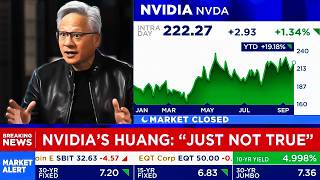
I'll be completely honest with you. I don't know what will happen in the short term, but based on everything I'm seeing the world is still compute constrained and I expect that it continue at least through the first half of calendar 2028. On Nvidia's most recent roughly 20% year-to-date and A100 rental prices are up nearly 15% year-to-date.
Yes, rental prices for GPUs that launched 6 years ago are still rising because there is simply not enough supply available. In a compute constrained environment, developers will use whatever viable compute they can get their hands on. . Back then, companies were laying fiber in the hopes that use cases and demand would eventually show up.
Today, we are seeing the complete opposite. As I've said many times, when market participants compare this AI revolution to the dot-com bubble, they ignore the fact that the internet is already here this tim are immediately possible. We don't have to wait years for it to show up. It's already here. The world is compute constrained, which means there is not enough supply to satisfy demand.
All capacity is utilized on their most recent earnings calls. Alphabet CEO specifically said that they are compute constrained and would have higher cloud revenues if they had more supply. Additionally, many of the clouds are building out into contracted demand. They're not blindly building in hopes that demand will eventually show up.
No, they're building out because they have signed contracts and in In cases significant prepayments . In 2026, will be a systems in the world's leading enterprises. The leading AI labs revenues are surging right now. Agentic coding and the implementation of agentic systems in large enterprises are new use cases that are why we're seeing an inflection in inference demand.
It's why we're seeing the leading AI labs revenue surge. I wish both Anthropic and OpenAI were public so the public could see the ramp in their revenues. Anthropic's ARR has surpassed $47 billion up from $9 billion just at the end of 2025. OpenAI is growing rapidly as well. I think the leading labs surging revenues may be the initial proof point that grabs market participants attention and causes them .
I think the leading labs surging revenues will also help assure investors of the longevity of Nvidia's growth since f they . Demand is not the problem. The problem is a lack of supply to meet the demand. As I've said previous, possibly longer. 3 to 4 .



Comments 0