원문 보기
A mental model is an individual's way of looking at the world and it shapes our actions of how we act or behave in a particular situation. So, it's like a framework, a mental map that allows us to think, perceive, and contextualize the environment, which is why we all use it in our daily lives for effective decision-making and problem-solving.
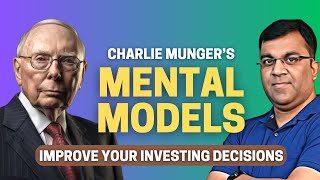
However, and correct me if I'm wrong, but we seldom stop to wonder whether the world we perceive actually matches with the real world outside. And while I'm just a Shankar and not Jai Shankar, in this video, I'll be covering some important mental models of another man I truly respect, which is none other than the legendary Charlie Munger.
These eight mental models are designed not just for application in the stock markets, but can also help you lead a more complete life. And if you like what you see and would like me to continue this as a series featuring other thinkers, then do let me know in the comments box below. Let's begin. Remember the time you learned how to drive a car?
It was not enough to understand how to move the steering wheel, but you had to distinguish between the accelerator, clutch, and brake. You learned how and when to shift gears, how to adjust the front and the rearview mirrors, interpreting the road signs, etc. So, you had to learn a bunch of things and since the world is a lot more complex than driving a car, it's imperative for us to learn more diverse ideas.
In fact, Charlie Munger calls this worldly wisdom and he himself regularly uses more than 100 different mental models that he has in his head. But don't worry, you don't have to remember them all, just the important ones will do. But what you should definitely avoid is getting into this man with the hammer syndrome, wherein every problem starts looking like a nail.
From an investing standpoint, it's like using a singular metric, let's say the P ratio to pick stocks across any sectors, and that's a problem because as we have learned earlier in this channel, the P multiple is irrelevant when evaluating life insurance companies and is not very consequential with many other investing strategies.
I think the same goes for investors who swear by the buy and hold approach and also for people who blindly follow Warren Buffett's I don't like gold dictum. My point is not to challenge anyone, but to impress upon the fact that being someone with a Swiss Army knife with different tools for different investing situations is likely to give you a massive advantage in the stock markets.
The 19th century German mathematician Carl Gustav Jacob Jacobi was known to solve difficult problems by addressing them backwards. Man muss immer umkehren is what he said, which means invert, always invert. So, what is inversion? Well, look at it this way. If you want to be a more productive person, then instead of thinking only in that direction, inversion requires you to think of it in terms of what will make you an unproductive person.
So, by thinking the exact opposite, you arrive at a completely different set of solutions which are equally effective in reaching your goals. It's a mental model that Charlie Munger applies almost every day on a range of activities, and so can you. And from an investing perspective, our goal of finding the best stocks to invest in can always be inverted as what are the kinds of stocks I should never invest in.
For example, I have an aversion towards investing in companies that are majorly government owned, and I've already presented my case in a previous video. Similarly, you might not want to invest in loss-making companies, or maybe stocks which are at a P multiple of 100, companies where the promoters have pledged a large proportion of their shares, where the return on capital employed is less than 2%, so on and so forth.
Which means by having this inverted checklist, you will be able to take better investing decisions. And if you practice inversion rigorously, I'm sure you'll see a huge improvement in your professional and personal decision-making process. I'm reminded of something a friend of mine had said many years back at an alumni dinner.
She said, and I'm paraphrasing here, "As a parent, our job should not be to decide for our children. Instead, I would have done a far better job if I can give them the right tools, a framework using which they can take the right decisions for themselves every single time." It's something that has stuck with me after so many years.
And to put it differently, always find a better problem to solve. The next mental model is of course compounding, and the mental picture here is that of a snowball, which probably started as a small pebble but grows exponentially over time. It's a story we've heard often, but just to add a small twist to it, you know what?
Let me explain this with an example. So, for all of us, our investing journey starts with not much capital to invest in. Now, let's say you start out with 50,000 rupees, and year one turned out to be quite good, giving you a 30% return. So, percentage-wise, you've done extremely well, but on a numbers basis, it's a gain of just 15,000 rupees, which is probably 2% of your annual salary.
Of course, you're in it for the long term, and as you go up the corporate ladder, your income improves, and you continue feeding the snowball by adding more capital into the investment bucket. Then, after a few years of slow progression, the snowball of yours has now hit a slope, which is where the yearly increase in portfolio value and the dividends have started contributing a significant proportion of your total annual income.
And the third phase is where the snowball really takes off, and your yearly investment income is now larger than the income you make from active work. Yes, it takes a decent amount of time. You'll probably get there in your 40s or 50s. And getting there essentially means you don't have to add any more capital from outside and then focus your attention on steering that snowball into ever steeper slopes, and that's the real model of compounding.
Warren Buffett was himself the beneficiary of this powerful mental model, and if you work on it, you are pretty much guaranteed to get rich over time. The fourth mental model I want to discuss here and one that Charlie Munger often talks about is the Occam's razor. It's an idea that focuses on how everything should be made as simple as possible and that the simplest solutions tend to have the best outcome.
The principle itself comes from the 14th century and is attributed to William of Occam who said, "If you have two competing ideas to explain the same phenomena, you should always prefer the simpler one." Both Munger and Buffett are known to apply this concept to their investing, wherein they often refer to it as two hard buckets on their desk, and they would invariably spend most of their hours in looking for simple businesses that require few assumptions and even less scenarios to work on.
As a matter of fact, this is one reason why I prefer buying shares in micro, small, and mid-size companies, as these businesses are a lot simpler to understand and analyze as compared to conglomerates like Mahindra and Mahindra, Reliance Industries, Aditya Birla Capital, etc., which are into a bunch of diverse businesses.
Now, the good part is simplification itself can be achieved in three simple steps. The first is to avoid the unknowable and unimportant, and as Buffett puts it, if the probable result of an investment decision is not known or is too trivial, then it's always better to step aside. The second step to simplification is focus, and principally when one tries to accomplish too many things simultaneously, then he or she generally ends up doing all of them poorly.
Buffett even mentions the importance of this focus in his 1997 letter to Berkshire shareholders, and the lesson for all of us here is to focus on the top 20% activities and to deprioritize the bottom 80%. And the third simplification loop is to start backwards. And yes, I'm talking about the principle of inversion and how eliminating the incorrect options is a great way of not only arriving at a superior solution, but also simplifying it.
So, to keep it simple, make fewer decisions, make better decisions, and improve the results of your investing efforts. And if you want some data-driven help with that, then do explore enrolling for the short and sweet course on quantitative investing strategy. Conceived and presented by Kirubakaran Rajendran, this practical course will help you build foundation skills in backtesting, logic, and screening.
It'll also help you understand how to collect, clean, and analyze financial data. More interestingly, Kirubakaran would also take us through a rule-based investing strategy that'll not only help us pick the best stocks, but will also clearly tell us when to enter, when to exit, and how much to buy. This capsule course is specially designed for beginners.
And if you're keen on enrolling for it, then do check out the link in this video's description. And don't forget to apply the code SKN20 for a 20% discount on the course fees. It was in the fifth edition of Charles Darwin's Origin of Species where we came across the term survival of the fittest. I read the book, and while it never struck me then, but now I think I understand why Mr.
Darwin said survival of the fittest and not the survival of the strongest. You see, unlike dinosaurs who were undoubtedly the strongest species on the planet, the ones who survived were those organisms and species that better adjusted to their environment. So, essentially, these survivors had a unique set of attributes and skills, which in today's world is a suitable analogy for businesses specializing in small and peculiar niches.
Charlie Munger often says, "In nature and in business, specialization is the key." And just like it happens in any ecosystem, people and companies that narrowly specialize in the little niches get extremely good at it. A good example of this in the Indian context is Asahi India Glass, which is now a big company, and its 70% market share in the automotive glass sector means three out of every four cars, SUVs, or MUVs manufactured in India have their product in them.
Automotive and architectural glass is the only business this company focuses on, and in 40-plus years of doing the same thing day in and day out, these guys have become very, very good at it. In fact, a 70% market share also means there's practically no competition for what these guys do, and relatively Mr.
Munger had this story to share. Enjoy. I can remember I come down to the Omaha Club, and there was an old gentleman who hit the Omaha Club about 10:30 every morning. He obviously did almost no work, and yet was quite prosperous. He became your ideal, huh? Yeah, so Well, but he made me very curious as a little boy.
I said to my father, "How in the hell does he do that?" And he said, "Charlie, he's in a business where he enjoys practically no competition. He gathers up and renders dead horses." Pari-mutuel betting or pool betting is a commonly used wager system in horse racing tracks. The biggest difference between this type of betting and normal sports betting is that instead of betting against the bookmaker, all bets are accumulated into a pool, and then the winnings are paid out based on the number and amount of bets taken.
In other words, the odds are entirely decided by the betters, and expectedly, the superior horses attract the most amount of money. Which means if a strong horse wins the race, then a large number of winners will split the pool money, and the opposite is true if a weak horse wins. As an example, let's say a strong horse has betting odds of 1:2, which means on every 10 rupees wagered, you'll make a profit of 5 rupees.
On the other hand, a weak horse might have odds of 20:1, which means if you won, then you'll have a profit of 200 rupees on every 10 rupees that you've bet. Now, this is a great way of thinking about the stock market, and a strong horse is symbolic of a Nestle India, Avenue Supermarts, HDFC Life, Titan, and other good companies that are currently trading at a price earning multiple of 80 or more.
Yes, these are all good companies, but that doesn't make them a good stock to invest into if the odds are not in your favor. And a P/E ratio of 100 even 120 means that many of these companies would have to grow at 15, 17, maybe 20% for the next 20 years to justify this valuation. On this, Charlie Munger once said, and I quote, "The investing game always involves considering both quality and price, and the trick is to get more quality than the price you pay for it." So, essentially, the idea here is to look for horses that come with a 1:2 chance of winning, but pay you three times to one.
Okay, all of us have heard of the margin of safety, but just to define it in a workable sentence, if someone offers you a company at say a 100 crores, then you should insist on paying no more than 50 crores for it. If you're wondering why, then that's because calculating the value of an investment like this 100 crore company involves a lot of estimations and assumptions.
And by having a margin of safety like 50% in this case, it's an effective way of protecting yourself against the possibility that you've been too optimistic in those estimates. In fact, I've even explained it in a previous video, the entire process of calculating a company's intrinsic value, where I took Infosys as an example.
And if you haven't watched it, then do have a look because I've also taken into account margin of safety in those calculations. Actually, if you come to think of it, margin of safety is built into every smartly designed system. For instance, when a bridge is commissioned to be constructed for 30-ton trucks, a smart engineer would typically account for a 50-ton vehicle to pass through.
Similarly, if you are expecting seven guests for dinner, then you'll probably cook food for nine, maybe 10 people. And I think even the human body has an inbuilt margin of safety with two eyes, two ears, two kidneys, 10 fingers, 32 teeth, and so on. It's a concept that Buffett and Munger understand very well, and it forms a big part of their investing and mental model framework.
Okay, we just spoke about the margin of safety and a 50-ton bridge. And it so happens that in ancient Rome, all bridge builders were required to stand underneath their constructions when these bridges were first opened to the public. Why? Because the Romans understood the power of incentives, and in this case, not a single bridge builder compromised on quality or forgot to add a little bit of redundancy into the structure.
Show me the incentive, and I'll show you the outcome. It's something Charlie Munger has said on more than one occasions, and rightly so, because incentives have the superpower to influence decision-making and shape behavior in businesses, investing, and most definitely in personal life. As investors, it's important for us to understand the underlying incentives in any system, and a lot of that can be examined in the company's annual report and the earnings call itself.
Cool. So, I've been doing a lot of data, a lot of number-driven videos. And for me, at least, this video is a serious reminder that how we view the world is how we live in it. And by expanding our own knowledge by these mental models, it allows us to live life in a bigger, better, and richer way. To recap, we, through the wisdom of Charlie Munger, have learned that one should have multiple tools like the Swiss Army knife to cope up with a complex world.
Problems are sometimes easier to solve if you turn them upside down. Money in the stock market tends to grow exponentially if you don't mess it up. Occam's 14th century wisdom still holds and simplification with fewer decision points often lead to better results. A company or even a person who specializes is often the fittest and survives and survives well as there is no competition to contend with.
Investing is all about getting more quality for the price one pays for it. Every smartly designed system, including your investment portfolio, should have a margin of safety. And finally, and I'm quoting Munger here, "Show me the incentive and I'll show you the outcome." The right mental model and its application have the ability to change our thinking, our perception, and by consequence, our personal and professional lives for the better.
If you enjoyed this video, then do tap on to the like button. Do subscribe. Do share this video with your friends, and I'll see you 3 days from now. Until then.


Comments 0