
원문 보기
The biggest thing that's happening is that AI has moved from generative AI to agentic AI. What that means is that an AI can now understand, reason about the question you give it, the task you give it, and it could plan and do work. Use tools like a browser or spreadsheet or, you know, PowerPoint or using simulators and C compilers.
It could write code, generate code, so it could do work. So, finally, AI is not just interesting, but it is doing productive work that's valuable. Now, the the important thing is as a result, the AI model builders are now generating tokens, which is basically what an AI is. It generate produces these tokens.
These tokens are now profitable, and so they want more compute so that they could generate more tokens for more revenues. You know, in the in the AI era, compute is revenues, which is the reason why our demand for our compute is so sky-high. Yeah, it was interesting that you guys for the first time broke down the data center revenue by hyperscalers and then some of the other categories like sovereign and other cloud AI.
The hyperscaler number, that's about what, 50% of the data center revenues? There There have been questions about how sustainable the growth is there given just whether these incredible CapEx numbers can continue from the hyperscalers and also the increasing competition from AMD and others. What do you say to those concerns?
The hyperscalers is where the AI frontier models are and we're gaining share there. We're gaining share there because we've already always supported OpenAI and xAI and Meta MSL and Microsoft's AI and a whole bunch of other AI startups, but this year we had the benefit of also winning Anthropic. We're helping them scale capacity so that they could have more reach, generate more revenues, and grow their company.
And so, with Anthropic, we're scaling very, very quickly. We've got big plans for them. And so, we're gaining share in AI inference, we're gaining share in hyperscale. The second category is a category that you really have to have a complete solution, including CPUs and GPUs and networking and switches and, you know, data processing and security processing and the whole software stack, which Nvidia is quite unique in having.
And so, the second category, whether it's industrial on-prem with manufacturing or enterprise on-premise, um AI-native clouds, the CoreWeaves, the Nebiuses, Enscales, so many others, uh and of course, the sovereign AI nations, where uh they want to have their own governance and they want to build it themselves.
All of these different data centers in the second category, Nvidia is fairly unique in being able to serve. And that represents half of our business and it's also the fastest growing. I was going to say, it's growing a lot faster even than the hyperscaler business. But on that, there are also questions lately, Jensen, about whether these these hyperscaler customers, which are so critical, are also becoming competitors.
You know, Andy Jassy of Amazon talked on the last call about their chip business, which she said if it was a standalone would be worth $50 billion a year and sort of hinted that they'd be selling maybe open to selling chips externally. So, is is this a threat to the to your dominance if they start doing it themselves?
We have a We have a lot of competition, but as you know, we're very good at this. And so, just because a competitor emerges, the the the distance the path, the journey from announcing a chip to eventually building a sustainable business is is long journey. And so, we continued to serve all of our uh hyperscale clouds, and um they have projects internally.
And many of the projects are delayed, and many projects are canceled, and some of them are sustained. And so, I I think a lot of it is quite noisy. We don't let it distract us. We don't We only focus on supporting our hyperscale partners, helping the AI model builders grow. And as I mentioned, you know, while competition and the number of announcements is growing, our share overall share is growing and growing quite fast.
And so, we're doing very well. You're also very bullish, obviously, about the Vera Rubin launch, and you confirmed shipping in in Q3. Can you just tell us a little bit about how that's going to change the business overall and what the pipeline looks like? The thing that's really great about Vera Rubin is that it's designed in the same systems architecture as Grace Blackwell.
So, it's easy for our customers to integrate and adopt. The second thing is very Whereas Grace Blackwell was designed for inference, Vera Rubin was designed to run the entire pipeline, the entire processing stack of an agent. Everything from the orchestration of the agent, which usually runs on CPUs, to the inference, the thinking, the thinking part of the agent, which runs on GPUs, or the tool use that runs on GPUs and CPUs.
So, the combination, that entire pipeline end to end, from short-term memory that the runs on CPUs and GPUs, to long-term memory that runs on storage, Nvidia has an architecture for every aspect of the agentic pipeline. And so, whereas Grace Blackwell's was for inference, Vera Rubin is for agents. Vera Rubin is gosh, it's in full production, seven different chips.
It's the most complex computing system the world's ever made. We're going to be very successful with it. Whereas, Grace Blackwell, uh we didn't have the benefit of every frontier AI model supporting it at the get-go. In the case of Vera Rubin, every one of the frontier AI model companies, every one of the hyperscalers, literally every single data center customer in the world is already fully geared up to launch with Vera Rubin.
So, it's going to be an excite- exciting launch. What what is the What is the barrier to to getting this going smoothly? Are the memory Is the memory shortage impacting you at all when it comes to launching this? Or even when it comes to thinking about your your next innovation? Well, as you know, Nvidia is a very large company.
So, our supply chain is literally the largest in the world. And we've been planning this for several years. You know, we started planning We started planning with the Hopper generation and got more than twice as large with Grace Blackwell, and it's going to get more than twice as large with Vera Rubin.
And so, we've been planning our supply chain for quite some time. And I think it's it's fair to say that everything is challenging at the scale that we're working. You know, there's nothing easy about the work that we do. Everything from the copper backplane of our Vera Rubin that we partner with uh Amphenol to do, this is incredibly complicated copper scale-up system, to silicon photonics, to you know, HBM memories and LPDDR memories and CoWoS of three different types.
There's CoWoS-S, CoWoS-R, CoWoS-L. The The amount of technology that's integrated in Vera Rubin, I could go on and on, but it's just it's kind of mind-staggering kind of mind-blowing kind of staggering. And so, but that's what we're good at. You know, we we are the largest the largest single company in the world at building focused in building this.
And we have every single company as a customer. And so we have you know, we have a lot of responsibility to to really lift the entire AI ecosystem in the coming months. So, do you feel good about the supply chain? But But Jensen, do you feel good about the margins, the 75% margins, and the ability to hold those in an environment where costs are going up?
Well, you know, every single generation is a challenge. Our pricing Our pricing is based on the value that we deliver. And the each generation, the value that we deliver is X factors. Always an order of magnitude better than the last time. And so, we have the ability to deliver great value, and as a result, our pricing and our margins should be able to sustain.
And I'm expecting it to sustain. Nvidia is already in space. Hopper is already in space. Vera Rubin's on his way to space. And so, you know, I think the ability to deploy data centers in space is a known ability. The question is, how do we scale that up? And so, there's a fair amount of engineering and a fair amount of science that we still have to do to scale it up.
There no As far as I could see right now, there no physical limits. There's no laws of physics limitation. There a lot of technical challenges. Some things are way easier. Some things are way harder, of course. Um but one of the things that's really terrific is that the amount of energy that will have in space is, you know, basically practically infinite.
And so, so I think that that's a a very big plus and a and a really a really great motivator and a a reason to to really endeavor to put data centers out in space. But we we have four five partners working with us in putting satellites out in space. Is this like a 3-year story, 10-year story? Any sense of it?
Well, we're already there now. And so, the question is uh we have the ability we have to do the engineering and then we have to scale it up. I think for the next 10 years, it's it's a fairly fairly fair certainty that the vast majority of the world's data centers will be here terrestrially and and so we'll just add with satellites and add with space data centers as we go.
And so, I I don't think it's going to be all or nothing. We're going to rely on on Earth for a lot of data centers, a lot of energy for some time to come. Okay, back to Earth. Question on China. Obviously, you just got back from the the trip with the president and the topic of the H200s came up again.
We know between President Trump and and President Xi and you have approval to sell there to certain companies, but the Chinese government, I guess, hasn't given the green light. What's your expectation around when that could happen? Um I don't have any expectation, which is the reason why we we put uh all of our guidance, um all of our numbers, all the expectations that I've set with all of our analysts and investors to invest nothing, to to expect nothing.
And so, that's my expectation. Uh the demand in China is quite large, just as demand for AI is quite significant here, it's quite significant there. They have indigenous companies. Huawei is very very strong. They had a record year. Um they'll likely very likely have an extraordinary year coming up.
And their local ecosystem of chip companies are doing quite well because we're we've evacuated that market, we've really largely conceded that market to to them. And so, so I think that that uh the the Chinese government, I think, has uh rightfully would like to protect their local companies. And on the other hand, they also would like the world to know that China is an open market.
And so, somewhere between the desire to protect the the local companies, which is understandable, and the desire to open up China for the world to invest in and participate in, which is a very much larger goal, in my opinion. The the tension between those two desires ultimately will will get worked out over time.
In the meantime, we've, you know, we're very clear that we would be more than delighted to serve the market. We have a lot of customers there. We have a lot of partners there. And we've been there for 30 years, and we've been more enjoyed and and honored to serve that marketplace. But at the moment, for all of our investors here and all the investors around the world, I would like to ask to expect nothing and let things work out in its own due time.
Okay, the other big announcement today was the authorization of the $80 billion buyback, which I think a lot of investors will take as a sign of confidence, and the dividend increase as well. I am curious, though, in light of your I've heard you talk so much about the five-layer cake, right? The of of the AI economy, and how Nvidia plays in all of it, including some of your investments.
What Why you felt it was a better use to return cash to shareholders instead of save it to continue to participate in the in the AI revolution, investing or acquiring companies? Well, we have we generate enough cash to do all three. The first use of cash is to scale up our supply chain. Remember, as we're growing hundreds of billions of dollars at a time, we have to support our supply chain so that they are able to support our growth.
And so that's the first use. The use to support to drive the the supply chain and support the supply chain to deliver the level of growth that we're looking into. You know, we're several hundred billion-dollar company growing on this at this trajectory towards the end of the the decade, the idea of of, you know, many times larger company is not out of the question and very likely.
And so I need to be able to support our supply chain in doing that. That's job number one. Job number two is recognizing that this five-layer cake we're inventing a brand new industry. The energy the sector needs support and has lots of great investments in it. The technology sector, the the second layer, which is chips, where we are, there's also silicon photonics and copper scale up and scale out and a whole bunch of technologies that we could we could invest in and partner with.
The third layer is the model layer and we have great partnerships with OpenAI and Anthropic and Reflection and TML and many others. The layer above that or I missed infrastructure, which is CoreWeave and Nebius and great partnerships there and Scale great partnerships there. And then of course applications, which is ultimately how AI can impact society and so we have lots of excellent investments there, too.
And so the goal is to support the ecosystem, to invent this brand new industry, and computing is essential at every single one of the layers. And so we're integral part of the whole five-layer cake and it's it's a real privilege and a real great opportunity for us to help the world create this brand new industry, which is at this point very, very clearly going to be a multi-trillion-dollar industry.
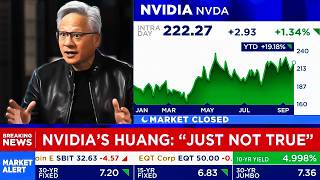
Yeah, I mean with that in mind, Jensen, you you have the number one AI chip. You've secured the top spot in building [clears throat] out the biggest tech revolution of our lifetime. I I am curious how you view the stock performance. Why I mean, why you think you've underperformed some of the other AI compute stocks and and trade at a pretty sizable discount to the S&P 500?
You know, that's one of the mysteries of the universe. Um but I think that all of this is going to get sorted out. In the end, they can't hold back performance. And at this point, in the people said, you know, what about competition? I think that that they ought to go back and and and reflect on all of the announcements that were made.
How many of them have been canceled? How many of them have been delayed? How many of them, you know, just quietly diminished? And all of those announcements reflect on those as all these press releases and announcements were being made and and where we are. I think that we've been very consistent. Every single year we're going to raise the bar.
Every single year we're going to introduce new technology. And so our annual rhythm our incredible technology leapfrog every single year, every you know, significant leap every single year. And so I think that the the competition factor is AI useful factor. And I think that that's now been put to put to rest.
It's very clear that the ROI of AI is incredibly good. The token margins are incredibly good. Compute equals revenues. So people need more compute so that they can grow their revenues. There's the question about about infrastructure spend and and how much investment and CapEx. Of course, this year the world the world very clearly has gone to a trillion dollars on on its way to three trillion dollars towards the end of the decade.
You know, I said that about a year ago. Very very few people understood it, believe it, but I think most people are starting to understand that in this new new AI era, compute is revenues. And to the extent that the CSPs and and software companies and technology companies want revenues in their business, they're going to need compute to generate the revenues.
And so I think each one of these concerns that were brought up this last year has been very, you know, uh fairly fairly clearly addressed. And I think that um uh in time, I think people will recognize uh our position in the marketplace, the value we deliver, and how we're supporting the ecosystem to create this new industry.
Everything will get sorted ou. Before I talk about Nvidia, I'll very briefly mention the information story that Anthropic is in talks to use Microsoft's custom accelerators. I have no idea if this story is true or not, and I'm just bringing it to your attention so that you're aware of it. As I've said many time.
Therefore, there's plenty of room in this market . If Anthropic so, they're trying to get more compute from whomever they can get it in an attempt to meet the massive demand that they're seeing from their users. Make no mistake, . There are many proof points that I can point to in order to support that claim.
H100 rental prices are up 20% year-to-date because demand is greater than supply. The Frontier AI Labs revenues are surging faster than what we've seen from any company in the history of humanity. And hyperscalers just told us that they're all supply constrained. Alphabet CEO told us that . And even the rental prices of because demand far exceeds supply.
And I could keep going. Today, there are no GPUs during the dot-com bubble. Today, the demand is already present and the off-take of new capacity is immediat. Now, let's talk about Nvidia. I'm once again going to cover the details of Nvidia earnings in case you missed Wednesday night's video. I'm also going to share some additional thoughts that I've had since having more time to process the results.
My overall read on situation is that this was a solid quarter. Everything remains on track and the long-term thesis remains intact. Nvidia reported quarterly revenue of $81.6 billion versus $78.8 billion expected. Data center revenue was $75.2 billion versus $73.1 billion expected. Adjusted EPS came in at $1.87 per share versus $1.77 expected.
And non-GAAP gross margins were 75%. Looking ahead to next quarter, Nvidia guided for $91 billion in revenue versus roughly $87.2 billion expected. And non-GAAP gross margins are expected to hold at 75%, which is in line with expectations. Nvidia is not assuming any data center compute revenue from China in its outlook.
Nvidia also announced an additional $80 billion share buyback on top of the roughly $39 billion remaining as of Q1. And Nvidia raised their quarterly cash dividend to 25 cents per share, which is up from 1 cent per share previously. Also, Nvidia's data center networking revenue came in at $14.8 billion, which is nearly triple what it was 1 year ago.
After going through Nvidia's CFO commentary, something that really stood out to me is that Nvidia is transitioning to a new reporting framework. So, moving forward, Nvidia will have two market platforms, data center and edge computing. Within data center, there are two subgroups, hyperscale and ACIE, which is the non-hyperscaler customer segment.
And then the edge computing platform highlights devices for agentic and physical AI, including PCs, game consoles, workstations, AI run base stations, robotics, and automotive. This new framework should give us a much better glimpse into the growth of Nvidia's non-data center growth opportunities, such as physical AI, moving forward.
I also really like that Nvidia is separating hyperscaler and non-hyperscaler revenue within the data center segment now. Over time, Nvidia's customer mix should gradually become less concentrated in the major hyperscalers as the non-hyperscaler segment grows larger. I want you to notice that back at GTC in March, Jensen shared that roughly 60% of Nvidia's data center revenue was from the major hyperscalers and the non-hyperscaler segment represented 40%.
But now, on Nvidia's earnings report, we can see that the split between hyperscale and non-hyperscale customers is closer to a 50/50 split. That's notable because it means that Nvidia's non-hyperscale customer segment is growing at a faster rate and will eventually be larger than the hyperscaler segment.
Nvidia's hyperscale business is not going away, and they're actually gaining share in the hyperscalers. But Nvidia is gradually becoming less reliant on the hyperscalers as customers, which is good. They're gradually reducing their customer concentration risk. Jensen told us back in March that once physical AI begins to take off, he expects the customer mix to be 30% hyperscaler and 70% non-hyperscaler.
Now, let's cover the earnings call. I'm going to rapid-fire multiple important points that stood out to me. Nvidia's CFO told us that Vera CPUs open a new $200 billion total addressable market for Nvidia. And Jensen told us that every major hyperscaler and system maker is partnering with Nvidia to deploy Vera CPUs.
Nvidia has visibility to nearly $20 billion in revenue from standalone Vera CPUs this year. Agentic AI is driving the surge in CPU demand, and standalone CPUs should be Nvidia's next multi-billion dollar business. Nvidia's CFO reiterated that Nvidia has high confidence in the $1 trillion of . Nvidia's CFO told us that H100 rental prices are up 20% year-to-date, and the a big reason for the increase in GPU demand.
And it's notable that pricing for older generation GPUs, even GPUs that launched 6 years ago, is still moving higher. Demand continues to outpace supply. Production shipments of Vera Rubin are on track to start in the second half of this year, starting in Q3. Jensen reiterated that Nvidia's customer base is expanding far beyond just the major hyperscalers, and that Nvidia offers the most flexible platform on the market.
Whether it's AI natives, sovereigns, on-prem, industrial, enterprise, and so on, Nvidia's system is the best option for these customers since it is the most flexible platform with the largest installed base. Jensen reminded us that these non-hyperscaler clients are not going to build their own chips or systems like some of the major hyperscalers are trying to do.
And so, for those customers, Nvidia's platform is by far the best option on the market. Jensen pointed out that Nvidia should be growing faster than the growth of hyperscalers capex. This is because of the growing diversity of Nvidia's customer base. In other words, Nvidia is gradually becoming less reliant on the hyperscalers as time goes on, and Nvidia's business should grow at a faster rate than that of hyperscaler capex.
Jensen later clarified that over the long term, the non-hyperscaler segment of Nvidia's business should grow faster and be larger than the hyperscaler portion of Nvidia's business. Jensen said that Nvidia is growing market share in hyperscalers. Jensen said that Nvidia is growing market share in inference very, very quickly.
Jensen said that hyperscaler capex is at $1 trillion today, and he expects hyperscaler capex to grow in the range of 3 to 4 trillion dollars by 2030. Jensen said he expects to continue growing market share of the frontier AI models, which could contribute incremental upside to the $1 trillion forecast at GTC in March.
Jensen also said that he expects Nvidia will be supply constrained throughout the entire life of Vera Rubin. In other words, demand will continue to outpace supply. Okay, so those are the main points that stuck out to me from the earnings report, CFO commentary, and the earnings call. I would characterize this as a solid quarter with strong guidance.
Investor returns and a share buyback and increased dividend signals that Nvidia has strong confidence in their future free cash flow, and therefore strong confidence in the longevity of the demand that they're seeing. And on the topic of returning capital to shareholders, Tae Kim, the author of the Nvidia Way, interviewed Nvidia's CFO Colette Kress after earnings and posted that interview on the Key Context Substack.
I encourage you to check it out. I'm just going to share one point from that interview on the topic of investor returns. Tae asked Colette if the plan to return 50% of free cash flow to investors this year is a permanent plan moving forward. Colette responded by saying yes. Tae then pointed out that the math points to hundreds of billions of dollars worth of share buybacks and dividends, and he asked if Colette agrees with that.
Colette responded by saying yes, do the math going forward. When will we meet a trillion dollars return to shareholders? That's what we're pretty much saying. It's on the horizon. A lot more was covered in that interview, and I encourage you to check it out on the Key Context Substack. Nvidia intends to return 50% of free cash flow to investors moving forward, even beyond this year.
The fact that Nvidia is transitioning to a new reporting framework where they separate hyperscale and non-hyperscale revenues, and where they have a separate platform for edge computing tells me that they are expecting notable future growth in the non-hyperscale customer segment, and eventually in the edge computing segment when physical AI starts to ramping at scale.
That's probably a 2028/2029 event to look forward to. Look, I don't know what the stock will do in the short term. And it's not uncommon for Nvidia to trade lower after earnings, even after delivering fantastic results. But regardless of what happens in the short term, Nvidia is firing on all cylinders.
Demand continues to outpace supply, and the long-term thesis remains firmly intact. I do wish that Jensen spent more time talking about the surge in revenues that's happening right now at the Frontier AI Labs. That said, I'm sure he can't share too many details about that right now, since Anthropic and OpenAI are both private.
Hopefully, they will both go public soon, so that the public can see their surging revenues. I think that once market participants can see the ramp in the leading AI Labs revenues, and once they realize that these companies' revenues are directly tied to compute, I think that will help common investors' nerves regarding the future return on AI infrastructure investments.
And I think it will help convince market participants of the longevity of Nvidia's future growth, because that's what the market is struggling with right now when it comes to Nvidia. They're wondering if Nvidia's revenues are sustainable. They're wondering if this is a cyclical peak in hyperscaler capex.
And they're wondering if there will be a clear ROI on AI infrastructure. As I've said before, this is not a bubble. This is not a cyclical peak. The leading AI Labs revenues are surging, and this AI buildout is a multi-year trend with multiple years ahead of us in which demand continues to outpace supp at that point, we should start to see physical AI ramp at scale.
That will likely fuel another surge in compute demand and another leg to the AI bull market that hasn't even started yet. And so, there's a very real possibility that the world may be compute constrained even beyond 2028. O.



Comments 0