
저자: SebastianBelifante외CNBC/Barron's출연자다수;주발언자불명확 · 외국인
요약 보기
엔비디아 실적 발표(수요일) 앞두고 AI 수요 가속(아시아 체크상 수요가 공급의 10배)을 근거로 단기 변동성은 인정하나 장기 상승을 전망. 컨센서스 상향(15~20% 이상 성장), 중국 매출은 미반영 상태로 긍정적. 옵션시장은 약 7% 변동 가격 반영, 실적 후 주가 하락 빈도 높다는 경고도 있음. 레오폴드 13F 풋포지션은 분기말 기준 헤지일 가능성 언급. 에이전틱 AI로 CPU·GPU 수요 급증, 2028~29년 피지컬 AI로 확장 전망.
다듬은 글
Speaking of Nvidia, wow, talk about a breakout ahead of these results. I mean, expectation that you're going to see revenue reaccelerate here in their new fiscal year, um and perhaps even coming stronger than that for Q1. How do you see it? The black weather jacket's getting ready for Wednesday because I I think the street numbers still are underestimated.
We think anywhere from 15 to 20% over the next few years because everything we've seen from our checks in Asia, from Taiwan, show demand to supply 10 to 1 for Nvidia chips. You've seen it from AMD, TSMC, just go across sort of the food chain, and I think this is really going to be another breakout moment relative to the AI trade.
I think investors are still, especially when it comes to physical AI, they might be China trade, you know, when you think about H200s, that's not factored in. And look, if the Godfather of AI speaks, you'll hear a pin drop on trading floors because that is the most important thing in this market. But look, Nvidia, we we could talk about everything.
That's what investors are focused on because there's no better sense in terms of the foundation, the purge, for what's going on in the AI revolution than Nvidia. And I think what we're going to continue to see is the demand trends accelerating. We've seen that from our Asia checks, and physical AI hasn't even come, and that's why it's a get the popcorn out moment when the Godfather speaks on Wednesday.
Okay. But you think that the Nvidia earnings could upset the market regardless of what they report? I think short-term traders who are concerned that Nvidia's earnings at don't add up are going to what's upset the market. Nvidia itself is going to do just fine with 60, 70, 80% growth. So, we're going to see what we usually see.
The algorithms get hold of the initial headline, boom, all over the place. It takes a couple of days to settle down. And basically, that's it, isn't it? Unfortunately, that is the world we live in. But if you're a long-term investor, that's an advantage because you can pick your battles and your price.
Short-term traders don't get to do that. They have to keep their money moving. That's all true. You think about a $4 billion company and then you think about Nvidia at a $5.5 trillion market value. You can quickly do the math. How many Macy's is that? I don't even know. 1,200? I don't know how many, but that's my point when I make it around market value.
So, I'll come to Nvidia. Jim, I'm sure you've seen this Morgan Stanley note this morning that raises the price target to 285, but sort of goes down some interesting roads in terms of the estimate that it has um overall for the cumulative revenue of the company. There's a an excerpt from it. Uh what they talk about is 1.07 trillion cumulative revenue calendar year 25 to 27.
They are talking about you know, just the power of Blackwell and Rubin trajectories. And they seem to be saying the rest of Wall Street is still modeling it too low in terms of where things ultimately end up with obviously the AI demand picture continuing and their opinion to remain strong for some period of time.
And that actually their supply chain will be a competitive moat for the company. Yeah, I I like that piece. Now, candidly, we've been writing this for so long earlier. But Belyus, and he he did this last week. I got to hand it to him because he was out there saying, "Listen, this is this is Nvidia time and ahead of the earnings." You know, Cole, when I look at what they're doing, I just say uh if you do get a China order, remember China's not in it.
And KeyBanc says it's going to be 13, 14 billion in revenues. That interest that's just icing on the cake. Now, we did we did notice that we didn't come back with any weak. The US government did not come back with any subsidies or orders. So, the Boeing got 200 planes. We think. Yeah. We think. Kelly O'Brooke said they did, but look, I I don't even It's amazing, you don't even need China.
I mean, and then one of the things that that that Jensen explained to me was there's always a new one because he he likes to think out 20 years. I said, "How do you think out 20 years?" He goes, "You start with 40 years, you work backwards." Yeah, well, that's been his his whole framing is that there'll be multiple sovereign wealth interests around the world who all want their own
Yes, they will. Yes, Yes, he then By the way, is there anyone cooler? I mean, did you see him eating the raw man when he was He was eating the raw man. Well, did you see the memes of what he was going to pack ahead of the trip? Just a suitcase full of leather jackets. Yeah. And then he just kind of wanders the street eating random food.
Well, we had the when he had the chicken with the sweet and sour sauce when he was behind the scenes. So, he made the deal when he ate the chicken. That said, what did Was there anything you guys obviously were covering this? I was on assignment, but what I was actually Well, what came out of this in terms of The model The model got to 23.
No, I'm talking about the China trip. What came out of it? Yeah. I think the raw man. Shares of Nvidia pulling back this morning as the company gets ready to report results on Wednesday. Let's get over to Oliver Renick at the Cboe in Chicago. Let's go to look at what the options market is saying about that upcoming earnings report.
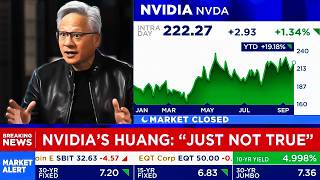
Oliver. Good morning, David. Nvidia is the highlight of the week with options volume currently trailing only the SPY, QQQ, and SPX. The options market is currently pricing in a 7% move. Though traders have had a habit of overpricing the stock's earnings reaction. The median move over the past year was just over 3%.
Right now, more than twice as many calls are trading than puts, but at least as many calls were sold as bought by volume this morning. In terms of dollar amount, the data start to look more bullish. 500 million of the total 600 million dollars in premium traded in Nvidia is in calls, and five of the 10 biggest trades out of the gate in the entire market this morning were Nvidia.
Four of which were $10 million plus purchases of expensive, deep in the money calls expiring this Friday. And there's also a lot of speculation happening on the zero-day front about 15% 15% of currently traded options premium and half the total delta is in contracts expiring today. Keep in mind last week ended with a brutal multi-billion dollar wipeout for those who held in-the-money contracts that flipped worthless in Friday's sell-off.
Options traders though are getting right back on the horse this morning. Today's most popular contracts are the 227 and 1/2 and 230 strike calls. Both out both out of the money now, which means an uphill battle, guys. It's making the rounds this morning, Oliver, is the 30-day moving average of total options volume.
That chart looks like a lot of looks like a lot of tech stocks. Yeah, bets are on basically. This is a huge deal this week for Nvidia. It moves not just itself, it moves the category, it moves the sector, and it moves the index. So, I wouldn't be surprised if you see action across the board. Well, there's this.
Nvidia. Uh does Barron's magazine that's I know you're with Barron's. I mean, do they they recommend Nvidia? Yeah, so we we write stock picks, right, at Barron's and one of the stocks that we just highlighted just last week's to you was Nvidia ahead of earnings. So, I don't know if earnings itself on Wednesday will be necessarily the key mover here.
Nvidia's expected to grow year-over-year earnings by 80%. Uh the expectations are still very high. They'll probably beat them as they frequently do, but we like the longer-term story here. If AI demand and this need for chips continues to play out, we like leaning into Nvidia, which is best in breed in terms of AI chips and quite frankly has not been rallying like the rest of the chip sector for much of 2026.
We think it catches up. So, that's part of your overall outlook. Short-term problems, long-term gains by the end of the year. Yeah, short-term I think the stock could still maybe chop a little bit, but long-term I think Nvidia is still a key part of this story and it's trading very cheap right now, 25% cheaper than its historical average, 5% cheaper than chip stocks.
So, we like Nvidia sort of a catch-up value trade. Nvidia is cheap. It's cheap? Somehow it's cheap after all this time. Okay. So, despite the huge spike in earnings, these technicians and some others are saying that the chip names have to pull down to the rest of the market. Of course, that brings us to Nvidia, the center of all the action.
When I say the center of all the action, it is the center of all the action. Look at that orbit. Look at these names here, right? A major beat from Nvidia would be like the coordination of Thor as king. This rally will keep going big time. And all these tentacles, you got Nvidia in the middle, you've got Oracle, you've got OpenAI, you've got SoftBank, you've got smaller names.
Some are saying this is a problem, this circular financing and all these things. You're not concerned about that. Yeah, not necessarily concerned. I think we have to be cautiously optimistic here, and we've got to pay attention because as you've said, Nvidia has clearly become a load-bearing wall for the overall sector for sure, and even the major index in general.
And the circular financing I know if you look at it, it looks a lot like that Three Stooges skit where $10 is passing around from one person to the next, and everybody appears richer. But the fundamentals are here, and as long as AI demand continues to climb higher, I think Nvidia and the entire sector climbs higher.
All right, so here's the thing. Nvidia earnings are coming out Wednesday, and you know, the thing is, folks, earnings estimates continue to rise. I love this. Whenever I see a a stock like this, they beat, they beat, they beat, they beat, and sequentially the numbers are going up. But here's the rub.
The beats have been small, single-digit beats, and we know that this stock hasn't reacted well to earnings. So, there's a lot of pressure. We know they're going to do well, but how well do they have to do because right now Nvidia is pulling back a little bit. Yeah, I think just as we said, Nvidia is kind of the center of it all, and and all eyes will be on that when it reports on Wednesday.
It's got to do better than just expected, I think, for this to to boom out of proportion, perhaps more than than even imagine. But here's the thing. I think Nvidia takes us higher throughout the course of the year. No matter what happens in this earning, stay the course. S&P 5000 S&P 500 at 8000 is certainly a possibility.
target. Yeah, so and and to your point, we've seen it react, cool back, and then regain its footing, and then continue to march higher. Now, there's a chance, of course, hardware names will trade sideways, maybe more profit taking ahead of Nvidia's earnings report on Wednesday. And this is what you have to think about.
Yeah, they're going to beat. They're going to crush it. We know that already, but the last seven times they've reported, a week later, six times the stock was down, sometimes down a lot. I'm going to bring in our founder and CEO of Gold Vest Advisory, Sebastian Belifante. Uh first of all, I want to say congratulations.
And USA Today named one of the top wealth managers in New York. How does it feel? Thank you. It feels great to get that recognition. I appreciate that. Yeah, congratulations. Um So, let's talk about this. So, Barron's has an article today online that says how Nvidia's stock could hit 300 after earnings.
It could, but that hasn't necessarily been the case. How do you How do you handle something where it's a great company, the numbers are always good, but the stock typically goes down? It does, and it could happen again. I mean, it's the biggest company out there, right? We have to have exposure, and we do have exposure for our clients.
At the same time, you mentioned it, they're going to crush it. We know they're going to crush it, but we can't lose sight of the fact that there are risks out there. Today's been a good day, but interest rates are up, inflation is up, uh straight of her move still not figured out, so I think this is a good time to take some profits, or you might see some of that from Nvidia.
So, we could see the stock price down. That's That doesn't worry us. We're looking for stocks that are down to buy into. And and and the long-term story, right? This is one of the slides from from Jensen. Uh just, you know, we're early, a thousand times more compute will be needed. I mean, the numbers are really I started the show with just a mind-boggling graph, right?
But it doesn't it doesn't mean the market will go up in a straight line to match this. Yeah, the market will not go up in a straight line, but if we're long-term investors, which we are, these are names we want to buy into. Never mind the backlog, the upgrade, and I see it mentioned here, the AI agentic upgrade, but also there's a cost component, too, right?
These big mega scalers do have to switch their chips, and I think that's going to happen. So, in the near term, you see some volatility, we might see a pullback from Nvidia, but this is an early innings AI story. So, this is one of the names we're holding for the long run. The Chinese government has to decide how much of their local market do they want to protect, and how much of their local market do they want to expand with more more AI capacity.
My sense is that the demand in China is so incredible, just like it is here. Agentic AI is also making enormous progress there. My sense is that over time, the market will open. That's Nvidia CEO Jensen Huang alongside Dell CEO Michael Dell earlier today at Dell Technologies World. They talked about several issues affecting AI space, from China to the AI buildout in an interview with Bloomberg Tech co-host Ed Ludlow.
He joins us live from Las Vegas. Now, Ed, thank you so much for joining us. That conversation made several headlines, but I want to talk about AI chips, because Jensen Huang said he expects Chinese authorities to eventually allow the import of AI chips from the US. Yes, what he was talking about there was this balance, right?
That China wants to protect its domestic players, largely Huawei. And so, in deciding whether or not to allow Chinese technology companies to buy Nvidia chips, that's the trade-off. The demand for computers is great there, just as it is all over the world, but they also are conscious of the American technology stack filling that gap.
Beyond the comments that you just played, probably the biggest piece of news from the interview is that, you know, Jensen Huang himself did not have any sort of direct conversation with Chinese officials. He was very clear that this was President Trump and those relevant cabinet members that were with him speaking with their Chinese counterparts.
And we're still kind of reconciling this idea that even as recently as March, Nvidia talked about the idea they were ramping up their supply chain to send chips to China, the H200, because the US had granted them licenses. Well, they have earnings on Wednesday and either sales to China show up as a line item or they don't.
But you would infer from that that they won't based on the idea that it's all waiting on China to send some approval whether they do or don't. Uh and another thing that that came up and I I've been curious about too is this idea sort of of what we've been seeing in the memory space and sort of what we can glean from that with regards to the broader AI buildout.
Uh did Jensen or for that matter Michael Dell, did they have any sort of comments about where we stand in that cycle and I do mean cycle? Yeah, cycle and it's still tight, right? You know, the point I made to them is that historically memory is cyclical and it's boom and bust. And the point that both Jensen Huang and Michael Dell made is that they have tried to give this entire market as much of a heads-up as possible.
Three years ago they both explained how they met with the key memory CEOs, the CEO of Micron, CEO of SK Hynix, saying you need to have more permanency and capacity. And now the main takeaway, particularly from Michael Dell, is that he sees those memory names putting their money where their mouth is.
They are willing to invest in that capacity, some of which happening on the East Coast, right? With Micron, we do see it being built because the staying power of memory demand, specifically from the data center, is completely different to the smartphone market or the PC market that we've seen with having a cyclical nature in the past.
Unpack for us at around 30 seconds here what Jensen Huang meant when he said we need to make sure supply chain is prepared and it will be hard to keep up with an AI buildout for the next decade. Yeah, I was really surprised by his comment that he sees the supply chain for everything that goes into a supercomputer server doubling or quadrupling on an annual basis and that's still not being enough.
So it gives some indication of the severity of how demand is still outpacing supply which for many like that's a very good position to be in but it causes frustrations why we're so zeroed in on capex. continues and after we got a highly anticipated 13F filing. Today Nvidia shared that they delivered the first Vera CPUs to OpenAI, Anthropic and SpaceX AI this past Friday and Oracle on Monday.
The standalone CPU is Nvidia's next multi-billion dollar business. With agentic AI the industry needs many more CPUs. As a brief reminder . In order to have efficient agentic AI at scale you need both GPUs and CPUs. In that context the two processors serve different purposes. Both are needed and the industry needs a lot more of both.
Today Jensen Huang joined Michael Dell on stage at Dell Technologies World saying quote "Demand is going parabolic, utterly parabolic." A key point from the keynote today is that enterprise AI has moved past pilot programs into agentic AI and infra deployments at scale. In other words we're seeing companies move past the testing phases and into the real world application of AI.
The main takeaway for Nvidia investors is that Nvidia and Dell are expanding their partnership into a full enterprise agentic AI stack. Rubin systems, Vera CPUs, liquid cooled networking, confidential computing, on-prem frontier models, enterprise agents and software partnerships. As I keep saying and this .
We got four Nvidia price target upgrades today so let me quickly go through those. KeyBanc's John Vin raised his price target to $300 up from $275 previously. Morgan Stanley's Joseph Moore raised his target to $285 up from $260 previously. Gil Luria of D.A. Davidson raised his price target to $300 up from $250 previously.
And Stefan Chong of Aletheia Capital raised his target to $270 up from $250 previously. I don't put much weight behind most analyst price targets, but I mention them so that you're aware of what's going on. It's normal for us to see multiple analyst price target upgrades shortly before Nvidia earnings.
Now, I want to briefly mention Leopold Aschbrenner's 13F filing because it's getting a lot of attention and many people misunderstand what's going on. Quick backstory in case you're unfamiliar with Leopold. He's a former OpenAI researcher who now runs the situational awareness hedge fund. And he's recently gained a lot of popularity due to his fund's outsized returns.
He has an understanding of AI that most market participants do not have and he invests accordingly throughout the AI ecosystem. And we just got Leopold's 13F filing for Q1. This is just a snippet of Leopold's 13F because unfortunately, I can't fit the whole thing on the screen. Now, what's getting a lot of attention is that at the end of Q1, Leopold held bearish put positions in many of the popular AI hardware names such as Nvidia, AMD, Broadcom, and the VanEck Semiconductor ETF among others.
You can imagine the talk that's happening online among retail investors and the sensational headlines that were published in response to this. Now, let me address two very important pieces of context that many people are missing. First, in 13F filings, option positions are reported in notional value.
Even though the 13F shows a $1.57 billion market value for the Nvidia put position, that does not mean the fund spent $1.57 billion buying puts. That is just the value of the underlying shares referenced by the options at the end of Q1. And remember, an options contract references 100 shares of underlying stock.
And so, Leopold most likely paid much, much less than $1.57 billion to open the Nvidia put position. The second thing I want you to notice is that these are Leopold's holdings at the end of Q1, meaning he held these put positions on March 31st. A lot has changed since then. The market bottomed back on March 30th.
And so, my guess is that he probably bought a lot of downside exposure sometime in Q1 as the market was selling off hard because of the conflict in the Middle East. And since the market is now trading notably higher than it was on March 31st, I would not be surprised if Leopold has exited most of, if not all of those put positions.
I think it's very reasonable that Leopold probably bought downside exposure in Q1 in response to macro events because he's not singling out one specific company with his put positions. He bought puts in many of the popular AI names, including Nvidia, AMD, Broadcom, Micron, TSMC, and others. That tells me that he didn't take this trade due to perceived issues at one specific company.
Rather, he bought downside exposure to many of the popular AI stocks during a time of market-wide weakness. Again, these were his holdings on March 31st, and there is a very real possibility that he has exited those bearish positions since the market bottomed on March 30th. I just wanted to mention this because I've seen it get a lot of attention online and many people misunderstand the context of what's going on.
On a side note, Leopold increased his Iron position in Q1. Very briefly, I'll mention two things about Iron so that you're aware of them. First, Iron announced today that they have acquired Awaken, a creative and media agency specializing in content strategy and brand development for high-growth companies.
As part of the acquisition, Awaken's founder and CEO is joining Iron. Awaken has served as Iron's lead external marketing partner, and now Iron is bringing Awaken in-house. And since I'm talking about Iron, I'll briefly mention that the green shoe on Iron's recent senior convertible notes offering was fully exercised, which is good news.
As a reminder, Iron initially expected to raise two to 2.3 billion dollars. They then upsized it to 2.6 billion dollars, which is a sign of strong demand. And they gave initial purchasers the option to purchase an additional 400 million dollar worth of notes. That 400 million dollar green shoe was fully exercised.
That gives Iron approximately 2.96 billion dollars in net proceeds at a 1% coupon rate. And cap calls should help reduce potential dilution up to an initial cap price of $110.30 per share. The terms of this offering are very good for Iron. I continue to be bullish on Iron in 2026 and most of 2027. I may be bullish longer than that.
And I'll try to update my thoughts on Iron as time goes on. Now, let's get ready for Nvidia earnings, which are scheduled for May 20th after market close. Last time I checked, the consensus estimate for revenue was roughly $78.8 billion. Adjusted EPS is expected to be $1.77. Q1 gross margin is expected to be 75%.
Next quarter revenue guidance is expected to be roughly $87.1 billion with gross margin holding at 75%. Those numbers could change, but that's what it was the last time I checked. Now, I want to mention something very important. I don't know how the market will react to Nvidia's earnings. In recent quarters, we have repeatedly seen Nvidia deliver fantastic results and then the stock sold off after earnings.
I'm not saying that that's guaranteed to happen this time. I'm just saying that it's a possibility we need to be aware of and we need to be prepared for that just in case it happens. The market expects Nvidia to report fantastic results and the bar is high. It always is for Nvidia. That said, I'm expecting a reiteration that Vera Rubin is on track to launch this year.
The leading AI labs are starting to see massive returns on AI investments as their revenues are surging and the long-term thesis remains firmly intact. Once the frontier AI labs return on investment becomes more widely known, two things should happen. First, market participants will finally AI infrastructure in recent years.
And second, Nvidia will then have the space to raise pricing if they choose to do so. Nvidia has a lot of pricing power and they could charge customers way more if they wanted to. Once the leading AI labs surging revenues are more widely known, that's when we could potentially see Nvidia raise prices, which would mean higher gross margins.
In the meantime, it makes sense for Nvidia to keep margins where they are until the leading AI labs ROI is more widely known. And then after earnings, we have another GTC keynote from Jensen Huang in Taipei scheduled for June 1st at 11:00 a.m. Taipei time. of us in the US, that's May 31st at 11:00 p.m.
Eastern, 8:00 p.m. Pacific. I want to mention a few things about Nvidia's upcoming earnings report that I think are interesting. First, I don't know whether we'll get an update to the $1 trillion in cumulative revenue from Blackwell and Rubin through 2027 that Jensen shared at GTC in March, but I wouldn't be surprised if Jensen gets a question about it.
It's important to remember that that forecast only includes Blackwell and Rubin revenue. It doesn't include any revenue from things like the Grok LPX racks, stand-alone CPU racks, and so on. And so, the $1 trillion is not Nvidia's cumulative data center revenue. It's just cumulative revenue from Blackwell and Rubin through the end of 2027.
Something else to consider ahead of this earnings report is Nvidia's massive investment gains. Nvidia is estimated to have unrealized gains worth tens of billions of dollars thanks to their investments throughout the AI ecosystem. Many of those company stocks have appreciated notably since Nvidia invested in them.
And so, we're very likely to see Nvidia recognize some of those gains on this earnings report. I'm also curious if investor returns will be mentioned on the earnings call. During the GTC financial analyst Q&A in March, Jensen and Collette informed us that Nvidia needs to work through some commitments in the first half of this year.
But after that, they will probably return 50% of free cash flow to investors in the form of stock repurchases and dividends. I'm curious if that will be mentioned again on this earnings call since we are approaching the second half of the year. I also expect Jensen to talk at length about the rapid adoption of agentic AI and the massive surge in revenue that's happening at the frontier AI labs.
2026 is shaping up to be a very interesting and pivotal year for the AI industry because we are on the cusp of many market participants finally coming to the realization AI infrastructure. Anthropic's ARR has reportedly surpassed $44 billion up from $9 billion just at the end of 2025. And OpenAI's ARR is estimated to now surpass $30 and to be honest, I would not be surprised if OpenAI's ARR is actually much higher than that.
Why are the frontier AI labs suddenly seeing this surge in revenue? It's exactly what I've been saying in these videos. It's because of the rapid adoption of agentic AI and the subsequent inflection in inference demand. There's a reason why I keep mentioning this. For many months, I told you that I was expecting into 2026.
I was completely serious when I said that. Then we saw open class surge in popularity. Then Jensen told us at GTC in March that the inference inflection has arrived and this is is a major fundamental inflection that we've witnessed throughout the AI ecosystem in just the past four months. I'm completely serious when I say that most market participants don't even realize this inflection is happening, and they don't realize the implications that it has for .
With AI agents, we're not talking about chatbots that simply respond hen we say agentic systems, we're talking about large swarms of these agents that all work together to complete tasks and get work done. Notice that this is not a short-term fad. This is a fundamental change in how work will be completed moving forward.
We are about to witness at massive scale. And these enterprises will consume an enormous even further beyond what we've already seen. As a brief side note, the rapid adoption of agentic AI is the reason why we've seen a surge in CPU demand recently. Because now we have a massive number of AI agents that are using digital tools and systems that rely heavily on CPUs.
I want you to remember that while agentic AI is the reason we've seen a surge in CPU demand, CPUs are not meant to replace GPUs. In order to have efficient agentic AI at scale, you need both CPUs and GPUs. In that context, the CPU and the GPU serve different purposes. Both are necessary, and the industry need a lot more of both.
Jensen has a track record of accurately telling , and therefore we can infer what's coming next from a demand perspective. Jensen recently said that we will be talking a lot about agentic AI for about 2 or 3 years. But after that point, we won't be talking much about agentic AI anymore because it will be everywhere.
And at that point, according to Jensen, we will be talking a lot about physical AI. And so that's the timeline we're looking at. The proliferation and rapid adoption of agentic AI for a couple years or so. And that should increase compute demand significantly. And then sometime around 2028 or 2029, physical AI will likely come into focus as the main event. From that perspective, it's .



Comments 0