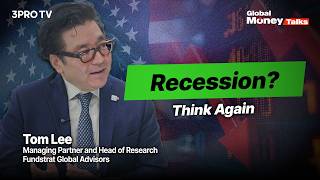
저자: TomLee · 외국인
요약 보기
Tom Lee는 관세 충격 이후 급락 바닥이 확인됐다고 보며 주식이 50% 반등한 점, 브레드스 지표(Zweig Breadth Thrust, 90% 상승일), 하이일드 스프레드 회복을 근거로 제시한다. 침체는 주로 부문별 '롤링 리세션' 형태이며 하이일드 스프레드가 1000bp에 도달하지 않는 한 전면 침체 가능성은 낮다고 본다(현재 367bp). 2026년 실적 개선 가능성과 기업 비용 관리 능력을 강조하며 현금 7조 달러가 대기 중이라고 주장한다. 마진 축소 우려는 과거 반복적으로 빗나갔다고 평가한다.
다듬은 글
Thank you everyone. Um Tom, thanks for being here. Thank you for having me. Okay, so first question. Um it's been obviously a pretty uh wild markets. Um it's been your call that the bottom is in. Um obviously you've been right uh so far. um you've been on uh media um explaining why that is some of the signs that you've seen sort of over the past several consecutive trading sessions um as to why you believe um that the bottom is in.
But for the audience here um could you could you kind of recap those uh evidences that you see? You know, we are in an unusual time because this tariff war has created a lot of uncertainty with businesses and consumers and trade partners and of course the stock market and markets went into a freefall decline from April 2nd to April 5th.
So, a oneweek period. And I think everyone's been struggling to understand whether or not the selling has gone too far. Mhm. Uh but we have seen some things that only happen after or near a low. And I I've been detailing them in our research, but among those that are worth noting is one, we have seen stocks recover 50% of their losses.
So that might be the most important thing and that came last Friday. because in the last 14 declines of more than 20%. 21 of the 22 never retested the lows after recovering half of the decline. So that's important. So when you can bounce back to get half of your losses back, it almost never goes to a new low.
Uh but the other things that we have seen um some of them are technical like a zwig breath thrust um which is basically a 10-day moving average of advancers that broke above 6. Uh we had two consecutive days of 90% advancers that's usually always happening after the low and I think maybe one of the more important ones is that the high yield market which is a leading indicator for equities managed to recover again 50% of its losses.
So that hap when that happens that generally helps stocks confirm below. Just for clarification um when you say two two consecutive days of 90% um advancers advancers. So 90% of like it's it's a breath indicator. Yes. It means and they don't have to be backtoback days but it means on two different days 90% of the stocks in the index rose right so two consecutive days of 90%.
That's SPX. Yeah. Yeah. Got it. I think the median um 52- week um decline for the S&P 500 companies is something like 18% or 19% the last time I checked. Um are they still uh down too much? Oh well, I mean you mean stock can they recover, right? Well, I think stocks can recover really based on 2026.
So the most important thing to ask is investors are going to try to focus on the next month or two and say, "Oh, well the news is going to be bad." But that's not how equity markets work. Equity markets are thinking about 6 to 12 months ahead. And the real question is, are the tariff negotiations going to lead to a road map where 2026 earnings could be better than expected?
And I think that that's possible. And if that's possible, stocks have a lot of upside. I think that if you're trying to look at stocks and decide to buy it every day based on the news coming out that day, you're making a big mistake. That would have kept you in cash since April 2nd. Right. So 2026 earnings could be better than better than expected.
Sort of take us please take us there. How the current policies lead to that. Well, you you don't want to get too specific because there is a multi- fork roadmap ahead of us. We don't know what the the tariff road map looks like, but I think the important thing to think about is what has the market been thinking about?
I think the market has been thinking about the downside risks and they've been talking about the risk of a recession or a trade war with China that leads to economic armageddon. That is why investors only think about the downside. The flip side of all this is that the US actually has a lot of upside for exports, a lot of upside for deregulation, a lot of upside for changing tax policy, incentives for creating investment in the US, and all of that would actually not only expand PE but also expand earnings.
So I I think you don't want to get too specific because at the end of the day if investors have raised if cash on the sidelines is $7 trillion and investment sentiment is persistently negative you don't have to be right the market just has to be wrong. How do you assess the uh risk of a recession? A lot of people are talking about or a lot of these companies we know that businesses um have been asking for for clarity for instance um a lot of companies are reporting that they're you know companies are giving two different versions of guidance for example because they don't know and naturally uncertainty creates sort of pause wait and see approach um you know how much time do we have um until that starts to actually start to um affect the economy negatively.
Yeah. Well, I think maybe the way I'll start that is there's always a recession somewhere in the US economy. Sure. Like in the last 5 years, I might even say 20% of part parts of the US economy have been in a recession. So that's why we call it a rolling recession. And the trade war is probably creating another set of rolling recessions.
Now, that doesn't mean the overall economy is in a recession because GDP could just grow slowly as parts of the economy are in recession. I'll give you an example. Housing has been in a recession for three years now. And since 1900, prior to this period, whenever housing was in a recession, the overall economy was in a recession.
But we've had a housing recession for three years and the US economy has been fine. So the question I think we're all trying to debate is if we have a trade war recession like so trade is slowing, is that enough to create an overall recession in the economy? because we know it's creating a trade recession and I don't have an answer to that.
But the one market I'm watching is the high yield market. If high yield spreads, which means high yield rates relative to risk-free rates, if that reaches a thousand basis points, then we're almost guaranteed a recession. But it's currently at 367 basis points. So to me, the high yield market is saying we have another rolling recession happening, not a US recession.
So that's why I I was asking you to clarify because I I think it's going to be too easy for people to say, "Oh, GM's in a recession, so the economy is in a recession." GM could go into a depression and it probably wouldn't affect the US economy, but we don't want too many parts of the economy to go into a recession because then that would drag the overall economy into a recession, right?
The US economy, and we've talked about this before, um has changed a lot um over the last several decades. uh manufacturing is much smaller part part of the US economy and therefore um it's you know we don't see recessions broad-based recessions as often um but even though um you know we have these rolling recessions the idea that we may not therefore um have a broad-based recession implies that things are not really interdependent but um sectors industries I mean aren't they even more inter, you know, interdependent.
Yeah, it's a good question. Um, like what you're asking is, oh, if you have a rolling recession, why doesn't it pull everything into a recession at once, right? And at some point, yeah, I think that that's possible. Uh, but historically, it's required what you call a shock. So for instance, if oil prices spike to 300, $300 a barrel would cause oil to be 15% of US spending.
That is a shock because it's currently $50, but oil has to go up a lot. But in the past, that's caused a recession. The second type of recession is a financial system shock like 2008. So if the financial system, the banks or credit has a crisis, then that pulls all the sectors of the economy into a recession, right?
But if manufacturing's in a recession or housing, it doesn't create enough ripples. Just keep in mind that in 2023 when the regional banks got into trouble, many people predicted a depression because they said, "Oh, the regional banks are going to be the firewall and if they fail, all credit fails, but we had a regional bank crisis and the economy was fine." I mean I think the reason why um a reason why um this topic of recession uh is poss potentially so sensitive is because you know I saw some data um recently there was something like 18 um draw downs in the S&P 500 of greater than 15%.
Or since the 1950s about half of it um coincided with the recession about half of it didn't. Yeah. But then when you see the the severity of the draw down when it comes with the recession is greater than the ones then the draw down. So this could mean um even though your view it sounds like a broad-based recession is unlikely.
That's not your base case. But if it does happen, do you see that actually causing a pretty bad uh market decline here in the US? Um again it's anything is possible. Sure. So people can't say they know anything with certainty. Yeah. But in 2022 we had a series of rolling recessions that have continued so for three years now.
And in 2022 the S&P was down 27%. And earnings didn't recover until the second half of 2023. investors at that time claimed the market was going to have more downside because of they thought the rolling recessions and the Fed tightening was going to lead to a bigger economic decline. We had argued strongly against that.
We said that credit the debt levels of consumers was too low to prevent a larger recession. Today the same conditions are true. businesses and consumers aren't highly levered. So, there is risk that of job loss coming. Um, and that's why we could have a recession. But for someone to be so confident that we're going to have a recession, I think they're dead wrong.
And by the way, that's what you're hearing. I think a lot of economists are declaring recessions. In my 30 years, I've never seen a economist get the recession right. So, the fact that many are claiming there's a recession probably tells me the odds are very low of a recession. Got it. We usually go into a recession and economists deny it and we're already in a recession.
Yeah. That's what happened in 2008. Um, is your base view that there will be sort of incrementally less globalization and the reason why I asked that which I I recognize is a general question. Um the reason why I asked that is because if you look at the past couple of decades um there's been some great work done on um sort of trying to under well the past couple of decades uh S&P what's been crucial to the S&P earnings growth um therefore the S&P return has been margin expansion um even excluding um technology I mean manufacturing margins have expanded over the last couple of decades a big chunk chunk, not entirely, uh, but a big chunk of that has been the direct effect of globalization by wage, you know, um, you know, lower cost of production, lower capital intensity, um, even um, sort of, um, tax treatments offshore.
If that were to if that tailwind were to go away, doesn't that make a case for a lower or slower S&P earnings growth going forward and therefore lower um equity returns? I think people overgeneralize um and people oversimplify the nature of margins. Okay, I can tell you definitively in 2008, I saw economist and strategist after strategist declare S&P margins after 2008 would permanently decline.
And when I was at JP Morgan, we forcefully argued that margins would continue to expand because productivity and automation allow smart businesses to to to radically cut costs and re-engineer. And during co We had many people chronically declare margins were going to fall because difficulty of unlocking supply chains.
And then when the Fed began to raise interest rates, people forcefully declared margins would decline because as either inflation rose or fall, companies couldn't keep up. So in every single instance that people have declared margins would shrink, that has not been the case. M now if someone's going to tell me that margins are going to fall because of this trade war I'm going to say that they do not have history on their side.
I I think US companies have proven time and again that they are able to manage costs. They are that is their strength. They are better at managing costs because they care about shareholder returns. That is not the case with other countries. And so I don't have an answer for that, but I'll just say that I'm hearing the same arguments I've heard for 15 years and everyone's been dead wrong.
The current riskreward setup of the US market, how does that compare to sort of in your experience different prior riskreward setups, meaning um we've obviously had a had a pretty strong draw down. We've recovered a lot of that. Who knows what's going to happen from here? But are there sort of prior episodes of draw downs and recovery that this is the most analogous to?
Nothing seems to ever match the the periods of time in history. Keep in mind when stocks fell during CO that never happened. Sure. And we upgraded stocks on the day of the low with zero certainty of what of how we would get out of that COVID. But we knew the market had gone through a liquidation event.
And nobody predicted that we would recover to all-time highs, but we did actually because of the size of the decline. And in October 2022, when the Fed was raising rates, there was no certainty that inflation would fall or what the Fed would do. So many people thought stocks would continue to fall. But we had declared that to be a low and we thought stocks were recover quickly, which indeed was the case.
But we had no visibility on the road map out. But what was the common thread? Companies were very good at managing costs and earning their way out of these. And I think that's going to be the case again. Well, Tom, that's all the time we have today. Thank you so much. Thanks.



Comments 0