
원문 보기
Regarding gold, one of the problems I foresee is that governments could come in and say that owning gold is illegal. That you have to hand over your gold. They will pay you some money, let's say today they might say, "Okay, we'll buy all the gold for 4,400 or 4,500." And they can borrow, they can print that money to buy it from you.
Do you understand? It's not that they suffer from it . They can do it. And then they can revalue gold to 45,000, 100,000, or a million. And there are many things the government can do. Western economies remain trapped by an unbearable burden of public debt, which political leaders refuse to address through fiscal discipline.
Democratic voters demand endless government subsidies and social programs while rejecting higher taxes, making any voluntary cuts in government spending politically impossible. Mark Faber, publisher of the Gloom, Boom, and Doom Report, argues that this accumulating fiscal rot cannot be solved through standard legislative compromises.
Instead, only an uncontrolled systemic crisis will be able to eliminate the accumulated debt imbalances, as governments will be forced to fight for survival. Their first reaction will be rapid monetary expansion, which will temporarily lead to inflation in stock markets and the value of physical bullion.
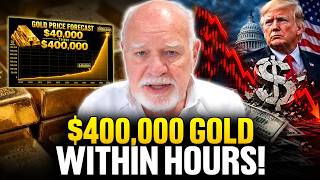
Under these circumstances , government authorities are expected to ban private ownership of gold, forcing citizens to surrender their physical assets at mandatory rates of around $4,500 per ounce. Governments are then supposed to revalue their national gold reserves to $45,000 , $100,000, or even $1 million, printing unlimited fiat currency to finance expropriations without financial loss to themselves.
think if I look at Western governments, and I'm not just singling out the US, others are in a similar situation. The solution, the long-term solution to the problems we currently face in terms of economic growth and stagnant living standards in the West, could be found by significantly reducing government; Let's say the government takes up 50% of the economy, we could reduce that to 25%.
But the voters, the electorate, they wouldn't want that, because people look at the subsidies they get, and they don't want to pay more taxes, but they want to get more benefits and so on . How can you come to pensioners and tell them that from now on your pension is 30% less than before ? How, how can you be elected with such a position?
And so, I believe that the only way to fix the system is not through voluntary government action, but through a crisis that will essentially destroy the system and the debts that exist within it . And this transition is like a complex surgery performed on a patient after an accident. Yes, I would say we need such an " accident" to clear the system.
Otherwise, it will not be cleaned . And the situation will only get worse, because the government's response to any problem is not to spend less, but to spend more. And strengthen your influence on the system. As a result, we get a planned economy, like under communism, where even your private property can be expropriated, that is, taken away.
This can happen in different ways. For example, regarding housing: you can raise property taxes so much that no one can afford to live there. Do you understand? Then you will have to move , say, into a government-subsidized apartment. This will lower your standard of living, because such buildings are usually poorly maintained, and so on.
In any case, we can move away from the market economy, from the capitalist system, towards something like socialism, communism, or fascism. Trump, if you look at his actions and behavior in business, is essentially a prime example of a fascist. Yes. You know, Mussolini-style. He wants to influence business, because when the government controls 50% of the economy, it has enormous power to distribute tax revenues: to this company or that, to this sponsor or another.
I would say the first reaction of governments would be to print new money. This is why I believe the stock market is rising and gold remains relatively strong, as money printing will benefit these assets. But in the case of gold, I see one problem: governments can declare that owning gold is illegal.
That you are obliged to hand over your gold. They will pay you some amount. Let's say today they can say, "Okay, we'll buy back all the gold at 4,400 or 4,500." And they can print that money to buy it back from you. Do you understand? This is not a problem for them. They can do it. And then they can revalue gold to 45,000, 100,000, or a million.
There are many more things the government can do. They can also take your bitcoins or take your house. I mean, if they could lock you up during COVID for no reason, just no reason. Government bond markets operate under intense manipulation due to constant liquidity injections by central banks and strict institutional mandates.
Commercial banks, insurers, and pension funds face strict regulatory requirements that force them to allocate fixed asset quotas to government securities, artificially supporting demand for debt. When monetary authorities lower base interest rates to 1 or 2%, institutions suffering from low yields are forced to buy long-term 10- year government bonds at 4.7%, rather than accept the near-zero return on cash.
Meanwhile, administrative authorities are adjusting official consumer price index statistics to prove that annual inflation is hovering around 3%. However, independent economic models show real cost-of- living inflation closer to 7–12% per year. By distorting inflation rates and controlling government bond yield curves, fiscal authorities conceal the erosion of real purchasing power in the macroeconomics.
Now let's get back to the interview. " Bond Avengers" is back to some extent. But you understand that in a money printing environment, you can influence bond pricing because if you inject money into the system, it flows through banks to various financial institutions, including pension funds, insurance companies, and so on.
And there are laws that require them to buy or own a certain proportion or allocation of assets, like 30% in bonds and 30% in stocks or whatever. But the fact that they are obligated to buy bonds supports the market. And when you have a bond, let's say we're looking at a 10- year bond or a 30-year bond.
A 10-year bond has, say, 5%, for example. Today it is about 4.7%. But if the government, through the central bank, lowers the federal funds rate to 3% or 2%, then I, as a bond buyer, have an alternative in the form of cash. I get 2% interest or I take a risk and buy a 10-year Treasury bond at 4.7%. Do you understand?
Through the central bank, governments can influence the bond market: not completely, but through the short-term end, and to some extent through the long-term end. I mean, if the central bank in the US now lowers the federal funds rate to 1%, then as an investor I would say to myself, "Okay, I can put my $10 million at 1% or at, say, 4.7%." Then I have an incentive to buy bonds.
I can, I can talk, I can fix the CPI numbers. I can tell people that CPI inflation is 3%. And other economists calculate it, say, as 7–12% per year . I think if people say to me, "Well, maybe this time it's different." I answer: “Yes, the economic losses will be very significant .” Because you know, let's say the bubble in, um, the dot-com sector was important, but it didn't affect the global economy fundamentally.
It caused some damage when it burst. But what we should pay attention to is capital expenditure, investment in the object of speculation as a percentage of the global economy. And at this time, investments in AI and related things can be compared in volume to investments in railways in the 19th century.
That's another matter. And I don't want to get into a discussion about what exactly that something else is. But on a grand scale, it is very important. This is the most important capital spending boom in the world since the construction of railways and canals in the 19th century. And when this bubble bursts, capital spending will obviously decline.
And the financial market will shrink. In other words, value estimates will fall. And both the reduction in capital spending and the financial market downturn will cause, I believe, essentially a depression. Global capital markets are currently experiencing a historic speculative boom in artificial intelligence infrastructure, the largest capital spending cycle since the construction of 19th-century railways and canals.
Whereas previous technological corrections, such as the dot-com bust, remained largely isolated, modern macroeconomic stability is directly linked to the sheer scale of these investments. When speculative investment manias of this magnitude run out of steam , the inevitable reduction in corporate capital spending and collapse in stock valuations, instead of restraint during deep recessions and increased regulatory control over private enterprise, transform market capitalism into centralized state planning and economic fascism, arbitrarily distributing taxpayer capital and undermining individual sovereignty.
The government is consistently dismantling private property rights through punitive increases in property taxes. By driving property taxes to unsustainable levels, governments are forcing independent homeowners into poorly maintained public housing complexes, permanently lowering living standards and consolidating political control over private wealth. alert, stay prepared, and continue to accumulate real assets.




Comments 0