
저자: Joe Bucher · 외국인
다듬은 글
채권 약세장과 중앙은행 정책
in the middle of an ugly bond bear market...
(원문 일부 구간이 중복되어 있어 앞부분을 기준으로 정리했습니다.)
I believe that's where prices go down and yields go higher. You and the rest of the world wait and wait and wait for a bond bear market. When will we see that? Well, that's the question of the day, and of the last several years, actually. We'll see it, I think, when central banks start to ease up in terms of their current policies—not only quantitative easing by the ECB and the Bank of Japan, but more tightening by the Fed and less reinvestment of Treasuries. That's the key question.
Yan Hatzius at Goldman Sachs is now linking those two tightly, as does Robert Kaplan at the Dallas Fed. How do you link yield changes by the Federal Open Market Committee with the balance sheet adjustments to come? How do you put those two disparate flows together? It's very hard to do that, and of course for the Fed as well. I know that Fed research, since they instigated quantitative easing, suggested that 75 basis points on the tenure was the ultimate result. Now, the exit—or the potential exit, which I've always been disparaging of—and the possibility that they really reduce their balance sheet. But if they begin to exit later in the year, they'll do it slowly, so we're talking about 5, 10, 15 basis points on the curve in the tenure, perhaps over the next year or two.
중앙은행의 유동성이 자산가격을 떠받친다
The important central banks I consider are, again, the Bank of Japan and the ECB. To the extent that they're pumping in a trillion dollars plus a year into the global economy and global liquidity, that's been critical for Treasury rates, critical for stock prices, and critical for all assets, because liquidity seeks a haven, and prices move higher as it does. Bloomberg News reported this morning that the ECB is going to cut its inflation outlook at this week's meeting. We're talking about what unwinding the balance sheet is going to look like. What's your timetable for that? When do you think we'll get to a more normal role for central banks?
Well, I hope later in the year for the ECB. The ECB's primary focus, as opposed to the Fed's dual or tri focus, is inflation, and inflation has not really picked up in the last few months, certainly in the euro area. So you can imagine they're simply not concerned and want to err on the side of caution. Perhaps later this year—I don't know. But as you know, I've been quite negative about the effects of central bank policies, not simply because they've raised asset prices in some cases into bubble territory, but also because they degrade business models such as insurance companies and pension funds, because they can't earn what they're supposed to earn against their liabilities. We're beginning to see that with Puerto Rico, Illinois, Detroit, and ongoing pension fund problems. It's the same situation with insurance companies; it's sort of masked, but as we move into the future, it will show.
성장률 목표와 재정정책의 한계
Get the sense that 3% growth is this administration's white whale—they talk about it so much, maybe they're willing it to happen. When you look at the tools at their disposal and what they're doing, are they using the right ones? Are they going down the right path to get to that level of growth?
Well, not yet. The proposals on fiscal policy, which I've been asking for, and others have for several years even under Obama, are certainly in the works. I'm suspicious of tax policy, but the trillion-dollar infrastructure policy may help. Ultimately, though, growth is a function of productivity, and productivity is a function of investment, and we simply haven't had that. My thesis this month on the investment outlook is that money is making money with money, but money doesn't lead to investment in the real economy. I think that's the problem Trump and the U.S. economy will face over the next several years.
금융억압과 미국 중산층의 저축
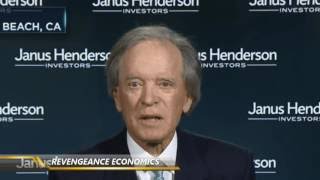
Bill Gross, with Janice Henderson, is with us now at our Bloomberg Invest conference on Bloomberg Radio, brought to you by SEI. Bill, I just looked up: if you book now, $235 Greyhound LA to New York—you can get it back if you delay a little. With Bloomberg Television, it may cost you $271. When you came here, you went out North Platte, through Des Moines, then got on I-80 and took it east. When you do this, you get a sense of the nation, and you've been dead right about the nation's financial repression. Don't talk to the fancy people in Newport or the fancy people like us in New York; talk to the rest of America about financial repression.
Well, you're right, and Des Moines has been my favorite metaphorical location, because it's in Iowa, it's the Midwest, there's corn there—and because people ultimately depend on savings, not just the one percent but the rest of the country. And why do people depend on savings? For education, for retirement, for health. When you can't earn more than 50 basis points on your savings in a bank account or a six-month CD, there are problems of plenty in terms of the ability of Des Moines and other middle-class Americans to reach their goals.
설명되지 않는 시장 구조와 로봇화
I look at this bill, and what you and I have been talking about since that meeting at the Waldorf Astoria and certainly since August of '07—it's not in the books that you and I studied on bond dynamics. How do you do it, Janice Henderson, day after day, realizing none of where we are now has a theory or a foundation? Well, it's a sort of braille-like process where you feel your way along, and central banks are trying to do that too. But you're right: when you talk about demographics, debt, and leveraging up, and when you talk about the displacement of workers by robots and robotization, these are non-measurable factors historically. You have to touch and feel and know that over time these factors will work their way into a slower economy in the U.S. and even globally.
인프라 투자와 민관협력
You were talking about infrastructure a moment ago. The president wants to get more private investment in infrastructure. What are the challenges to doing that, and how does he make it successful—getting more public-private partnerships, getting more private investors to invest in American infrastructure?
There's a political problem there, which isn't my area of expertise, but you're right: Trump's emphasis has been on public-private, and I think there are a lot of willing private partners. A lot of private equity firms have geared up to take advantage and make money from infrastructure problems. So if you combine that with congressional action, you have something to work with. But the trillion dollars is over a long period, and it takes time to put these into effect, so it may take a while.
워싱턴의 혼란과 경기 심리
Very quickly, Bill: does the drama of Washington diminish GDP and dampen the animal spirits of the nation?
Yeah, I think so. To the extent that risk is a factor in forward-looking investment—and hope is really the essence of capitalism—and to the extent that you have turmoil in Washington and turmoil on a global basis, I think that's a problem.
Bill Gross, thank you so much.




Comments 0