원문 보기
This makes a lot of sense. We also see a lot of tribalism in the cryptocurrency and digital asset industry. It's no wonder that in the institutional world , you know, the auto industry wants its auto stocks. They don't like to exchange ideas or share what they consider their own insight. The history of digital assets, of course, begins with Bitcoin.
You founded ARK in 2014 . Bitcoin already existed, but it was still finding its way. How did you initially approach this idea and what was your reaction to Bitcoin at the time? Was he ready for institutional asset allocation? No, not yet. In fact, we started studying and talking about Bitcoin at my previous company.
I brought with me to ARK the lead analyst who was most interested in Bitcoin. He is now our chief futurist, Brett Winton. I remember us talking about this at a previous firm, and it was just interesting . Okay, let's see what comes of this. In 2014, when I founded ARK, we did n't have five innovation platforms, but four.
We combined AI and blockchain technology into what we called the next generation internet . And that's actually still the name of ARKW, one of our funds focused on these areas. We did this because there was a breakthrough in deep learning AI. So AI was getting more and more attention, but it was still very new, very young.
As for blockchain technology, we were more interested, but we didn't yet know whether it deserved separate development or whether people would lose interest in it at all . We were very interested and wrote our first technical article about Bitcoin in collaboration with Art Laffer in 2015. We were simply asking the question: can Bitcoin fulfill the three roles of money?
That is, a medium of exchange, a store of value, a unit of account . And Art Laffer—I don't know if you know the Laffer curve, he's known for it in the area of fiscal policy, but he's also an expert in monetary theory. His mentor was Robert Mundell, who won the Nobel Prize for his monetary theory. We presented our thesis to Art, and from an economic perspective, he helped us tremendously .
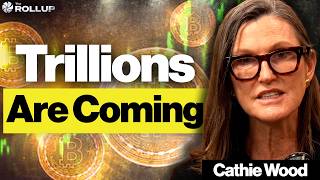
And I have an economics degree, so I began to understand Bitcoin deeply, because then he told me: "This is what I've been waiting for since the US closed the "gold window" in 1971." And I said, "Okay, Art, that sounds like a pretty big idea." "How big can this idea be?" And he said, "Well, how big is the US monetary base?" And then it was four and a half trillion dollars.
Today it is a little over six trillion. And Bitcoin had the equivalent of, we called it network value back then, $6 billion in market capitalization. Think about this. $6 billion, and he was talking about trillions. So I personally invested right away. Um, and we were looking for the best way to get access for our clients, and we had to, we had to ask for permission: the New York Stock Exchange, the SEC, you know, right?
We had to overcome some regulatory, uh , barriers or maybe obstacles. And we found GBTC, uh, and GBTC really, I think, had to go through a year of " maturation" before they were able to launch it. And uh, so that's where we started. Uh, bitcoin was worth $250 at the time . Uh, we opened our first position in the summer of 2015, when Greece was threatening to leave the EU, and we noticed that, wait a minute, every time a headline like that comes out, uh, Bitcoin goes up.
Hey, that's pretty interesting. It acts as a hedge. Uh, a hedge against catastrophe, and so, uh, we thought, wow, this could be not only an asset for risky investments , but also a protective asset . He could fulfill both roles at different times. So, uh, quite interesting. Yes. And Katie, I think looking back at that time , there was a lot of thinking that this would be, uh, adopted by the world's largest asset managers, institutions.
It's going to be, you know, a lot of the rhetoric was like, oh, institutions are going to come and buy Bitcoin from us, right? It's like we're, you know, finally participating in something earlier than the typical " residents" of Wall Street, right? And that was a big part of the rhetoric, and now it's 2026.
We see ETFs, we see the introduction of stablecoins, tokenized assets, we see a real explosion of permissioned blockchains, the world's largest institutions are launching pilots, real products, stablecoins, etc. And really, this convergence that we talked about at the beginning across all these different sectors, the main thing in digital assets is the institutional adoption that's working with this crypto culture and all the products and infrastructure that the industry has built over the last 5-8 years, actually, since Ethereum.
I'm curious about your assessment of the current state of affairs regarding this implementation from an institutional perspective, as it correlates with some pretty interesting sentiments within the industry itself. There is a lot of apathy, a lot of almost internal frustration from within, from crypto enthusiasts, people who should be believers.
Meanwhile, many newer users from large sectors, large firms, are frankly more optimistic. That 's right, you are one of them. Why is this happening and what is your vision for the state of implementation, as this industry has already grown and matured to some extent? Well, I think there are a few things going on right now.
And that was interesting. So, we opened our first location in 2015, and we were actually laughed at then. I believe. You may or may not have been in the industry at the time, but many thought it was just a marketing gimmick. And that's when I really realized: wait, we could be on the verge of something big.
When so many people make fun of you or just brush you off —and many did just that. This makes me even more interested in technology. So, we have a global monetary system, which is actually Bitcoin. Bitcoin owns this space. DeFi, meaning Ethereum, Solana, I think they are developing this space. Hyperliquid also gives them some competition.




Comments 0