원문 보기
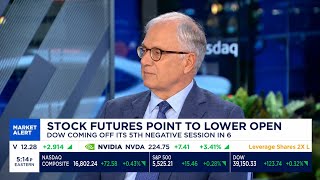
percent. Meanwhile, in the United States, 30-year bond yields have approached their highest level in nearly 20 years. This morning you are analyzing the situation. It is now 5.33%. Ed Yardeni joins us to discuss this and the state of the markets. He is the president of Yardeni Research. It was he who coined the term " bond avengers" that we have all used so often since then .
Ed, where are these "bond avengers" and are you worried? Well, the "Bond Avengers" were definitely very active in Japan. Japanese bond yields have increased significantly. The same thing is happening in the United Kingdom. Both countries have a large amount of debt relative to their GDP. By the way, the United States too.
The debt- to-GDP ratio in the US is very high. Although not as high as in Japan or the UK. I am worried. I believe that the 10- year bond yield has returned to normal. The norm is 4-5%, this was the range we had before the great financial crisis. So when we look at how far back we have to look to see current levels of returns, we go back to a period that I think was much more normal than the one between the great financial crisis and the great virus crisis.
But now there is reason to worry that the indicators may go outside my range. I don't think that will happen. I think at 5% there will be a lot of buyers, as we saw in 2023. There are many sectors of the economy that have been waiting for bonds to return to the " new normal," that is, to the lower levels that we have.
We were just talking about Home Depot and how people aren't using their home equity lines of credit the way they used to. You can look at all the debts that are accumulating in hyperscalers and other companies. All of this activity is based on the idea that 4-5% is the limit, and higher rates are not necessarily expected.
Yes, I think the bond market is finally working the way it should . It allocates capital efficiently. This was not the case when the Fed was effectively manipulating the bond market by keeping yields close to zero by cutting the federal funds rate to zero. So, this is to some extent a return to market interest rates.
Now, of course, this also means that the “ bond avengers” have much more freedom to express their opinions than when the Fed controlled everything. And they are, of course, worried about debt. They are concerned that the Fed may not be monitoring inflation closely enough. They are worried about the price of oil.
Apparently, the Strait of Hormuz is still, uh, not a safe passage. So, the concerns are there, but ultimately, the bond deal wouldn't have happened if the economy wasn't doing well. So I see this as a vote of confidence in the strength of the economy. I meant to say that you listed a long list of problems but remained quite optimistic about the future of stocks.
Yeah, I mean, a lot of it has to do with, uh, profits. The economy has been extremely, uh, strong, and that's been transforming into what I call " femmo"—fabulous earnings momentum , to distinguish it from " fomo," uh, fear of missing out. “ FOMO” is roughly what we had during the “bubble” in 1999 .
I don't think we have that situation right now. Okay, describe it. Let's dig into this a little bit, because there are two camps here too . Some people say it's very similar to the huge accumulation we've seen and the many events that are happening. You have n't thought so for a long time. You have long been convinced that this is some kind of turbulent "bull" market.
Yeah, well... And you were right up until this point. Yes, I call it the " stormy 2020s." I, of course, am drawing an analogy with the 1920s . Skeptics object, "Well, that did n't end well." And Andrew wrote a wonderful book about this whole experience. But we have tested the economy for strength many times, even with tariffs.
And tariffs were one of the factors that caused disaster at the end of the turbulent 1920s. What exactly? Smoot-Hawley law. Yes, Smoot-Hawley was adopted in May... 1930. In May 1930. Look at the charts: commodity prices have collapsed. Lending collapsed. Everything that could go wrong, did go wrong.
This time we had something similar. Maybe not so strict. We had no response. We didn't have the same experience. in many of these cases, funds are refunded. Yes, that's right. So, tariffs are actually incentivizing. Yes, if you think about it, you have hyperscalers stimulating the economy with huge capital expenditures.
You have baby boomers like me . I still work to support myself, but many of my friends are retiring. And the baby boomer generation collectively has about a hundred trillion dollars in net worth. And when they retire, you know what? Their disposable income becomes zero because they no longer receive a salary.
And they live off their savings. This means that when interest rates rise, they are actually happy because they have money market funds, whose returns are rising. They're not particularly concerned about the job market, because you know what? They are already retired. So there is significant resilience in the economy , which is reflected in profits.
Analysts currently expect S&P 500 earnings per share next year to be $408, but that figure is rising every week. And I think it will reach 415 by the end of the year. Ugh. Multiply that by 20.2 or so and you have 8,400 by the end of the year. So, full steam ahead for you in the stock markets , but you are a history buff.
What are the red flags that you're looking for that could be ... Well, you know, I find that when you make a list of things to worry about, and I update my list regularly, it helps to stay disciplined in your thinking. Nvidia just made a move that could be much more serious for open sourc Nvidia purchase of another AI company.
Perhaps Nvidia wants to secure a place for itself at every important level of the AI stack. competitive environment is changing. OpenAI, Anthropic , Google, and other major AI developers are increasingly turning their attention to entirely on companies to build the biggest AI models, Nvidia is moving deeper into the ecosystem where developers directly discover, build, and deploy the corporate customers.
Think of it as a huge meeting place for the open source AI community. Nvidia now wants to own a much larger share of this meeting place. could lose some of its hardware demand. in the Nvidia ecosystem, the more opportunities Nvidia has to sell computing power, networks, software, and infrastructure.
And this is the flywheel. More developers means more models. More models means more AI applications. More applications means more demand for computing. And more computing ultimately means more Nvidia infrastructure. And that's another reason why this deal smaller company doesn't necessarily have to have billions of dollars to train its own advanced models from scratch.
It can start with around them . And this can accelerate the adoption of technology by businesses. And Nvidia wants to take a position around all this expansion. But there are certain competitive nuances. Amazon, Google, Microsoft —they are all developing their own chips. And hyperscalers are seeking greater control over infrastructure cost Nvidia hardware even while alternatives are being developed .
And 's trying to make it harder to ignore her. And there is another important point. The implementation of AI is at a very early stage. The industry is simultaneously witnessing cheaper models, explosive growth in the number of users, huge infrastructure costs, and rapid improvements in equipment. This means that it is still difficult a few years.
But Nvidia is clearly preparing for many scenarios . If closed AI models dominate, Nvidia has already provided the infrastructure. If open AI models explode, Nvidia now has a deeper presence there. If enterprises start to aggressively implement AI, Nvidia has has already carved out a niche for itself there.


Comments 0