원문 보기
The man who saw the 2008 crash before almost anyone just placed one of the loudest bets of his career. The target is not a bank this time. The target is artificial intelligence. His name is Michael Burry. If you saw The Big Short, you know the character. The doctor turned investor who shorted the housing market and walked away with a fortune.
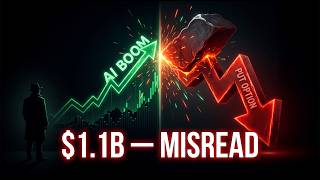
For years, he went quiet. Then in late 2025, the filings landed and they were not subtle. Burry's fund had bought put options. A put is a bet that a price will fall. He held puts against 1 million shares of Nvidia. He held puts against 5 million shares of Palantir. Two companies at the absolute center of the AI story.
Together, those positions carried a notional value of roughly 1.1 billion dollars. About 80% of his reported portfolio pointed in one direction, down. Now, here is where most headlines get it wrong and we are not going to. That 1.1 billion dollars is the notional value. It is the size of the bet on paper.
It is not the money he actually put at risk. When you buy a put, you pay a premium. That premium is the most you can lose. On the Palantir puts, reporting suggests he spent around 9 million dollars in premiums. 9 million, not 900 million. So, when you hear the phrase bet big, hold that thought. The exposure is enormous.
The cash truly on the line is far smaller. Both things are true at once. So, why is Burry doing this? His thesis has a name he keeps returning to, depreciation. Stay with me because this is the heart of it. AI runs on specialized chips, mostly Nvidia's. These chips are expensive and they wear out fast.
Burry argues their useful life is maybe two to three years. Nvidia releases new, faster chips almost every year. Each release makes the older ones look slow. But here is Burry's accusation. The big cloud companies are not writing those chips off over two or three years. Microsoft stretched its accounting from four years to six.
Meta moved to around five and a half. Google, Amazon, and Oracle made similar moves. Why does that matter? Because the longer you spread out the cost of a chip, the smaller the expense looks each year. And the smaller the expense, the bigger the profit appears. Burry's claim is blunt. He says the industry is making its earnings look better than they really are.
His estimate is around $176 billion of understated costs between 2026 and 2028. Now, that number is his calculation. It is a prediction, not a proven fact, but it has not happened yet. Burry goes further. He points to what he calls circular financing. AI companies invest in each other. They trade computing power for equity stakes.
Money and chips flow in loops between the same handful of players. To Burry, that rhymes with the dot-com era. Back then, a company called Lucent lent money to customers so they could buy Lucent's own equipment. The demand looked real. Some of it was just money going in a circle. But here is the part an honest channel has to say out loud.
Not everyone agrees with him. The AI cloud provider CoreWeave pushed back. It argues the longer chip life is justified. It says even older Nvidia chips hold most of their value under long contracts. Nvidia itself rejected the bubble claim. The company even name-checked Burry in an internal memo. So, this is a genuine fight over accounting, not a settled case.
Now, let's talk about the comparison everyone reaches for, Nvidia today versus Cisco in the year 2000. In 2000, Cisco made the routers and switches that built the internet. It was the backbone. The stock soared, then collapsed and never fully recovered. Nvidia is the backbone of AI. The parallel is tempting.
Both are picks and shovels companies in a gold rush. Both saw a massive building boom. Both had that circular vendor-style financing swirling around them. But, an honest analogy also shows the differences, and they are big. At its peak, Cisco generated a little over $1 billion of cash flow per quarter.
Nvidia is generating around $25 billion of cash flow per quarter. Cisco's customers were fragile dot-com startups that ran out of money. Nvidia's biggest customers are the richest companies on Earth. At the top of the dot-com bubble, the Nasdaq traded at nearly 79 times forward earnings. Today, that number is closer to 25.
So, the Cisco comparison is a lens. It is a way to think about risk. It is not a prophecy. The fundamentals underneath Nvidia are far stronger than anything in 2000. That does not mean the stock can't fall. It means the story is not a copy-paste of history. Then, Burry did something strange. In November 2025, he shut down his fund.
He deregistered Scion Asset Management with regulators. The man who just made the loudest bet of the decade walked away from the machinery of managing money. But he did not go silent. He went to Substack. He started a newsletter called Cassandra Unchained. Cassandra, the figure from myth who saw disaster coming and was never believed.
Here in 2026, we can check the scoreboard. And it is a mixed picture. Let's be fair about it. Palantir did pull back from its wildest highs. Reporting suggests his Palantir put position was up around 35% from where he entered. That part of the trade worked, at least on paper. But Burry had floated a target.
He suggested Palantir could fall toward $50 a share. By mid-2026, Palantir is trading around $130. Well above his target. And Nvidia? This is the hard part for the bears. Nvidia did not crash. Nvidia climbed. By July 2026, it trades above $200 a share. His puts had a strike of 110. That position is deep underwater.
So let's say the quiet part clearly. As of mid-2026, the AI boom did not collapse. The title of this video is Burry Spat. It is his thesis. It is not something that has come true. In early 2026, he posted a cryptic line. Shorts are not forever. Some read it as a hint he was heading for the exit. A quiet victory lap on Palantir, perhaps.
But we do not know his current book with certainty. After he closed his fund, he stopped filing the official reports. What we hear now comes from his newsletter, not from regulators. So, treat the latest positions as his word, not as verified filings. And that brings us to the twist, the real one. That newsletter, Cassandra Unchained, costs $39 a month.
By July 2026, it crossed 300,000 subscribers in just 231 days, the second most popular finance publication on the entire platform. If every subscriber paid the full annual price, that would be over $113 million a year. Now, hold on. That is the ceiling, not the reality. Most subscribers on a platform like this are free readers.
Realistic estimates put his actual recurring revenue in the low millions, not over 100 million. But, sit with the irony. The man built his name shorting bubbles. His billion-dollar bet against Nvidia is losing. His bet against Palantir is only halfway there. And his single most reliable money maker right now,
selling the warning itself. The bubble call became the product. So, what do we make of all this? Michael Burry might still be right. Bubbles can take years to pop. He was early in 2007, too, and early looked wrong until it looked genius. Or the AI build-out might be different from the last mania, exactly the way its defenders argue.
Stronger companies, real cash, real demand. This channel does not give investment advice. We are not telling you to buy anything or to sell anything. We are telling you a story about conviction, about a man who looks at the most loved trade in the world and says, "Not so fast." Maybe he is Cassandra, doomed to be right and ignored.
Maybe he is the boy who cried wolf and the wolf never comes. For now, the boom rolls on and the man betting against it is making his best money by telling us it will end. If bubble stories fascinate you, that is exactly what this channel is built on. We will be watching this one closely.




댓글 0