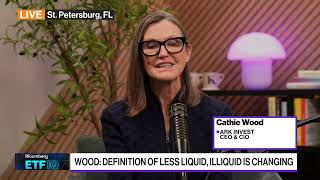
저자: CathieWood · 외국인
요약 보기
캐시 우드는 SpaceX·xAI 합병과 상장 가능성에 낙관적이며, ARKVX 내 SpaceX 비중(약 7.5%)을 유지하고 상장 시 공개 비중만 늘린다고 밝힘. 사모 자산의 유동성 분류와 ETF 편입 제약(15% 한도)을 논의하며 규제·세컨더리 시장 변화를 언급. 달러 약세(디베이스먼트) 트레이드는 잘못된 해석이라 주장하며, 미국 탈규제·감세로 미국 내 투하자본수익률이 상승해 달러 강세 가능성을 시사. 금과 비트코인의 상관관계는 낮고 과거 사이클에서는 금이 먼저 상승했다고 언급. 후계 체계는 견고하다고 강조.
다듬은 글
Let's start with your holdings in your venture fund because I'm taking a look. It looks like your second biggest holding is SpaceX of course as we know that is a private company uh one of Elon Musk's company right now in talks to potentially merge with XAI and in talks potentially to IPO later this year.
I mean as you digest these news events, how are you feeling about your current slice in SpaceX which I believe is about 7 and a half% of this fund? Yes, we're feeling great. Uh especially the rumors are we have no idea if it will go out at 1.5 trillion. Again, rumors, rumors. Uh but SpaceX has big ideas.
Uh orbital data centers being the latest. Uh and uh and XAI, which we also own in ARKVX, uh is going to become a part of this ecosystem. We do believe and I think we're getting more information now uh that this is becoming more and more likely. So when SpaceX does make its debut on the public markets, when it lists, when it IPOs, what does that do to your fund?
How do you respond to that? Yes. Uh the wonderful thing about ARKVX and uh interval funds generally in terms of the way we've constructed this one uh is that it's 20% roughly 20% public 80% private uh and when SpaceX goes uh we will uh obviously uh bump up the public position but we don't have to sell it.
Um, now, uh, it would be unusual if all of these names, SpaceX, Anthropic, XAI, if they all were to go public, uh, yes, we would want to diversify into more private names, but we don't have to sell right away. Uh now the other thing that's uh that our companies really like is that uh they can see we have 30 billion dollars of assets under management and and most of those are in the public equity market.
So uh we will be feeding these names into our ETFs uh as as time goes on. So Kathy, let's talk about this conundrum, right? This is the mo one of the most fascinating topics to me that I'm writing about. You've got all these stocks. You have 500 million. Meanwhile, there's been three ETFs that have sort of I don't know we call bend the rules or whatever, but they've added privates into their fund.
XOVR immediately 1.5 billion. A crane shares ETF has two privates. And then Ron B added 22% of SpaceX and immediately assets jumped 50% in a week. Clearly the demand is to get this in the ETF format, but it's not the right format. How is this going to play out? It's going to be very interesting. Eric, thank you for doing uh the research on this and uh and this space is moving very quickly.
Uh the reason we chose the interval fund format uh was we could have more than 15% of our fund in illquid assets. Uh now it may be that the definition of illquid is changing. Um, I know we actually have gone to some of our uh our private companies, the ones in the interval fund, saying, "Hey, we'd love to add you into our ETFs um because we think this is such an important story.
All we do is focus on disruptive innovation. You are one of the biggest disruptors, let's just say SpaceX." And what we found over time is that they have been reticent. So, something is changing here, Eric, and it would be very interesting to get to the bottom of it. The SEC, of course, is um is deregulating.
So, that could be part of it. Secondary markets are beginning to grow, meaning private shares on secondary markets. Uh so, there's access there. Uh so maybe this uh definition of illquid or less liquid is uh is changing here. Yeah. Our understanding and Bloomberg Intelligence's understanding Kathy is that basically Baron uh classified their SpaceX holdings as less liquid rather than eliquid.
Uh as we were talking about, we're learning that that comes from the issuer rather than the SEC. But you also make another interesting point when it comes to the private companies themselves maybe being a little bit reticent to be in a vehicle such as an ETF. Of course, we talk about it from the issuer perspective all the time.
So interesting to hear it from the perspective of the companies, but you mentioned that, you know, when it comes to going ahead of that 15% cap in an ETF that that's not something that you necessarily want to do, but have you thought about adding perhaps less than that? you know, in the realm of five to 10% into an ETF.
Yes. Uh we we certainly have thought about it. uh so much so that we've gone to the companies uh and as I said there at least when we went to these companies there was some reticence uh because there in in the worst case let's just say uh black swan the public markets go down dramatically these these private positions are are not marked to market every day they could end up easily well above uh 15% % and then what what would uh a fund be faced uh doing uh trying to find a secondary market?
Now maybe the secondary markets are becoming more liquid themselves. They're they're much more liquid today than they were when they first started maybe five, six, seven years ago. Uh so we've been I would say from a compliance point of view very careful. Uh and then you know our market makers are also trying to figure out what to do with this.
How do they price in real time when at any minute something crazy could happen uh uh coming from one of these private companies. So uh there there there's a there are some ecosystem challenges here. Some ecosystem challenges and it's something that we will be watching for. Certainly it's an evolving story.
Kathy, I do want to get your take on what a lot of people are calling the debasement trade, the effort to diversify beyond uh the US dollar and US dollar assets. Uh moving to other assets like precious metals specifically as a hedge against the dollar. What's different this time around from what we saw last year is that crypto is not part of this.
It's not getting uh the bid from folks who are looking to diversify, who believe in this debasement idea. How do you think about that? uh a a couple of uh thoughts. I've been writing a lot about it recently. Um I think uh if you look over time, if you look for the last five years and you do a correlation between gold and uh Bitcoin, you'll find very little uh correlation at all.
uh what you will see if you look back a little further, the last two major cycles for Bitcoin uh were preceded by the gold price uh increasing first. Uh now I think what's going on this so-called debasement trade if I if I can just back up a little bit uh I think is misplaced. uh and especially when we think about the dollar, if you put the dollar into perspective, uh you will see that over the years and in recent years, it's toward the higher end of its range against other currencies.
And we think that the combination of deregulation here in the United States, big tax changes, especially for corporations, uh, and very business and capital friendly policies here in the United States. We think because of those, the returns on invested capital in the United States are going to go up relative to those elsewhere in the world.
And this we think is because Trumpanomics, if you want to call it that, is uh is like regonomics on steroids. If you look at what happened to the dollar under Reagan, it it doubled. It nearly doubled. Uh so much so and so quickly that we ended up in the Plaza and Louver Accords to try and get it down.
So I think it's a little misplaced. Kathy, um, we had Todd Stone, thank you for explaining that, by the way. We had Todd Stone of, uh, Strategus on with us last week, and he was talking about the keyman risk idea for funds that are tightly tied to their star managers. And you're nothing if not a star manager.
Take a listen to what Todd said. Think of Arc. Kathy Wood is the Arc. She's the face of that company. What happens when Kathy says, you know what, I'm I'm moving on or whatever it might be. This is going to be really interesting over the next 30 years of all these established players coming into the ETF market and you're going to lose these key mankey key women risk type there.
Key woman risk. I I'm just curious about the state of your succession planning over at Arc Invest if that one day you want to move on to do something else. Oh my goodness. Uh I can't imagine that day. Let's just say that to start. Uh but we have um a very firm succession plan here. the way we've set up the firm uh with directors of research, a chief futurists, analysts, research associates, and really the the equivalent of investment committees for each of our funds.
Um, I think any due diligence effort uh would look at what we've done here at ARK and uh be pretty reassured by Head.


Comments 0