저자: RakeshJhunjhunwala내용요약영상—발표자미상 · 외국인
요약 보기
故 라케시 준준왈라의 투자 이력과 철학을 소개하는 요약 영상으로, 영상 내에 앞으로의 가격 방향에 대한 예측 발언은 없음. 생애와 배경: 1960년 하이데라바드 출생, 아버지는 인도 세무 공무원. 시딘햄 칼리지에서 공인회계사 자격 취득 후 주식시장 진입. 초기 투자: 초기 자본 5,000루피, 형 고객에게서 20 lakh 대출(연 18~24% 이자 제시). 타타티(Tata Tea) 5,000주 매수로 3개월 내 3배, 타타파워에 장기 배당 투자. 주요 베팅: 세사고아(Sesa Goa) 철광석 관련 레버리지 투자로 큰 수익. 1991년 마드후 단다바테 예산안 발표 당일 하락 베팅 및 일부 헤지로 포트폴리오 10배 수익. 공매도 및 타이밍: 1992년 하쉬드 메타 주도 급등장에서 차익 실현 후 공매도로 추가 수익, 'Markets can remain irrational longer than you can remain solvent' 인용. 2000년 IT 버블: 인피니에 고PER 매수 거부, 가치주(공기업 등) 중심으로 버블 붕괴기에도 손실 최소화. 2002년 인도 장기 강세장 전망 발표, 2004~2008년 센섹스 5,000→20,000 상승기에 타이탄, 크리실, 유나이티드 브루어리스 등에 투자해 막대한 수익 실현. 'Big Bull of Dalal Street' 별명 획득. 투자 철학: 역발상 가치투자, 경쟁우위 보유 기업 선별, 소형주 중 대형주로 성장 가능한 종목 장기 보유, 인도 성장 스토리에 대한 낙관. 타타그룹 종목에서 큰 수익을 얻었다고 평가. 결론: 시장 예측보다 원칙 있는 장기 가치투자와 인도 경제 낙관론을 강조하는 회고형 콘텐츠.
다듬은 글
Have you ever thought of someone who can compound his wealth at the rate of 62 percent CAGR for 37 years?? Was that done by George Soros of Quantum fund or Peter Lynch of Megallan fund or Charlie Munger of Berkshire Hathaway Bill Ackman of Pershing Square or the Oracle of Omaha himself Warren Buffett None of the above he is an ace Indian investor who is also known as the Big Bull l of dalal street Mr Rakesh Jhunjhunwala Mr rakesh jhunjhunwala has astronomically grown his wealth from rupees 5000 in 1985 to rupees 30 000 crores in 2022.
with a compounded rate of 62 percent CAGR .The only man to achieve a greater return than him is Jim Simons of Renaissance Technologies with a 66 percent CAGR but he did it with a team of super bright mathematicians and physicists who developed techniques and algorithms to trade the market with accuracy and managed other people's money.
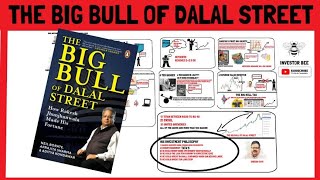
Rakesh Neither had a big team nor he managed someone's else's money, he did it with his own money and intelligence.Do you wonder how he made this incredible journey possible??Let's dive into the summary of the Big Bull of the Dalal Street This is the summary of The Big Bull of the Dalal street written by Neil borate Aparajita Sharma and Aditya kondawar and presented to you by the Investor Bee.Early years, was born in Hyderabad on 5th July 1960.
His father was an Indian Revenue Service Officer hosted in Hyderabad at the age of two jhunjhunwala's father shifted to Mumbai and family spent the rest of their life in Indian Financial capital. Rakesh's father took interest in stock market despite his steady career as a civil servant Rakesh was also fascinated by the stock market and would always ask his father why prices of stocks went up and down Daddy?.From an early age he showed interest in stock market and who knew then that this curious chubby boy would one day go on to become the most successful investor of India Rakesh studied at Sydenham College in Mumbai and qualified as a chartered accountant.His father told him to do so because he thought if stock market career doesn't work out his CA practice will generate a steady income.Back then people had a view of stock market as a speculative Arena .There was lack of financial wisdom regarding stocks moreover there were systems which were not transparent as Indian economy was not that open to technology and many reforms were due.Rakesh's father was no different, he was skeptical about his son's chosen career and even told him not to expect him to give him any money for stock market investing Entry into the stock market Rakesh had an initial capital of rupees 5000.He managed to get a loan of rupees 20 lakhs from his brother's clients who was also a practicing chartered accountant At the time when fixed deposit interest rates were 10 percent Rakesh would offer 18 percent and go to the extent of even 24 percent per annum to get his initial capital This was highly risky as a few bets gone wrong would have ended his career but God had different plans for him.He earned a whopping return of rupees 25 lakhs in the first year of his career How?
let's get a closer look.His first stock was Tata Tea which he bought 5000 quantity at rupees 43. the stock Rose to rupees 143 within three months multiplying his money three times over This was merely a speculation. later he bought Tata power 5000 quantity at the time when power companies were getting fixed return as per electricity Act.There was 100 utilization of Tata power capacity which convinced him that he would at least get the dividend of rupees 18 on a price of rupees 150 per share which was equivalent to 12 percent on investment later on he could buy the shares of Tata power when dividend yield was staggerring 30 percent.
he couldn't have lost money then so he stayed put in tata power a majority of his portfolio Here he did like a veteran investor where he would not lose money even if the price of stocks move down.This is the benefit of dividend stock if after analysis one finds that dividend income would continue in coming years then investment basically becomes quite safe.Later on when his net worth reached 50 to 55 lakhs he bought shares of Sesa Goa and iron ore Mining Company At that time next year prices of iron ore were set a year in advance and Rakesh knew it could be 26 percent higher next year .Sensing the big opportunity he leveraged himself and bought shares double his net worth of rupees 50 lakh Rakesh was right again .Price went from 26 to 65 in three months and to 2200 in three years ,we don't know when he exited the shares but by then his net worth reached 2 to 2.5 crore Indian rupees A 10 bagger .Have you ever made a 10 bagger in one day that too not on a single stock but on the whole portfolio.Is it even possible to do that ??Nothing was impossible for Rakesh It was at the time when Madhu Dandavate then Finance Minister in the V.P Singh government presented his budget.
Market was unduly pessimistic as Dandavate was considered a socialist. A socialist is someone who supports a political or economic philosophy that says society as a whole rather than private companies should own and control various goods and services Rakesh thought differently.He knew VP Singh then prime minister was a businessman and would not allow Market unfriendly budget and again he took a leveraged bet on stocks before the budget day He hedged his position by shorting some stocks .Hedging is a process used to protect against losses if the direction of stocks move opposite to the assumed Direction Next day when budget was presented his portfolio skyrocketed from two crore Rupees to rupees 20 crore rupees He made a killing.A 10 bagger that too on his complete portfolio.
Rakesh's first Big Short. Shorting is a process where you benefit by the stock falling in price rather than the rise in price. Shorting is selling the stocks that you do not own by borrowing them and in return you pay some interest to the person who has lent you the stock ,you must also return the stock to the lender by the stipulated time which means you must buy them back from the market.
When Market Rose from 1000 points in January 1991 to 4000 points by April 1992 Rakesh made a lot of money in the rise but at some point he sold his Investments According to him a four-fold jump was not backed by economic fundamentals. This was harshad Mehta driven boom in the stock market which included scandals.
One day The Economist ran an article as have you heard of Saddam Hussein. Magazine wondered why all Global markets were falling except India. Rakesh was alert , he always believed that shorting should be accompanied by timing otherwise there is no height in which the shares would go There is also a saying by John Maynard Keynes Markets can remain irrational longer than you can remain solvent .It was the right time to nail it and he shorted the market This time again he made a lot of money.His net worth reached 200 to 150 crore rupees A matured value investor.
in 1998 a new Bull Run began in stock market Sensex Rose from 3000 points to 5313 in February 2000 but the action wasn't technology stocks He did not make any money in the tech boom because he was more value investor.There is a constraint you impose when you are a value investor and only buy things that meet certain tests Buying infosys at 50 times earnings or 60 time earnings didn't make sense to him.
His focus was on public sector companies which were reasonably priced and the people who were making money in the short term in tech stocks would bully him soon to realize that how wrong they were. When most investors lost money in the tech burst of 2000 Rakesh remained unaffected.Neither did he make money nor did he lose much The big bull tag Rakesh gradually changed his style from short-term trading to more long-term investing and laid the foundation for a spurt in his wealth in the coming boom.
Rakesh was an optimist , he firmly believed in the Indian story. One of the Rakesh's most famous call was one in 2002 that India was on the cusp of long structural bull market.Investors were shocked and surprised at his optimism.He even wrote an article in the economic Times. It was a period of Bloom and doom It was in these confusing years that made most of his fortune In this period Rakesh bought TITAN between rupees 20 to rupees 40.
and he started buying Crisil ,United breweries was another buy and rest is history. Sensex Rose from 5000 points from 2004 to top out at around 20000 in January 2008. Rakesh made huge money during this period which is when MEDIA labeled him the BIG BULL OF DALAL Street His investment philosophy .Let's take a look how Rakesh JHUNJHUNWALA went about searching for Investments.
Rakesh invested when other people were pessimistic in other words he was a deep value investor not too confuse with bad quality stocks and dishonest managements he would give management all the credit for his wealth.He has always credited TATA's for majority of his wealth may it be Titan Tata Motors Tata coffee or Tata power He would invest where opportunity exists naturally .He would then look for the company's Competitive Edge to get the maximum benefit of the existing opportunity.
He would invest in small cap companies which can become large cap and he would invest for long term to achieve that .This was his Mantra of investment Although Mr Rakesh jhunjhunwala is now no more with us but his investment philosophy, his never diminishing optimism regarding India and his cheerfulness will always be remembered. Cheers guys

Comments 0