
원문 보기
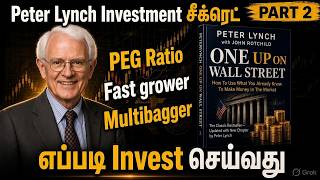
Hello Investors, I'm going to talk about Part One of this book, which is a beautiful explanation of how to invest in the Open Wall Street book by Peter Lynch, in a way that even the average person can understand. ActuallyFirst, our Tamil investment community, who have been investing by watching our YouTube channel, should first order this book.
Start reading this book. Peter Lynch explains so beautifully that even laypeople can understand how to look at a company, what to look for, how to buy, and what to invest in. Who was the first Peter Lynch? Peter Licht was also a mutual fund manager. The mutual fund he was managing was called Megal Fund .
He managed a company called Fidelity Investments from 1977 to 1990. The first book he wrote, One Unwall Street, was the one that gave the investor a huge return of nearly 29%. This is why he would have explained in an easy-to-understand way how we should look at a company and invest in it, what to watch out for, and what to avoid .
In this video, I first explain this in Part One . I'll explain it to you in more detail in Part 2 . Watch this video until the end. Investing in businesses that we know about is not enough. Don't invest in an unknown business. That's what the Beatles say. Invest in what you know, that is, invest only in what you know.
Now let's go to our supermarket and see people consuming all these products . If we know that no matter what price the company increases, consumers will consume it in their everyday lives, we can trust that the company will always exist. So, he says to only invest in businesses that we know about . He says to avoid unknown businesses .
So invest in what you know, that's what we need to have an edge over . We shouldn't get stuck investing in a business we don't know about . He says that the retail investor has the knowledge to know why this trend works, even before the Wall Street analyst knows it . When you go to the supermarket now, what products do people buy the most?
A consumer retail investor is the first to know that no matter what company's product is selling the most, people will buy that product . So we know that now a company that does business with a product cannot exist without that product . People will buy this product no matter what the price increase.
So this is what he says about investing, this is what he knows about the edge that retail investors have. He says, "Nobody wants to know what business you've invested in and why you've invested." I have invested in this business. If you thought that this company's shares would last forever, you would have invested in it.
This is why I invested. This will pay good dividends. They'll give you a nice bonus . This is a blue chip company. If it weren't for this company, India wouldn't exist. That's why I'm here. That's why he says, " No, no, no, why are you doing this, why are you sharing this?" He says, "We want to know." What Peter liked was this boring investment, meaning that boring sectors beat up and down stocks do good business.
It should have a boring name. Doing boring business. What is boring business? Now, there is a company called Boring that makes some of the things that India needs, meaning we will also be Boring. But they will continue to make good profits and do good business . They should have paid a good dividend.
Take ITC cigarettes for example. Well, what Peterlin is saying is that he likes the cigarette business, which has negative growth, because it would be a good investment. No company will come to the competition . If you look in India now, only ITC and Godrej Flip are in cigarettes. IDC is the only market leader in this.
IDC is the only one that is selling India full-time. No one, Ambani or Adani, will disturb this business. They won't come to mind as if they are interested in that profit. The government can impose taxes if it wants. Even so, they would have fashioned that taxi for that customer . They say this is a motor by increasing the price.
Invest in boring business. A good example of this is a boring business, a company with a boring name, Kubit. Look at what kind of return a share of Kubit gave over the years. That company was doing a boring business. They were doing only one business, that is, a company that was manufacturing a product that was controlled by Bertha.
It gave a terrible return . The name they had was also a boring name. The business they were doing was a boring business. No one would say that much about that product outside . But everyone will use it . So Cupid is a good example. For a boring boring investment to yield a good return, that boring company must be a company with good fundamentals and good business.
That's what they call betalin. Big companies only give small moves. He says that small companies will make big moves. That means that the company, which has already grown and become established, will have already run up and finished. He says that he is a slow-growing stock and business . Similarly, if a small company is doing good business and has a good path for growth, then it will do well .
That is, he is talking about a small company, namely Fast Kroyer . He says there is a chance to give a good return . He comes here and says he is a fast climber. This is the most important thing to consider when investing: debt. Peter Lynch says that a company without debt will never fail . And that's because a company with more cash reserves is going bankrupt.
A company should not have debt. The company we invest in must be debt-free . If a company has a good cash reserve, that company will never go bankrupt . That company will always be in business. He says he can face any problem. Even if this is only set for some businesses, everyone would say that this debt to equity ratio should be below one.
So, getting into debt is really, really bad . It would be great to have a debt-free company . Peterlin is very fond of a company, a company that can turn on the customer by raising prices, a company that the customer will buy no matter what, and he comes and says it's a terrible investment. That means there should be a company that can pass it on to the customer even if the cost increases .
Whatever it is, if that customer buys it, it will be a great investment. That's what the company says. He also says to avoid unnecessary stock market noise. How is the stock of the company we invest in performing? Is that company performing well? That is why we should concentrate on this, but we should not base any of our decisions on the current interest rate, the current crude oil price increase, or geopolitical issues.
Because there will always be some issues. All we need to look at is how the company we are investing in is performing . This future prediction of interest rate hikes and crude oil prices is all a temporary issue. This will not have any impact on the stock price in the long term. He says that all we need to look at is how the company is performing.
What I saw in the first part was just talk. How to find a multi-packer in One App Whats Part 2 video . In Part 2, we will see Peter Linlin's company classification, i.e. whether a company is a slow grower, a stagnant grower, or a fast grower. How he makes us classify it, as well as some important points about which sectors to avoid .


Comments 0