원문 보기
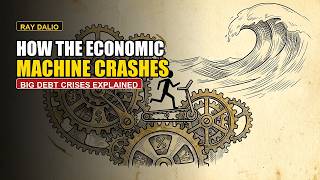
Most people view the global macroeconomy as an incomprehensible maze of financial jargon, quantum algorithms, and chaotic randomness. But billionaire hedge fund titan Ray Dalio views it entirely differently. In his masterpiece principles for navigating big debt crisis, Dio explains that the economy operates like a remarkably simple mechanical machine.
It consists of a few basic moving parts and countless repetitive transactions driven by timeless human psychology. By understanding how credit creation expands spending and how debt burdens inevitably compound, you can predict economic cycles, protect your life savings, and capitalize on downturns while others panic.
An economy is simply the sum of all transactions that make it up. A transaction occurs every single time you buy something. You give money or credit to a seller in exchange for goods, services, or financial assets. If you can understand transactions, you can understand the entire multi- trillion dollar world.
All cycles, all stock market surges, and all financial panics are driven by one fundamental reality. One person's spending is another person's income. Every dollar you spend becomes a dollar earned by someone else. Credit is the most volatile and dangerous component of the machine. When you buy something with credit, you are not merely borrowing from a bank.
You are borrowing from your future self. You create a future period in which you must spend less than you make in order to pay back the loan. In an economy without credit, the only way to increase your spending is to increase your productivity. But in an economy flooded with credit, you can increase your spending instantly by pulling future income forward into the present.
This creditfueled spending creates the short-term debt cycle, which typically lasts 5 to 8 years. As credit becomes easy and cheap to obtain, borrowing surges. People buy homes, cars, and consumer goods. Spending expands faster than the production of actual goods, causing prices to rise. This is inflation.
When inflation rises too fast, central banks slam on the brakes by hiking interest rates. With higher rates, borrowing becomes expensive, debt payments skyrocket, and spending collapses. The economy enters a recession. When the recession deepens and unemployment spikes, central banks do what they always do.
They slash interest rates back down to stimulate borrowing. Credit flows again. Asset prices rebound and a brand new short-term debt cycle begins. But here is the critical catch. Human beings love borrowing to celebrate good times, but hate paying down debt during bad times. As a result, at the end of each short-term cycle, the total pile of debt is higher than it was at the end of the previous cycle.
This debt accumulation slowly builds the long-term debt cycle. The long-term debt cycle spans roughly 50 to 75 years. Over decades, debt burden steadily outpace income growth. For a long time, the machine continues to function because asset values, stocks, real estate, art inflate alongside debt, creating an illusion of boundless creditworthiness.
People feel extraordinarily wealthy, but eventually debt service payments grow larger than the amount of new money borrowers can pull into existence. The cycle reaches its absolute apex. Borrowers can no longer pay. Banks tighten credit. Asset sales flood the market. And the economy enters a deleveraging.
In an ordinary recession, central banks rescue the economy by lowering interest rates. But in a severe long-term debt crisis such as 1929 or 2008, interest rates are already at 0%. The central bank's primary emergency weapon is completely empty. Credit evaporates overnight. Borrowers cannot get loans, lenders cannot get paid, and asset prices crater.
This is not a recession. It is a full-scale economic deleveraging. Dallio emphasizes that there are only four levers policymakers can pull to resolve it. The first lever is austerity. Individuals, businesses, and governments drastically cut spending to pay down debt. While austerity sounds morally responsible, it is economically disastrous.
Because one person's spending is another person's income, severe spending cuts cause incomes to plummet faster than debts can be repaid. The debt to income ratio actually worsens. Austerity is deflationary, painful, and breeds catastrophic unemployment. The second lever is debt defaults and restructuring.
Lenders realize that receiving 80 cents on the dollar or extending repayment over 30 years is better than receiving zero. Many non-viable debts are written down or erased entirely. But when a bank writes down an asset, its capital reserves evaporate, threatening systemic insolveny. People rush to the banks to withdraw their cash, sparking banking panics and freezing the commercial credit markets.
The third lever is the redistribution of wealth. As budget deficits explode and public anger boils over, governments raise taxes on the wealthy to fund social safety nets. If carried out with hostility, this triggers massive capital flight. Wealthy investors move their capital abroad and social friction between the halves and the have nots intensifies leading to political radicalism, populism, and civil instability.
The fourth lever is printing new money. Because the first three levers are deflationary and socially painful, central banks inevitably resort to expanding their balance sheets. They print digital currency to purchase government bonds and financial assets, injecting liquidity directly into the financial system.
This lowers bond yields, elevates asset prices, and depreciates the fiat currency. If money printing is too reckless, it triggers runaway inflation and currency collapse. Ray Dallio coined the term beautiful deleveraging to describe the ideal equilibrium. When policymakers balance the deflationary forces of austerity and debt write downs with the inflationary force of calibrated money printing, debt burdens decrease while economic growth remains positive.
Inflation stays moderate, credit markets stabilize, and the economy gradually crawls out of the debt hole over a decade of patient healing. While credit creates the dramatic swings of the short and long-term cycles, productivity is what truly matters over the long run. In the final analysis, an economy does not get rich by shuffling paper promises or printing paper slips.
A nation gets rich by inventing better tools, building stronger infrastructure, and producing more value per hour of human labor. Productivity grows slowly, predictably, and steadily at about 2% per year. It is the unshakable foundation of human progress. To survive these macroeconomic title waves, Ray Dalio developed the legendary all-weather portfolio.
Recognizing that the future is fundamentally unknowable, the all-weather framework divides the macroeconomic environment into four quadrants. Rising growth, falling growth, rising inflation, and falling inflation. By holding a diversified basket of equities, long-term treasuries, intermediate bonds, gold, and commodities, your capital is protected no matter which quadrant the world shifts into.
The average person is perpetually blindsided by financial crisis because they view events through the narrow lens of their own lifetime. They believe that a bull market will last forever or that a downturn is the end of civilization. Dalio reminds us that every economic event you will ever live through has happened dozens of times before throughout history.
Study the mechanics of the machine, track the credit cycle, and refuse to be swayed by short-term media hysteria. Ray Dallio leaves us with three simple unbreakable rules. First, do not let your debt grow faster than your income because debt burdens will eventually crush you. Second, do not let your income grow faster than your productivity because you will eventually become uncompetitive.
And third, do everything you can to raise your real productivity because in the long run, productivity is the only true currency of wealth. Master the machine, control your leverage, and let the cycles work in your favor.






Comments 0