
원문 보기
Does it feel frothy or is this a different moment? Look, it does. I mean, you know, we've talked about it a lot. I mean, this is an AI revolution. And when it comes to the chip trade, that's going to continue to move higher because demand to supply, and we've talked about it from, you know, Nvidia, 10 to 1.
And that ripple effect is across the board from inference to infrastructure. And that's what investors are focused on around the world. And this is something, you said it's it's really just the appetizer to what's going to be as we go into SpaceX, OpenAI, Anthropic, and others in terms of tech. You are the bull on steroids, Dan.
I think you'll be comfortable with that particular description of your approach to this market. When do you start to get nervous about what's happening here? Look, and I I get that the sort of view. To me, if I was sitting in an office building and just looking at a spreadsheet, okay, then maybe that that's how you could sort of buy the bears, that's how they're looking at it.
I go Look at my when I was in Asia just a few weeks ago, demand to supply has accelerated 20% quarter over a quarter. So, when I see companies, if they start to slow down their pace of spending, that's where I can start to get negative. But to some extent, it just continues to increase. And I think in this nine-inning game, baseball game, third inning, one out, man on second.
At this point, Dan, Cerebras is a bit different than OpenAI or Anthropic, given the fact that it produces chips, which it doesn't produce CPUs or GPUs. Last night, I was learning about wafers and wafer system engines, which is essentially the full-page sized chip that they sell. How much are we seeing a very different type of response in markets to the IPO of Cerebras that can't really foreshadow what we could see with some of the big IPOs coming later this year.
Sure, it's a great point. I mean, look, everyone, you can't put them all in the same bucket. But when it comes to inferencing and what we see in terms of the overall demand for the trillions of dollars spent, you need to power. And when it comes to the chips, that right now on the supply chain, it's not just about Nvidia.
We've talked about chip rally. We still think 15-20% higher at least. From AMD, you've seen it go out to Intel, and obviously you've seen the reaction here. But I think it just speaks to the second, third, fourth derivatives around the AI trade. I mean, and that's our view. And I think software is included there.
It's why I believe we'll be looking at Nasdaq 30,000 over the next 6 to 9 months. That's driven not just by big tech, by the second, third, fourth derivatives of what's going on this revolution. Nvidia is the last of the Mag 7. They're going to report results next Wednesday after the markets close. Interesting trading pattern going in there.
The stock's down this afternoon, but the shares are still higher by 6% for the week. Katie Stockton told us she thinks we have a confirmed breakout based on where it's closed the last couple of weeks. And the mega cap name is has surpassed the 5 and 1/2 trillion dollar mark and set a new record high just a few days ago.
For more on how the options markets market is trading it, let's head out to Chicago, where our options reporter Oliver Renick is standing by. Oliver, what are you tracking? Hey Kelly, it's a rough day for Nvidia bulls, not just because the stock is down, but because options traders are watching hundreds of millions of dollars of short-term profits slip through their fingers.
The most popular contract at yesterday's close is on pace to expire worthless. We've got the chart of the 235 strike call expiring today that accounted for more than 100 million dollars of premium yesterday when it was in the money. After that massive run, a 10-day trillion dollar rally in Nvidia market cap.
The line that you see for that contract spiking up yesterday on US-China trade hopes and going through zero today is the options equivalent of having 19 in front of you and then the dealer hits 21. If you're curious what the dealer looks like, there's about 200, 300 of them behind me. But that's the risk if you hold options into big expiry days like today.
The good news is today's big monthly options expiry allows for a reshuffling of the deck and traders will get a second chance with earnings next week where options are bracing for a move of 7%, which is notable compared to Nvidia's median realized the move of just 3% the past four quarters. Three of which were declined, by the way.
So, two lessons from today. One, be careful trading politics. And two, no matter what options contract you're trading, they all become zero days eventually, guys. Always be careful trading politics. I think we can take that one to the bank for sure. Oliver, appreciate it. Oliver Renick. Let's end here on Nvidia, Ben.
You know, President Trump picks up Jensen Huang in Alaska on the way to China. Because of that, you know, the rumors started flying, right? Well, okay, what does that indicate or suggest? Maybe maybe a big deal's about to get done with Nvidia in China. What was your big takeaway? Yeah, I mean, obviously there's a lot of geopolitics that goes into this.
I mean, we know that both Nvidia and AMD have wanted to really accelerate their sales into China. It seems like that has been done, right? That that that we will get more clarity on the approval of those sales into China for later generation silicon. So, this is again, you know, a lot of of the geopolitics that that has to happen, right?
in order for them to continue to grow their business into, in this case, right? another market and compete in China. And that's been what I think what a lot of investors have looked for, too, is is can they get back into China? I think, you know, they've been clear that could be a $20 billion market, right?
for them, possibly more. So, it's certainly, you know, good dollars. But but again, I I've never built our models or our thesis on Nvidia requiring China, and I I don't think it does. I think there's a lot of dollars ahead for them again in this compute, you know, constrained environment that we're in.
Um their again ability at this point, right, to grow revenues still just largely hinges on their ability to make more chips and secure more capacity when, you know, we're at a capacity scarcity story that, you know, the industry hasn't seen in in really a long time. Would you with you know, Nvidia earnings on deck, Ben, next week, what would you expect to hear there?
Is that going to be, you know, another beat and raise? I think so. I mean, obviously, you know, we're continuing to hear unprecedented demand in the space. Um again, they they among all names remain severely uh supply constrained. So, again, their their limitation is is purely their ability to get more wafers and and and and manufacture more chips with their foundry partners.
Um we don't think anything structurally changed in this, right? Then the numbers continue to go up into the right as the growth story. Um so so we still think they're structurally very strong. Again, because this dollar TAM is growing and compute equals money and that is the one thing, right, holding back the frontier labs, the hyperscalers from truly monetizing inference at scale is really just getting more compute.
So, that direct tie of compute to dollars just continues to benefit Nvidia at every level. You mentioned AMD a minute ago there, Ben. How competitive is AMD's AI roadmap with Nvidia? Yeah, they've they've maintained a fairly competitive position, right? This is going to come down to memory in the kind of inference era as I've been saying it.
AMD's uh next rack Helios has got a tremendous amount of of memory on board that I expect that to go even higher with product generations they'll announce at their advancing AI day in uh in July. So, we think it's it's very competitive. And again, if you're optimistic on Cerebrus's opportunities, if you're optimistic on any of these um uh new uh startups for accelerators, and even just Nvidia's inference accelerators, then AMD is just as well positioned there.
Again, in this environment, as I like to say, that all viable compute will be adopted, and that includes AMD's road map. How are you thinking about Nvidia next week, and what this could mean to the overall market picture, given what you just had to say? Well, it it feels as if we've we've built up so much expectation on the durability of CapEx demand in every respect that I just wonder if it's a little bit of a challenging setup.
I also want to keep emphasizing that Nvidia's report has not really been necessarily a huge blockbuster swing factor for either the stock or the market uh recently, because there's so much transparency about underlying demand that it's often like there's not a whole lot of success. Um Applied Materials today was somewhat interesting.
Absolutely gangbusters guidance and and numbers, uh but also the stock had a muted response to it, suggesting that at, you know, kind of generational highs in valuation on price to sales, not much uh incremental to to get excited about. Yeah, that may be a good sign. Like just like take a Yeah, let's cool it off a bit.
How are you thinking about Nvidia, which is reporting next week, and you know, it's going to going to come at an interesting time. We'll see what this market does, whether there's some red [snorts] carryover into the new week, but this report's now looming especially large. Yeah, uh I think I'm with Mike on this, which is that these these earnings reports for Nvidia have become less and less of an event, because there's so much visibility into what's happening in their business.
And I think that the fundamentals are great. This is something you and I've talked about going back for months. You know, our GPU availability data, and GPU availability has plunged. So, there is a true scramble for compute. There's better models, compute scramble, all of those things underpin the earnings uh revisions we've seen, and all of the positive things that have driven this bull rally, but I think it's kind of known at this point.
So, I I expect Nvidia to be to blow the doors off of their earnings and everything else, but probably not a huge market mover, which is a bit counterintuitive. So, Nvidia CEO Jensen Huang was a late addition to the list of executives accompanying President Trump to China, but Nvidia's future there does remain unclear after no official announcements were made on chip sales or long-term access.
So, how was Huang received in Beijing? Where does all that stand? Well, Huang is has been charming the locals. He was spotted in a tourist area. He was eating a bowl of Beijing noodles, which people assessed was a $5 bowl of noodles. He had a peach bubble tea, which people were saying is only a dollar.
And in fact, the tea company even has been marketing it as the same as the big shot tea. So, he's been able to charm everybody, but as you said, a lot of big questions about exactly where the H20 chip, which was approved by the US for China, stands. There were some hope that with this trip, they would see some approval, but the USTR's Jameson Greer had told Bloomberg that that this was a sovereign decision by the Chinese.
And so, that suggests that they didn't see any sales. [clears throat] And Amen, what about the broader concerns in Washington around chips and China? It feels as if there's a sort of an internal tension about how to treat this anyway. Yeah, absolutely, Mike. There are two camps on that. One camp is that we should push as many chips to China as we can so that the Chinese are dependent on an American tech stack, and that's beneficial to the US in the long run.
The other is that these chips are simply too powerful. And if you give them to the Chinese, you're going to accelerate their AI campaign, and they might get to artificial general intelligence before anybody in the US does because of the volume and the subsidies that they've got on this side of the Pacific Ocean.
So, it's really divided. The president seems to be on the side of at least for now pushing as many as as is practical. So, he authorized the sale of those H200s, but as Eunice just pointed out, the Chinese haven't bought any. So, those have been allowed to be sold here in China for months now. The Chinese haven't gone through with that largely because they want to protect their own industry, Huawei, and also they want they want to be a little bit wary of potential US meddling in the chips for intelligence purposes.
They don't want like the idea of potentially being spied on. After the close, we get results from the most important stock in this entire market. And yes, indeed, that is Nvidia. If the data center is the most important piece of this economy, and I would say it is, then Nvidia is at the heart of the data center, the beating beauty that's helped propel our markets to incredible highs, including its own stock.
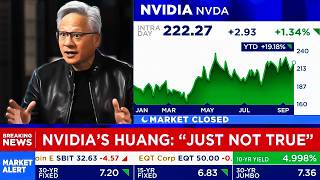
Now, I've been telling you to own Nvidia, do not trade it, since the days when it was in the low single digits. Sometimes it tries men's souls and women's souls, like when it was stuck under 200, I said stay with it. It's now 225. Now, my modus operandi going into the quarter is that once again, don't focus on the short term.
The growth here should be spectacular, the earnings colossal. Stock's been running though. I'm glad it cooled off today, dropping 10 bucks. But it was up 10 the other day. I am cognizant we need a perfect quarter for Nvidia to go much higher. But you know what, then again, we might get i. Friday was a rough day throughout much of the market after oil moved higher and yields moved notably higher around the globe on inflation fears related to higher oil prices.
Nvidia, along with many other tech hardware names, traded lower on Friday after it was revealed that Nvidia's ability to sell the H200 in China was not a major point of discussion in US-China talks. Earlier this week, Reuters reported that the US cleared 10 Chinese firms to purchase Nvidia's H200, but shipments installed because China had not approved the sales.
And then sometime between Thursday and Friday sessions, the president said that China had not yet approved the deal from their end, quote, because they chose not to, they want to develop their own. From a long-term strategic perspective, it's in the United States' best interest that developers in China build on the American tech stack, and China realizes this, which is why they're hesitant to allow the sales to happen.
I think the presidents of both countries are expected to meet with each other again multiple times later this year. So, we'll see if anything happens. that analysts are not factoring into their estimates. At the same time, Nvidia's business is re-accelerating even without China revenue. Nvidia's business is growing strong either way.
On Friday, we got another Nvidia price target upgrade. TD Cowen Joshua Buckhalter raised his target to $275 per share, which is up from his previous target of $235. I don't put much weight behind most analyst price targets, but I mention them so that you're aware of what's going on. It's normal to see multiple price target upgrades ahead of Nvidia earnings, and we've seen many upgrades throughout this week.
This past week we got multiple pieces of important news from some of Nvidia's key partners. Foxconn reported strong results with profits up 19% on year, and they expect AI rack shipments to more than double this year. And TSMC, which is the company that manufactures Nvidia's chips, said they expect the global semiconductor market to exceed $1.5 trillion by 2030, which is up from a previous forecast of $1 trillion.
Bank of America also raised their 2030 AI data center TAM forecast to $1.7 trillion, which is up from $1.4 trillion previously. Those two updates from TSMC and Bank of America helped calm investors' nerves because many market participants are still wondering if we're in a bubble. They're wondering if we're at the peak of hyperscaler CAPEX, and they're wondering how long this can last.
As I've said many times, this is not a bubble. This is a multi-year trend. This is not a cyclical peak, and Nvidia still has plenty of runway ahead of it. TSMC and Bank of America's forecast helped reassure investors of that. Unfortunately, I'm once again hearing some people bring up the AI bubble talk.
So, as I've done many times in the past, let me briefly share multiple reasons why . First, the AI build-out is primarily being funded by the largest companies in the world with the deepest corporate balance sheets on the planet. Second, this AI revolution is different from the early days of the internet because can both happen immediately.
We don't have to wait years for it to happen. It's happening right now. And this substantially reduces the risks of both long digestion periods and overbuilding capacity like we saw during the early days of the internet. Today, the off-take of new capacity is immediate because the demand is already present.
And the demand far outpaces supply. This t the peak of the dot-com bubble, the vast majority of the fiber that had been laid was dark because companies were building out in the hopes that new use cases and demand would eventually show up. But today, there are no dark GPUs. Every GPU is spoken for as demand far outpaces supply.
Again, the demand is already present before new capacity even comes online. The world is compute constrained in the face of very strong AI demand. The hyperscalers are monetizing new capacity as soon as it comes online. And all of them spoke this past earning season about being supply constrained. They simply cannot get enough compute to satisfy .
If the hyperscalers finally, the valuations that we're seeing today are nowhere near the massive overinflated valuations that we saw during the dot-com bubble. Nvidia is trading at a forward PE in the mid-20s, which is not much higher than the forward PE of the S&P 500. I saw Daniel Newman posted this graphic recently.
And I think it sums up the situation well. Look at some of the forward multiples we're seeing today compared to those of the late '90s. They're drastically different. We are nowhere near bubble territory. Sure, certain companies or certain segments of the ecosystem may enter bubble territory. But that does not mean that the AI ecosystem as a whole is a bubble.
And while some market participants claim that there isn't a clear ROI on investments in AI infrastructure, the leading AI labs have seen their revenues inflect notably higher in just the past 4 months thanks to the rapid adoption of agenic AI. Anthropic's ARR has reportedly surpassed $44 billion, up from $9 billion just at the end of 2025.
And OpenAI's ARR is estimated to surpass $30 billion. And I wouldn't be surprised if it's actually much higher than that. I'll come back to that in a moment. Now, let's get ready for Nvidia earnings, which are scheduled for May 20th after market close. Last time I checked, the consensus estimate for revenue was roughly $78.8 billion.
Adjusted EPS is expected to be $1.77. Q1 gross margin is expected to be 75%. Next quarter revenue guidance is expected to be roughly $86.6 billion with gross margin holding at 75%. Those numbers could change, but that's what it was the last time I checked. Now, I want to mention something very important.
I don't know how the market will react to Nvidia's earnings. In recent quarters, we have repeatedly seen Nvidia deliver fantastic results, and then the stock sold off after earnings. I'm not saying that that's guaranteed to happen this time. I'm just saying that it's a possibility we need to be aware of, and we need to be prepared for that just in case it happens.
The market expects Nvidia to report fantastic results, and the bar is high. It always is for Nvidia. That said, I'm expecting a reiteration that Vera Rubin is on track to launch this year. The leading AI labs are starting to see massive returns on AI investments as their revenues are surging, and the long-term thesis remains firmly intact.
Once the frontier AI labs return on investment becomes more widely known, two things should happen. First, market participants will finally AI infrastructure in recent years. And second, Nvidia will then have the space to raise pricing if they choose to do so. Nvidia has a lot of pricing power, and they could charge customers way more if they wanted to.
Once the leading AI labs surging revenues are more widely known, that's when we could potentially see Nvidia raise prices, which would mean higher gross margins. In the meantime, it makes sense for Nvidia to keep margins where they are until the leading AI labs ROI is more widely known. And then after earnings, we have another GTC keynote from Jensen Huang in Taipei scheduled for June 1st at 11:00 a.m.
Taipei time. For those of us in the US, that's May 31st at 11:00 p.m. Eastern, 8:00 p.m. Pacific. I want to mention a few things about Nvidia's upcoming earnings report that I think are interesting. First, I don't know whether we'll get an update to the $1 trillion in cumulative revenue from Blackwell and Rubin through 2027 that Jensen shared at GTC in March, but I wouldn't be surprised if Jensen gets a question about it.
It's important to remember that that forecast only includes Blackwell and Rubin revenue. It doesn't include any revenue from things like the Grok LPX racks, standalone CPU racks, and so on. And so, the $1 trillion is not Nvidia's cumulative data center revenue. It's just cumulative revenue from Blackwell and Rubin through the end of 2027.
Something else to consider ahead of this earnings report is Nvidia's massive investment gains. Nvidia is estimated to have unrealized gains worth tens of billions of dollars thanks to their investments throughout the AI ecosystem. Many of those company stocks have appreciated notably since Nvidia invested in them.
And so, we're very likely to see Nvidia recognize some of those gains on this earnings report. I'm also curious if investor returns will be mentioned on the earnings call. During the GTC financial analyst Q&A in March, Jensen and Collette informed us that Nvidia needs to work through some commitments in the first half of this year.
But after that, they will probably return 50% of free cash flow to investors in the form of stock repurchases and dividends. I'm curious if it will be mentioned again on this earnings call since we are approaching the second half of the year. I also expect Jensen to talk at length about the rapid adoption of agentic AI and the massive surge in revenue that's happening at the Frontier AI labs.
2026 is shaping up to be a very interesting and pivotal year for the AI industry because we are on the cusp of many market participants finally coming to the realization AI infrastructure. Anthropic's ARR has reportedly surpassed $44 billion up from $9 billion just at the end of 2025. And OpenAI's ARR is estimated to now surpass $30 billion.
And to be honest, I would not be surprised if OpenAI's ARR is actually much higher than that. Why are the Frontier AI labs suddenly seeing this surge in revenue? It's exactly what I've been saying in these videos. It's because of the rapid adoption of agentic AI and the subsequent inflection in inference demand.
There's a reason why I keep mentioning this. For many months I told you that I was expecting into 2026. I was completely serious when I said that. Then we saw Open Claw's surge in popularity. Then Jensen told us at GTC in March that the inference inflection has arrived. And this is is a major fundamental inflection that we've witnessed throughout the AI ecosystem in just the past 4 months.
I'm completely serious when I say that most market participants don't even realize this inflection is happening and they don't realize the implications that it has for . With AI agents, we're not talking about chatbots that simply respond hen we say agentic systems, we're talking about large swarms of these agents that all work together to complete tasks and get work done.
Notice that this is not a short-term fad. This is a fundamental change in how work will be completed moving forward. We are about to witness t massive scale. And these enterprises will consume an enormous even further beyond what we've already seen. As a brief side note, the rapid adoption of agentic AI is the reason why we've seen a surge in CPU demand recently because now we have a massive number of AI agents that are using digital tools and systems that rely heavily on CPUs.
I want you to remember that while agentic AI is the reason we've seen a surge in CPU demand, CPUs are not meant to replace GPUs. In order to have efficient agentic AI at scale, you need both CPUs and GPUs. In that context, the CPU and the GPU serve different purposes. Both are necessary and the industry needs a lot more both.
Jensen has a track record of accurately telling and therefore we can infer what's coming next from a demand perspective. Jensen recently said that we will be talking a lot about agentic AI for about 2 or 3 years. But after that point, we won't be talking much about agentic AI anymore because it will be everywhere.
And at that point, according to Jensen, we will be talking a lot about physical AI. And so that's the timeline we're looking at, the proliferation and rapid adoption of agentic AI for a couple years or so. And that should increase compute demand significantly. And then sometime around 2028 or 2029, physical AI will likely come into focus as the main event. From that perspective, it's .



Comments 0