
저자: 미상 · 외국인
요약 보기
영상은 엔비디아가 AI 칩 시장의 리더로 여전히 우위이며 밸류에이션이 과도하지 않다고 주장한다. 에이전트 AI 확산으로 CPU·GPU 수요가 급증하고, TSMC 4월 매출 전년비 +17.5%, 1~4월 누적 +29.9%를 근거로 든다. 엔비디아 Vera Rubin 7월 출하, 마이크론 전환사채 발행 등 단기 이벤트도 언급하며 장기 성장 여력을 강조한다.
다듬은 글
Will Nvidia remain the best company in the AI chip market going forward? Yes, and you always very accurately note everything we see now in the field of AI. There is only one "godfather" of AI, and that is Jensen. And that means it all starts with the heart and lungs of AI – Nvidia. Great. Thank you for answering so briefly, because it brings me to what I wanted to say.
If Nvidia is still the " godfather", then it is the best on the market, which I am absolutely sure of. And you already mentioned Intel. Why should I pay four times more for Intel than for Nvidia when Nvidia is an outstanding, fantastic company? You, I mean, preach to those who already agree with you.
I agree 100%. That's why I think Nvidia is the one company where, even if I look at AMD, I think everything that's happening now is finally starting to get validated. When I look at Intel, it's like, ' Look, they had tremendous growth.' I think they're in a relatively good position, but I'd rather own Nvidia stock than Intel any day.
Doesn't this distract from the point? I think people are just throwing money around without caring about the valuation. They're interested in momentum, which is good while it lasts, but then this happens: Nvidia has been doing well lately , but Intel has been doing this , and that makes me think that's exactly how things are going to play out .
Look, I think part of it is about second, third, fourth derivatives, and investors are trying to figure out, "Okay, let's take Nvidia, you look at it, and obviously it was a historic deal. And now Intel? What about AMD? Is it worth playing on the memory supercycle that is currently unfolding? And then look, you can own shares as things unfold, you know, there may be areas of excess capital , and we talk about that.
But I think this is where an investor needs to pick out the winners and determine what valuation they can grow to. There was a whole controversy around Anna Palantir, right? There were many opponents. They hate when stocks were $12-$13 in high school. They despise them when they cost $140. I believe that in two or three years their market cap will reach a trillion dollars, but they have to prove it.
Ultimately, you have to see how they execute their plans, and that speaks to our opinion on how to navigate this segment of winners and losers. But did anyone watch Jensen's speech at Carnegie Mellon? I don't. I watched, I saw Andrew in America. Yes. Well, it was different for him. Yes. Um, well, he talked a lot about what David talked about, which is the concern about what artificial intelligence can do, and he talked about how good it is, but he also said that there have to be limits.
I said, "Wow." Is it any different for him ? No, not at all . I think he is a real evangelist , although I wouldn't say he is not. I understand the objections, and I want to say that I think they can be overcome with limitations. It was a very, incredibly thoughtful speech. Yes, here's a little bit of what Jensen said at the graduation ceremony: " Entering the world at an extraordinary moment.
A new industry is born. A new era of science and discovery begins. Artificial intelligence will accelerate the expansion of human knowledge and help solve problems that were once inaccessible to us. No generation has entered the world with more powerful tools or greater opportunities than you . We are all standing at the same starting line.
This is your moment to help shape what comes next. So run, don't walk." What didn't I like? Well, they didn't include the part about fencing. It's clear. He talks about it. Yes. He also, at the beginning, in such a melodic way, talked about how you need to look back at your moms and dads. This is who did it.
This is who needs to be celebrated. He said, "Happy Mother's Day." And it was the same thing that had won the hearts of people in Jens for years - that little spark that always disarms . Because he just ...Please talk about this for a second. He's just... he's... he's... he's very real, David. He is also an excellent investor.
Well, I know, but I'm talking about something that goes beyond money. O.O. We don't go beyond money here. Well, we...we...we...we... we...you're a dollar sign walking around like... I never claimed to be anything other than a dollar sign. Like the rating... Like me...Yes. So, okay, I wanted to ... I mean, I just quickly put together Claude for us.
Using Claude, right? Well, we use Claude on Team Favor, of course. We are trying . We can't keep up with you with all your color coding. All...Eli Lilly...Well, we just did... you know, just Nvidia's public investment, what they show. As for Intel's investments, by the way, they are the largest. I mean , again, it's not us...
we haven't triple-checked them, but somewhere in the 20s—that's what they paid in December when they acquired their $5 million stake. And now it's worth $28 billion. So he made a profit of 464%. But if I own them, I want to continue owning them, and I would wait for a correction to buy aggressively.
But the only stock that looks different is Nvidia. Nvidia has been doing nothing for months and is only now starting to perk up. So if Nvidia gets ahead, you'll see the semiconductor group , or in the case of SMH, or the stock continue to rise. Is it because Nvidia has already passed its peak? I mean, was Micron a stock that people weren't paying attention to because everyone was buying Nvidia last year, the year before, and now?
Yes, Micron is memory, and people are starting to realize that memory is in demand. Nvidia has created a chip for AI. So Nvidia led this whole movement and I think consolidated its gains, while other semiconductor companies joined in, because now people are waking up, it's not just going to be an Nvidia story.
With chip demand high, there will certainly be other semiconductor stocks that can do very well , but Nvidia remains the leader. Therefore, if the situation changes and the company begins to “wake up”, in our opinion, it will continue to dominate the semiconductor market. Fine. I think the development will be bigger than anyone ever dreamed of.
Wow. Well, speaking of your dreams, your last note is Jensen's fantasy. We've talked about the rise of agent computing and inference, and how that's resulted in such high demand for CPUs and memory, but let's get back to GPUs, which of course brings us to Nvidia and your dreams. You say she has the most growth potential of all your targets.
Namely, Nvidia. Why? Well, it's showing below- expected results. I mean, as of this morning, the stock is up 18% year-to-date, trailing SMH by 42 points, and the stock is 50% lower than AMD when you factor in options. It just doesn't make sense. Although, of course, it makes sense, because in order to grow, Nvidia needs to increase its market capitalization.
So I understand. But something has to break. Either this semiconductor market has to completely collapse and everything has to go down again, or Nvidia has to go up. God help us. I really hope Nvidia grows. But I think they will beat expectations and grow, and I think the market will understand that Nvidia will grow at least in line with capital expenditures.
And this growth will be significant, double-digit, by the end of the decade. And Nvidia just can't get anything cheap. I mean , it looks like next year's earnings will be 20 times earnings, but in reality, it's more likely to be in the 10-20 range. And she just needs to fly higher. Many of these companies have gone too far, and the Goliath leading this entire onslaught needs to be stopped.
Do you think there's risk or uncertainty around the stock given how many deals and creative solutions, stock deals and sales have been made with various players in the AI ecosystem—from models to core components and even software companies providing services—and if something goes wrong with any of them, Nvidia will be at risk?
I mean, Sarah, this guy is the best investor right now... He's doing Warren Buffett, I'm not kidding, but Jensen has everything on his side right now. Let's see what happens. He's investing because, you see, in the past, companies have gotten burned and said, "Jensen, we need to increase capacity." And Jensen was happy to lend money because he saw what was happening .
He said, " Genetics will cause this surge. I am so sure of it. Here is my money." And now you have more confidence in what you can build based on what we see. So far, this guy was right, because he started investing before Anthropic's annual revenue grew from 9 billion to 44 billion. He saw what was happening because Anthropic trains its models and now works with them, and he was able to see it and get ahead of it .
I think we have to give him credit. On paper, that's tens of billions in profits, and he seems to be moving in the right direction. At some point you have to say, 'Hey, give this guy some credit. The shares are too cheap. He seemed to have foreseen it." And I think that, you know, the multiple has already suffered because of this so-called perception of closed deals.
When you say, "Hey, the guy kind of saw it, and give him credit "? So I'm on that side. I understand you. This morning Claude put together a little spreadsheet with all the profits. Intel, by the way, is leading the gains in Nvidia stock in terms of where they've invested and where those stocks are now .
What do you think about Nvidia in this situation? Because when we talk about semiconductors, we're not necessarily talking about Nvidia being the main driver here. I think there was an article in Bloomberg that it might be overtaken by Alphabet as the largest company. I mean, what do you do with Nvidia in this situation?
You continue to maintain... Yeah, you're holding the stock long and, you know, managing your size. And in the race for market cap leadership, Nvidia is now pulling ahead thanks to the progress we're seeing today. Jensen Huang was right in everything he told us about where he thought the growth of this new industry would ultimately go.
The powerful strength they have is that the chips they provide to their customers eliminate the need for multi-tiered architecture. And if you eliminate the need for a multi-tiered architecture, which Nvidia chips allow you to do, you're much more efficient and certainly faster at using resources and producing results than if you ultimately had to go the other way.
I think this is a solution that Nvidia continues to offer, and that's why they remain in the lead. That's right, you own it too. Yes, we own that too. And as Joe said, Nvidia has now caught up with its market value, right? The stock was trading at a very high P/E ratio, earnings were continuing to grow, and the market was sort of saying, "Okay, let's see how sustainable your earnings are." This is exactly what we are talking about now in the context of memory company stocks.
Right. And now that you see that there 's a huge demand for memory stocks, you might say, "Well, if there's demand, then people must be using Nvidia chips." And again, the reason I like companies like Nvidia is because they reinvest money into new technology. They're trying to become more energy efficient, they're trying to make more, you know, fewer multilayer chips, they're trying to be present not only in the AI space.
So now you're kind of saying, "Okay, where else, you know, can it grow?" And we know Nvidia was there. So it will be a question of whether they can enter this quarter with a high P/E ratio again. We're talking about 5.3 trillion. So, there are two ways to look at the situation with a company like Nvidia, Dan.
Firstly, it is profit, revenue. These numbers are astronomical. They justify this assessment. But secondly, there's a question that always bothers me: will it become a $10 trillion company? Or 6 trillion? At what point will it begin to stabilize? Well, I think you started by saying, " Intel had a great month, etc." And Intel at one point in 2000 was the second most valuable company in the world after ExxonMobil, I think, at that time.
It only returned to those levels this year. So it took you, it seems, 26 years to return to your previous levels. So the point is that the valuations now aren't as crazy as they were in 2000, right? Cisco traded at a P/E ratio of 150, which at one point at its peak made it the most valuable company in the world.
Nvidia, for example, is in the 20-25 range. So the valuation landscape is completely different now, and that's why I think you're seeing growth with Gentec AI. This is indeed true. Let's step back for a second . If you look at Anthropic and Open AI at the beginning of last year, their combined annual revenue was 7 billion.
If you look at the latest reports of both companies, you will see that it is closer to 70 billion. So you see this huge jump, especially this year, where Open AI went from, I think, 9 billion, sorry, Anthropic went from 9 billion at the end of 2025 to 45 billion in about 4 months. You see this big growth in Gentec, and that's why I think this year will continue to be strong.
Now, if you move from CPUs to GPUs, as Gentec does, the biggest growth drivers may not be the GPUs that Nvidia has, but the CPUs. And we wrote about this at the end of March, that AMD, Intel or any other manufacturer you choose provides them. If you go from eight graphics cards to one CPU, some would argue that you'll achieve parity or even outperform the competition because you're doing a lot of different tasks, as opposed to just one CPU.
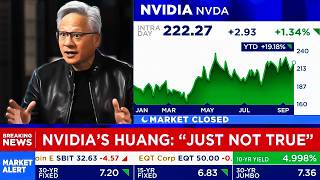
It's exciting and I love this story. There's no better story for 2026 than Intel taking chips it was going to completely repurpose and repurposing them to catch up . I hope you are all doing well today and staying calm in the market. Today was a mixed day for the overall market, but a positive one for Nvidia, as shares reached a new all-time high and surpassed $220 per share for the first time.
Last week, it was reported that the White House would invite CEOs of several companies to accompany the president on his trip to China, including Jensen Huang. However, Reuters reports today that Jensen was not invited to accompany the president on this trip because this particular trip is focused on agriculture and commercial aviation issues .
As I've said many times , I currently view Nvidia's access to the Chinese market as a secondary factor. Any revenue from sales in China will be an additional benefit for Nvidia that analysts do not take into account in their models. At the same time , Nvidia's business is gaining momentum again, even without taking into account revenue from sales in China.
In any case, Nvidia's business is showing strong growth. At the end of last week, we also received TSMC's April earnings report. Let us remind you that TSMC produces chips for Nvidia. April revenue showed a strong increase of 17.5% year-on-year and a decrease of 1.1% month-on-month. A decrease in revenue compared to the previous month is quite normal for TSMC, and there is nothing to worry about.
The important thing is that the general trend remains unchanged. TSMC's revenue for the first four months of 2026 increased by 29.9% compared to the same period last year. Over the weekend, Taiwan's Economic Daily reported that Nvidia had completed development of a production version of the Vera Rubin with ODM partners and would begin trial production in June.
Starting in July, Nvidia will begin shipping to major North American carriers such as Amazon, Microsoft, and Google. This is significant because it suggests that the Vera Rubin is on track after rumors surfaced about potential design changes that could have delayed the Vera Rubin's release. As far as we know, Vera Rubin is still planned for release.
Now I want to mention Micron briefly because today they announced a convertible note issue. It's very similar to convertible bond offerings Micron has conducted in the past, but this time with a few unique details . Micron intends to issue $2 billion in convertible senior notes due 2033, and they expect to grant the initial purchasers of the notes an option to purchase up to $300 million in additional notes .
Micron is thus seeking to issue bonds totaling between $2 billion and $2.3 billion. Micron also plans to enter into capped call transactions . This should help reduce potential shareholder dilution, assuming a price similar to what Iron has used in the past. Pricing details are not yet known and will likely become available within a few days.
I will try to provide updated information as soon as we have this data. Another interesting point in this announcement is that Iron also plans to terminate existing capped call option transactions entered into in connection with the issuance of 3.5 % Convertible Senior Notes due 2029 and 3.25% Convertible Senior Notes due 2030.
Iron expects to terminate a portion of the capped call option transactions associated with these previous issues. This is very interesting because on December 8th, Iron announced that it would buy back some of these old convertible notes maturing in 2029 and 2030 . As a reminder, the redeemed portion of these old bonds has been redeemed and is no longer convertible into Iron shares.
Now, it appears Iron plans to terminate some of the capped call option deals it entered into when the bonds were issued. Since Iron already repurchased and redeemed a portion of these bonds late last year, it is logical to assume that Iron will also terminate a portion of the capped call option transactions associated with these bonds.
And that was included in today's announcement. So what does all this mean? Iron is issuing convertible senior notes in the aggregate principal amount of between $2 billion and $2.3 billion. Part of these funds will be used to pay for options to buy/sell shares (cap calls). Pricing details are likely to be announced within a few days.
Call/ put options on shares should reduce potential shareholder dilution to a price-determining level. We will inform you of the price as soon as we receive detailed pricing information. Iron also plans to terminate some of its previously entered into call/ put option agreements for shares when issuing older bonds.
Some of these old bonds have already been redeemed, so it makes sense for Iron to terminate some of the call/ put option agreements. In the short term, this could lead to some volatility in Iron shares. As a result of the placement, we may see a decrease in their value. However, this doesn't change my overall thesis on Iron, and it's similar to what we've seen in the past with corporate Iron equity issues.
I will try to provide an update as soon as we have pricing details for this accommodation. We will likely receive these details within a few days. Looking ahead to Nvidia's earnings report on May 20th. I'm sure I'll have more to say about this in the coming days. And then we have another Jensen Huang presentation scheduled for GTC Taipei on June 1st at 11:00 AM Taipei time.
For those in the US, it's May 31st at 11:00 PM ET , 8:00 PM PT . 2026 promises , as realizing that large-scale investments in AI infrastructure will yield clear returns. Anthropic's annual revenue has reportedly exceeded $44 billion , rising from $9 billion by the end of 2025. OpenAI's annual revenue is now estimated to exceed $30 billion.
Frankly, I wouldn't be surprised if OpenAI's annual revenue was much higher. Why are cutting-edge AI labs suddenly seeing such a sharp increase in revenue? This is exactly what I was talking about in these videos. This is due to the rapid adoption of agent-based AI and the subsequent change in demand for computing resources.
I keep saying this for a reason . For months, I've been telling you that I expect a surge in computing demand driven by agent-based AI that will continue through 2026. I said this completely seriously. Then we saw a sharp rise in the popularity of OpenClaws. Then Jensen told us at GTC in March that a tipping point in computing resources had arrived, and that this was significantly increasing the demand for computing resources.
This is a major fundamental shift that we have seen across the entire AI ecosystem in just the last 4 at this inflection point is happening, and don't understand the impact it will have on Nvidia's business growth over the next couple of years. When it comes to AI agents, we're not just talking about chatbots that answer your queries.
Now we're talking about agents who can use tools and perform tasks on your behalf. And when we talk about agent systems, we mean large swarms of such agents that work together to perform tasks and achieve results. Please note that this is not a short-term fashion. This is a fundamental change in how work will be done in the future.
We are about to witness the widespread adoption of agent-based AI by large enterprises. And these businesses will consume a huge amount of tokens. This will increase the demand for computing resources even more than we have already seen. As a quick note, the rapid adoption of agent-based AI is behind the recent surge in demand for processors.
Because we now have a huge number of AI agents entral processing units (CPUs). I want you to remember that while agent AI is driving the . For efficient scalable agent AI, both CPUs and GPUs are required. In this context, the CPU and GPU perform different functions. Both are necessary, and the industry needs much more of both .
Jensen has a track record of accurately forecasting the future in terms of technology, and so we can draw conclusions about the future in terms of demand. AI for about two to three years. But after that point, we won't talk much about agent AI anymore, because it will be everywhere. And then, Jensen says, we'll be talking a lot about physical AI.
This is the timeframe we a-based AI within a couple of years. This should significantly increase the demand for computing resources. And then, sometime in 2028 or 2029, physical AI will probably come to the fore as the main event. From this perspective , it is clear that Nvidia still has a lot of room for growth.
stay focused on implementing AI systems on a large scale. This will significantly increase the demand for computing resources. And after that, the next surge in demand for computing resources will likely be fueled by physical AI. We no longer talk . In the case of physical AI, we a phase of growth for Nvidia." This industry is fundamentally transforming society, and Nvidia has positioned itself to reap enormous benefits.
Nvidia sells hardware for data centers wher models are trained and tested. Nvidia also sells hardware that enables real-time data inference directly on the device via NVIDIA AGX, allowing robots to intelligently interact e that NVIDIA takes positions itself as the foundation that powers it all . More than 2 million developers are already building apps on the NVIDIA robotics platform, and it's not getting enough attention.
I still believe that most analysts' long-term forecasts for NVIDIA are understated given the prospects for ramping up production. Blackwell Ultra is currently growing very rapidly, resulting in accelerated revenue growth. Rubin is scheduled to launch in 2026. Then NVIDIA Grock 3 LPX is expected in the second half of 2026.
Later, in 2027, Rubin Ultra is expected to launch , and after that, in 2028, Fiman. We have a clear data center product roadmap that extends to 2028, and Jensen believes that global AI factory construction will be worth between three and four trillion dollars by 2030. This means Jensen expects demand for AI to grow and the overall addressable market that underlies it all to expand.
I do n't think we're close to any kind of collapse. Given all this, I seriously believe that Nvidia still has a lot of potential. And I think that in the future this company will be worth much more than it is today. At least that's my opinion. A brief note before closing. All , preserving the original structure and commentary.
Sometimes the same edits appear on other YouTube channels. If you are looking for the original version, it i. Keep the long-term perspective in mind and don't make hasty or irrational decisions. With that said, I hope you all have a great rest of your day, and I'm interested to hear ike this video so more people can see it. And while you're there, please subscribe. I hope to see you in the next video.



Comments 0