저자: 미상 · 외국인
요약 보기
결론: 조엘 그린블랫의 책 요약 영상으로, 특수 기업 상황(스핀오프·합병증권·위험차익거래·구조조정)에 투자 우위가 있다는 내용이며 특정 종목·시장에 대한 가격 전망은 없다. 주제 1 - 스핀오프: 25년 연구(1988년 종료)에서 스핀오프 기업은 독립 후 처음 3년간 S&P 500을 연 평균 10%p 상회했고, 모회사도 연 약 6%p 초과수익을 냈다고 소개. 기관 매도 압력, 애널리스트 커버리지 부족 등이 초기 저평가를 만든다고 설명. 주제 2 - 합병증권: 인수 대금이 현금·주식 외 채권 등 합병증권으로 지급될 때, 투자자들이 이를 바로 매도해 실제 가치보다 낮게 거래되는 기회가 생긴다는 예시(Mr. Mash/Frankie's Fries) 제시. 주제 3 - 위험차익거래(비추천): 인수 무산 시 하방 손실이 크고(예시: 상방 2달러 대비 하방 25~30달러), 자금이 오래 묶여 연환산 수익률이 낮다(12개월 대기 시 약 3.4%)는 이유로 저자는 이 전략을 권하지 않음. 주제 4 - 구조조정: 수익성 낮은 사업부 매각·폐쇄 시 주당순이익이 개선되어 주가 상승 여지가 있으며, 이를 결정한 경영진은 주주 이익을 우선한다고 해석. 주제 5 - 실행 원칙: 경영진이 지분을 보유한 쪽에 투자, 소수 종목(약 6~8개)에 집중, 자기 조사 필수. 노력이 어렵다면 Greenblatt의 'The Little Book That Beats The Market'처럼 수동적 접근을 권함. 리스크: 특수상황 투자는 소수 종목 집중에 따른 위험과 인수 무산·시간 지연 위험이 있음. 출연자 전망: 특정 대상 자산에 대한 가격 방향 예측 발언은 없음.
다듬은 글
Have you heard the story about the plumber? He arrives at a customer's house and bangs on the pipes, and tells the customer that "That will be $100". The customer response "$100! All you did was bang on the pipes..." the plumber replies that "oh no, the banging on the pipes is $5, but knowing where to bang is another 95".
This is where the following takeaways take root... Where to bang. As with all investing strategies, you need to create your edge over the market. According to Joel Greenblatt, the founder of Gotham Asset Management, a lucrative place to start digging is with special corporate situations. From 1985 to 1994, Joel Greenblatt achieved an annualized return of 50% per year, that's a good return.
Sorry, I think I mispronounced that - that is a tremendous return! This investment record is largely boosted by investing in these special corporate situations that you soon will learn about. This is a top 5 takeaway summary of: You Can Be a Stock Market Genius, written by Joel Greenblatt, and this is The Swedish Investor bringing you the best tips and tools to reach financial freedom through stock market investing.
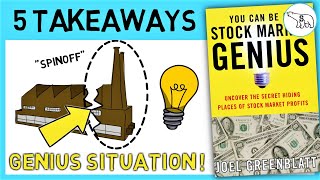
Takeaway number one: Spinoffs. The first investment area of special corporate events and perhaps the most lucrative one is spinoffs. A spinoff is when a company takes a subdivision and separates it from the parent company, making it an independent entity. A study that went on for 25 years and finished in 1988 found that spinoffs had on average beaten the S&P 500 by 10% per year during the first three years as standalone companies.
Also, the parent company managed to beat the market average by about 6% per year. Other studies have found similar results. So, on average, with a basket of spinoffs, one would have achieved returns of about 20% annually without any talent or comprehensive research. Imagine picking your spots within this area and increasing those returns even further.
Even though that period ended 30 years ago, the same mechanics that enabled those returns to spinoff back then are at play today. Institutions don't want them. A spun-off company can be too small for institutions to own and they're often not the reason that they bought the stock in the first place. This creates an initial selling pressure on the stock that hasn't got anything to do with the business itself.
The spun-off company lacks existing analyst coverage. This makes private investors hesitant and increases the initial dumping of stocks even further. Operators of the spin-off suddenly have increased incentives. Now, this standalone entity isn't hidden away in some subdivision of its parent any longer.
Combine this with a higher freedom to operate and it makes an acceleration in the business of the spun-off company more likely. There are additional mechanisms that makes the spin-offs a lucrative area, but these are the major ones. Greenblatt dedicates most of the book to spin-offs and states that one doesn't really have to go beyond this to become a successful investor.
But hey, the more possibilities, the better. Take away number two: Merger Securities. Another sort of special corporate event is the one of mergers and acquisitions, and here you want to be on the lookout for the special type of merger securities that is sometimes used during these transactions. Normally, when a company buys another company, the majority is paid in cash and stocks.
However, in order to further sweeten the deal or when the acquirer doesn't want to issue more stocks or raise more cash, the decision can be made to use other mergers securities. The opportunity for you arises because as a general rule, no one really wants these other securities. A company named Mr.
Mash is producing and selling canned mashed potatoes. The stock is trading at $31 per share. When another company, Franky's Fries announces a takeover bid for Mr. Mash for $39 per share in cash and another $4 in face value of Frankie Fries 7% bond due in 2032. Pretty good for the shareholders, their portfolio is made a huge return just overnight.
But, what do people typically do with the proceeds? Well, the cash part is easy, they reinvest. And what about the bond? A 7% return per year in coupons and $4 of face value received in 2032, this might actually be a good deal in terms of risk reward, but who cares? A bond? Nah... People own the stock because they wanted to own their favorite brand of mashed potatoes, not some boring bond of whatever.
So, they sell the merges securities and don't think twice about it. What is face value anyways? But what about the sophisticated institutions? Surely, they will make some advanced calculations in Excel; benchmarking the yield to maturity, analyzing the synergies between the two companies and so on. Nah...
Institutions who own stocks in Mr. Mash also wanted stocks in that company, not some bond of a new conglomerate. And this is where you enter the picture. Similar to the dynamics of spin-off situations, merger situations can make you a lot of money, dealt with correctly. Since individuals and institutions both get out quickly, the selling pressure makes the security trade far below its actual value, and this is where you can pick it up.
Takeaway number three: Risk Arbitrage. As many great individuals and investors advocates, start with what not to do. This is a take away of a special company situation which to stay away from, the one of risk arbitrage or sometimes referred to as Merger Arbitrage. Let's get back to Mr. Mash and Frankie's Fries.
Let's say that the shareholders of Mr. Mash declined the takeover bid of $39 plus bonds. Now Frankie's decides to up the bed a little and to pay in cash. It is now offering $60 in cash only. The stock was previously trading at $31 per share but in anticipation that this bid will go through, the stock market pushes the stock to $58.
A risk arbitrageur is a person that will buy Mr. Mash at $58 hoping the deal will go through as soon as possible in order to cash out the $2 per share indifference. There are many great ways to make money in the stock market but according to Joel Greenblatt, this is generally a bad one. The risks undertaken by attempting this are mainly two; there's always a possibility that the acquisition doesn't go through due to a number of reasons including financial problems, extraordinary events after the announcement, discoveries during the due diligence process etc.
In the case this happens, the downside is huge and it's not uncommon to see stocks fall back to the trading price before the acquisition announcement. So, given the example above, the upside is $2 and the potential downside is perhaps 25 to 30 dollars. The second risk is time. An acquisition can take much longer time to go through than first intended.
If you have to wait, let's say 12 months for the deal to go through, you've made an annualized return of about 3.4 percent, which considering that the stock market is full of other opportunities is a terrible use of your money. Again, there's a vast number of ways to make money in the stock market, please don't choose that of risk arbitrage.
Takeaway number four: Restructurings. Back to the kind of special corporate situations that you should try to understand and be involved in, restructurings. When we talk about restructurings, I don't mean minor tweaks, I mean when companies decide to sell off or shut down a whole division. This actually happens on a regular basis, and if you are on the lookout, you may spot some real opportunities here.
Usually, the reason for selling or shutting down a whole division is simply that its business isn't doing that well. Let's say a company has three divisions and makes an earnings per share of $4 in total, but if you look under the hood, (which I hope you will do in these events from now on) you discover that division A contributes with earnings of $2 per share, division B with $5 per share and the third, division C actually drags down the result with $3 per share.
All in all, the company makes $4 per share. But once division C is gone, the earnings per share will take a leap to $7 and this will most likely lead to an increase in the price of the stock. Also, another contributing factor that makes this area potentially a lucrative one is that management can now focus more of its time and effort developing the part of the business that is the most profitable, which is likely to lead to better results in the future.
It is often a difficult decision for management to decide to shut down a large part of its operations, as it means that from now on they will lead a smaller organization. This is bad for people with large egos. Management teams that decide to shut down a whole division therefore shows that they put shareholders interest first and these are the leaders you want to invest in.
Takeaway number five: How to act in all special situations. This last takeaway is a mash up of things to keep in mind when going for these special situations. Some may be repetition from other videos from this channel, but hey, repetition is the mother of all learning. Don't trust anyone under 30, and don't trust anyone that is above 30 for that matter.
Actually, don't trust anyone at 30 either, do your own homework. If you ought to look at special corporate situations because so few others do, you simply have no choice but to do your own digging. You can beat the rest of the market with these methods because you'll stand out of the herd and understand something that other people don't.
Invest with the operators: As in all investments, you want to be on the same side as the insiders; make sure that the management have skin in the game. Taking spin-offs as an example, the new standalone entity will open the possibility for the new CEO to buy shares in the company, but if he or she doesn't bother, you shouldn't either.
Pick your spots and concentrate: While you can reach extraordinary results investing in special events, it is a minefield. So, make sure you pick your spots carefully. But once you've found one of these gems, make it count by investing big. After having distributed your money in around 6 to 8 of these situations, the benefit of adding additional investments in order to decrease the risk is small though.
Once you have a basket of some eggs, just make sure to watch that basket carefully. If you are not willing to put in the effort required to learn about and identify these types of special situations, that's completely OK. Then you may want to check out a more passive investment approach, like the one from Joel Greenblatt's other book: The Little Book That Beats The Market.
This book reveals how to spend a minimal amount of time and still be able to reap a great deal of the rewards that the stock market has to offer. Cheers guys!




Comments 0