원문 보기
Listen, Brooke, good day. This, you know, is something we haven't seen in a long time. We completely eliminated those election rallies . Now the Nasdaq has entered a correction zone. Tell us about the factors you think are contributing to the sell-off this afternoon. Yes, Brooke, I think there are a whole bunch of different factors at play here.
First, I think people were taking huge risks in their portfolios , right? If you look at the beta calculations, the leverage, all these different things, people were taking on enormous risk. Secondly, we have elections and the uncertainty around them, and what will happen with regulation and things like that.
Although, admittedly, a significant portion of data center regulation may be at the state level, rather than the federal level, we'll see what happens next. Then number three: corporate performance in the tech sector was deteriorating, but everyone hoped that there would be insatiable demand for AI and that this deterioration in the fundamentals would be insignificant in the long run.
Well, now, with all these other uncertainties, you don't have any confidence in those long-term fundamentals, instead you have deteriorating balance sheets and short-term results. So, if you put all of this together, you get a day like today. At the same time, Rich, we are witnessing the worst day for the tech sector since March 16, 2020.
Are investors finally taking the "foam" we may have seen in AI? What does this mean for those fears about the " AI bubble" that we talked about so much about this time last year? Well, Brooke, you know, the risk of investing in momentum—and I think that's what we saw , right? It's actually hard to justify that this had a fundamental basis.
The risk of investing in momentum is that no one can ever predict when it will reverse, right? It always ends like in the Wiley Coyote cartoon: you run at full speed, and then you realize there's nothing under your feet , and you fall to the bottom of the canyon. This is momentum investing. This is how momentum investing usually ends.
And so I think we're seeing it again. But I think the most important thing to point out on this very volatile day — Jared mentioned this earlier — is that 10 of the 11 S&P sectors actually outperformed the market today. The S&P balanced index outperformed the S&P market cap weighted index. The expansion of the market is a very, very healthy sign, compared to what it was before, when we were talking about just one sector: first it was seven stocks, then one theme, and then one sector.
This market expansion is ultimately very, very beneficial for the economy. The thing is, we know that after elections , stocks tend to rise over time. In fact, in almost 100% of cases, six months after the last 19 midterm elections, stocks showed an average increase of about 14%. A person looking at their portfolio today doesn't necessarily have the foresight to see this.
So explain to us how long this volatility will last and will we see it again? Brooke, I would say that in about two weeks, people will probably forget about the midterm elections. I think the next inflation report we'll get, and as you know, this week we'll get the employment report. I think some fundamental economic data will push the midterm elections into the background.
I think this will really be a short-term phenomenon. But that doesn't mean the risks have disappeared. What happens if inflation rates turn out to be higher than expected? What if employment figures turn out to be stronger than people expected? And the Fed will likely start raising rates. Well, this is another obstacle that the market will have to face .
But I think that as far as the elections themselves are concerned, the time we will devote to this topic is running out. And I think in 2 weeks no one will care about it anymore. People may be worried about the slowdown in AI deployment right now, but this will pass over time. Rich, you should also mention that in 2 weeks, as you mentioned, we have a pretty big IPO coming up.
Apparently, this is the Entropic IPO, which is set to debut on Nasdaq the week of November 17th. Some are skeptical that the company will reach the $1.5 trillion valuation that many expect due to these concerns and the correction we are seeing. Do you think it is possible to see such an assessment? You know, I can't comment on Entropic itself, but I can say that these big tech companies are entering the stock market, and perhaps more importantly , the bond market, with excessive recklessness.
Nobody cares about valuation , and, you know, these companies, when they issue debt, most companies, when they issue debt, say, "Oh, corporate debt is trading at a 150 basis point premium to Treasury bonds." Can I get it for 140? This is not what is actually happening. What happens is that people say: "It's trading at 150, I want to raise 35 billion." Can I get 40 billion?
Interest rates are irrelevant to these companies. And I think what will start to happen is that investors, whether through debt or through equities, will become more discerning. They will become more realistic about the opportunities and start looking at fundamentals and pricing, I would say, more judiciously.
Rich Bernstein, thank you very much for joining us. Great thoughts on such a crazy day. I am grateful to you. Thank you. Of course. And the collapse in chip and AI stocks is also putting pressure on the Invesco QQQ Trust ETF. Let's delve into this in more detail in our ETF report presented by Pimco.
I want to turn Jared Bleecker back over for more information . Jared, what are we seeing now in the after-hours session? Well, let's take a look at the results of the day, and they were disappointing. Let's move on to Wi-Fi Interactive, and here we have, as you said, the Invesco Nasdaq 100 ETF, the so- called "Q's," versus the VanEck Semiconductor ETF, SMH.
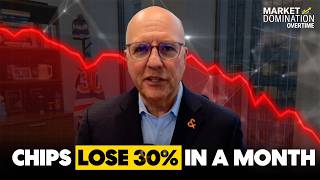
I think any joke about disappointment would be appropriate today. And we see that both closed at the lows of the day. So, chip stocks fell 11%—their worst day since what seems to be the pandemic lows of 2020. Nasdaq 100—worst day, probably, since April 2025. And look at what has happened in the last month.
We peaked almost exactly a month ago , on October 6th, with a significant intermediate high. It wasn't an absolute high for chip stocks, but it was one of the turning points. So the monthly chart really shows a deterioration of the situation over this period. During this time, chip stocks lost 30%. Meanwhile, the Nasdaq 100, full of those mega-cap companies we like to talk about, fell 15%, or about half as much.
So, in agreement with the previous guest, we've talked about concentration many times during this three- to four-year bull market, and you know what? This is no longer a concentrated market. Everything has changed. Before we move on to the next point, I want to show you what's happening with credit ETFs.
So we have three times leverage on semiconductors, up and down, and in one day the bearish bet was the winner . It rose by almost 40%, while Soxl, the bullish bet, lost 40%. This just goes to show that these tools are not for the faint of heart. Leverage can really hit you if you don't know what you're doing.
And speaking of the Sox semiconductor ETF in general, the momentum they've gained since the beginning of the year, Jared, has been pretty significant. Is this pullback expected, perhaps it is profit-taking? I think we've definitely seen a lot of profit-taking over the last month. What worries me is that now there are new catalysts due to the elections, the situation could escalate, and we could see a continuation of the recession.
Let's move on to the charts , I'll show you the dynamics since the beginning of the year for both the Nasdaq 100 and the chip sector, as it looks now. This was , so to speak, the "floor" or what was considered support for the chips. This is no longer support. We had a low tested in the summer and it was tested again a few days ago, it broke through the 200-day moving average and now it just collapsed.
Meanwhile, it maintains a 24% gain, but this is a market that grew by almost 90% in the middle of the year, in early summer. Now take a look at QQQ. The Nasdaq 100 rose by... how much? 20, 25, maybe even 28 %. Now it is falling back to zero . A lot has been damaged here, and if there's time, we can discuss cost versus growth, because that's another topic I'm researching.
Yes. Jared. Certainly. I want to hear more about this as we discuss it today. Where do we stand now, especially given this pullback, in terms of growth versus value stocks, and what should investors know right now? October 6 was a key turning point. Since then, everything seems to have changed. So let's go to the interactive dashboard, and I'll show you the Russell 1000 value to Russell 1000 growth ratio.
So the purple line here is the value stocks, and you can see that they're still holding a 3.2% gain, and for most of the last month they've been going up, going up, then kind of leveled off, but they've jumped up dramatically in the last few days. Trading in value assets has really picked up, and many have asked whether this has any prospects?
Is it like 2001, when the dot-com bubble burst and value stocks outperformed the market for years, or is it just one of those intra-year things that last for a while and then we go back to the usual story of growth taking over, as it has for most of this century? And the other line is growth stocks.
As you can see, they've already fallen by 14%, and after a day like this, I'd like to say that maybe everything will return to the average, but I'm not sure that's necessarily the case. I think we should take this as a serious alarm bell, considering how many technical levels have been breached. Yes, we usually have a rebound the next day , but it often turns out to be a " dead cat rebound." So at the end of the week, which is tomorrow, the situation probably won't look too optimistic.
So we need to look at next week and think about what we can build on there. What new catalysts might emerge? Will we see a downgrade for many of these stocks that have just seen incredible declines? This is my biggest concern. But in the meantime, many of these valuable names are still holding on. They fell today, but essentials, energy, healthcare—many of them held on to gains and even increased them over the last month.
Jared, I wonder if we'll see any reaction to the employment report tomorrow. I mean, 65,000 jobs. jobs tomorrow. Yes. We have employment data tomorrow. Tomorrow is the first Friday of the month. So, we expect, at least Wall Street expects, about 65,000 new jobs. Let's see if we get it. Jared Bleakry, as always, thank you very much. Good luck to everyone.


댓글 0