원문 보기
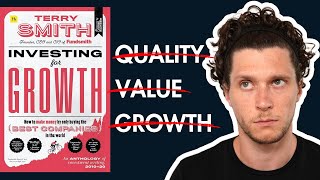
Hey everyone, in this video we're going to look at how to manage bear markets, then why the distinction between different investment styles—gross investing, quality investing, value investing—doesn't necessarily make sense, and finally what disadvantage professional investors have over individual investors.
I'm taking these three points from Terry Smith's book, "Investing for Growth," which I recently finished, and this isn't an exhaustive summary, so I still recommend reading it. First point: how to manage bear markets according to Terry Smith. First of all, no one can predict the timing of a boom market.
So, it's simple: don't even try. Secondly, never listen to people who predict that a boom market is inevitable next week or next month, because it's impossible. Secondly, if you listen to these people who predict boom markets and then stop investing, or worse, sell everything you have, you risk missing a huge opportunity.
Because even if that person is already in a boom market... At some point, she'll inevitably be right one day; there will be a bull market. But if, between the time this person predicted a bull market—and therefore when we invested or sold— and the moment the bull market actually occurs, it's possible that, despite the correction, the stock price at that point—well, the market price—will still be higher than when the bull market was announced.
That's why you should never exit the market, and also never think, " Because the market is expensive, I'll stop investing." You always have to be looking for opportunities, and the times when there truly are no opportunities are very rare. Point number 3 is that bull markets don't die of old age, so phrases like "This bull market has lasted too long, so there will inevitably be a bull market" don't work.
You can't draw conclusions from that; you can't make decisions based on that. Markets do n't have a lifespan either. Point number 4 is not to think that a bad A new negative event will inevitably cause the end of a BLL market, since bull markets tend to, in English, climb (or "climb of war"), to overcome a wall of anxiety.
For example, if we go back to before the dot-com bubble, Alan Greenspan in 1996 said that the markets were irrationally exuberant. So I looked at the valuation multiples at the time, and I don't understand why he said that, at least based on valuations. But he must have said it based on other reasons, perhaps economic issues, I don't know.
In any case, he said that the market at the time was irrationally exuberant. And in 1997, there was the Asian crisis, the Russian crisis, and the collapse of Long-Term Capital Management in 1998. These negative events made the Fed hesitate to raise rates. They were planning a rate hike, but then they hesitated to do it precisely because of these negative events.
The fact that they hesitated to raise rates caused another leg up until... 2000 and then the bubble burst. So, between the moment Alan Greenspan judged the markets to be irrationally exuberant and the bursting of the bubble, four years passed. Although, looking at the valuation multiple in '96, I have trouble understanding why he said that.
Anyway, point number 5 is that the longer a bull market lasts, the more it refocuses. We would intuitively tend to think that the more a bull market advances, the more it expands to encompass the entire market, but it's actually the opposite that happens. So, we had a bull market between 2009 and 2020.
In 2020, the entire market started to rise, then it refocused on the US, then on US tech, and finally it refocused on what we called the "fengs": Facebook, Amazon, Apple, Netflix, and Google. And point number 6 is that a be market will inevitably happen one day, but since no one can predict it... Well, it's better to simply ignore that, invest in good companies at reasonable prices, and above all, hold on emotionally for the day the bear market finally arrives.
So that was how to manage a bear market according to Terry Smith. Next, we move on to why the distinction often made between growth stocks, quality stocks, and value stocks is superficial, according to him. He begins by quoting Warren Buffett, who says that many analysts think they have to choose between two opposing investment styles: value and gross.
And we see this as a mistake. In our opinion, the two approaches are strongly linked. Growth is always a component in valuation calculations, and its importance can range from negligible to enormous, and its impact can be either negative or positive. Then, in the book, Terry Smith adds that most investment strategies require attention to valuation, even his own, which focuses on high- quality stocks and which people tend to categorize as quality investing.
Furthermore, the growth rate itself is a critical component of valuation calculations, and that's important to... Understanding this is crucial because otherwise, someone who identifies as a growth investor might be inclined to ignore valuations and pay any price for growth, even growth that destroys value.
This is possible if that growth is achieved through debt and dilution, and in startups, we find many cases where growth is largely achieved through dilution. Furthermore, someone who considers themselves a value investor often falls into value traps, focusing too much on multiple valuations but ultimately buying companies that are in dire straits or have stopped growing.
This doesn't yield very good results. Those who define themselves as quality investors might believe that quality comes at a price and therefore ignore valuations. They can also fall into the trap of buying shares of companies considered solid, like Coca-Cola today, for example, which has a good profitability ratio—a central criterion for a quality investor— but which now has very little growth.
It's rather expensive compared to the low growth, so it can also be a trap. That's why I think there's no need to put yourself in a camp like that, in a category. You can find quality stocks with good growth that you can buy at reasonable prices. And you see, when you do a cash flow discounting, you have to take growth into account.
It's really the variable that will most influence the result, since we need to estimate roughly how much freshness the company will generate in the future. To do that, we have to start with the current freshness per share and apply a growth rate to estimate how much they will generate in the future.
So that was the distinction between the different investment styles. And the last point is a significant disadvantage that professional investors, like fund managers, have over us individual investors. This disadvantage stems from the fact that to maintain their reputation, it's better The biggest risk for fund managers is not underperforming the index, but rather falling short of the index's performance and that of other managers.
If they take the risk of doing things differently, they risk significantly underperforming. However, in that case, clients will withdraw their money, and since funds primarily earn by taking fees on assets under management, this will simply mean they earn less money. Therefore, they can hardly afford to take this risk.
Yet, to achieve good performance, one must be somewhat contrarian and unconventional. But for a fund manager, this is difficult because they risk ruining their reputation if they make a mistake. Therefore, they prefer to avoid this risk by buying a large number of stocks and diversifying to the point where their performance is very close to that of the index and other managers.
one of the others, and if you then add to that the fees, well, in the end, the net performance is in most cases lower than that of the index. So that's another argument for not listening to people who tell you it's impossible for an individual investor to beat the market because professionals can't manage it.
As professional investors, they have constraints that we, as individual investors, don't. And tell me in the comments if you like these videos where I give short summaries of the investment books I read, and tell me if they're useful to you because it's true that after reading so many investment books, I end up finding these points a bit commonplace.
But I tell myself that it's not necessarily for people who haven't read these books, so I don't realize. So tell me in the comments what you think. And I remind you that you can try the website I developed for doing my own stock analyses for free for 7 days by clicking on the first link in the description. See you in the next video!

Comments 0