원문 보기
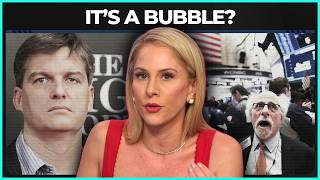
Michael Beugry is one of the famous investors who predicted the "big short" in 2008, when the housing bubble burst, and he was able to play on the decline. He was right that everything would fall apart. Well, now he says the AI bubble will burst and the economy will crash again. So why does he say that and what kind of mess are we in?
Annie, you have this material. Well, there's a lot to be concerned about with our economy, and if you look at the stock market, you hear all these fantastic stories about how we're in a " bull" market. Bull market, bull market, everything is great. The stock market is doing very well. But if you dig deeper, you will see that there are serious problems.
I will outline these issues now, but first a few words from Michael Beugry, who says he is switching from short positions in key AI stocks to put options. So, he says, “Basically, I’m speeding up the timeline. As a result, I want more leverage in my short positions. The AI bubble may burst sooner than expected.” So, he believes there is an AI bubble, which is why he shorted AI stocks.
However, by moving into put options, he believes or signals that this bubble will burst sooner rather than later. He cited a recent study by Aris Management that highlighted the fragility of relying on unverified AI revenues structured through complex legal agreements. So, you know, the revenue aspect here is really interesting, considering how leveraged these AI companies are, how much debt they've taken on to build data centers, for example.
There is also the issue of circular lending or financing within the AI sector. He is not the only one who has researched this and concluded that we are experiencing an AI bubble. John Higgins, chief economic advisor for financial markets at Capital Economics, quotes: “There are many signs that we are now in the late stages of an AI bubble .” James Riley, senior market economist at Capital Economics, agrees.
He says: “If you look at the rate at which the profits of the leading AI firms are expected to grow compared to the rate of growth of the US economy, by many measures they look very overheated, as if this is the dot-com bubble again.” And while we believe AI will be transformative and profitable, we don't think the returns will be as high as analysts expect.
And to give you an idea of the scale of spending in the field of AI, in 2026, global investment in AI projects, according to Goldman Sachs, will reach $1 trillion , including $581 billion in the United States. If you look at the stock market as a whole, it looks extremely optimistic, but if you dig deeper, you realize that this is not entirely true.
So, let me give you the numbers. The S&P 500 index is less than 100 points away from its all-time high set in mid-August and has every chance of rising 12% by the end of the third quarter. Last week, it rose 1.2%, while the Nasdaq Composite Index added 2% after setting a new record just a week ago. Wow, that looks really good.
It seems like everything is going great in the stock market, right? No, you are wrong. Because you're not seeing the whole picture. Only one S&P 500 sector— information technology— has shown growth over the past month. Only four out of 11 sectors showed growth over the past two months. In reality, the market is held by only five stocks.
I'm not kidding. Five stocks have driven the vast majority, namely the S&P 500's stunning 93% gain since late July. All of them are tech giants, and the leader is Microsoft, which accounts for 181 points out of the 330 points of the total index growth. So the other four companies are Meta, Apple, Alphabet, and Nvidia, which, by the way, just spent $150 billion on share buybacks.
We're coming back to you, Jenk. Yes. Here's one reason why the AI bubble will burst, and we'll talk about how catastrophic it will be. When most of the growth depends on AI companies, any small problem in them means that—poof— all that growth disappears overnight. This has resonating consequences for markets and the entire economy.
But wait, we haven't gotten to the most important thing yet. Most importantly, all banks have issued hundreds of billions of dollars in loans to AI companies. So when AI companies have problems, all the banks will go under, just like in 2008. And that's why Berry is betting against the markets again.
He pushed back the deadline, saying it would almost certainly happen by June next year. I think it will happen much sooner. And he too is starting to think it will happen sooner. That's why he's raising the stakes and willing to take bigger risks, because he thinks everything is about to explode. Maybe it wo n't happen tomorrow.
Maybe not next month. But will they last a whole year? This seems incredible . Now let's talk about triggers. What could cause a crash? Wall Street's expectations for these AI and tech companies are now too high. One bad quarter and we're in trouble, right? Because if you're operating at maximum, say , potential—100 conditionally , and the entire stock market thinks you're at 100.
Oh my God, you're going to conquer the world. These AI companies are going to take over. They will cost trillions of dollars and so on. And then suddenly in a quarter you don't fulfill the plan, you don't meet expectations. Usually they are punished for this. But if you are already at your peak and everyone thinks your potential is 100, and suddenly you are giving out 72, it will lead to a massive market correction.
And market corrections are what set off the dominoes. Not to mention what Michael Bury points out: what happens if revenue models that are largely speculative don't work out, especially at the start? Then people will panic and say, "Oh my God, we thought they were going to make a ton of money on, well, let's make another hypothesis, robots cooking us salmon, right?" As one of our guests said, " We're in for an amazing future.
Robots will cook your salmon, okay?" But it turns out that they either can't cook salmon, or they can, but people don't want to buy it. So, they are not meeting quarterly plans, perhaps significantly. Good night, Irene. AI companies are in trouble, banks are going under, and our politicians and media are once again talking about bailing out the bankers.
Well, let's move on to the allocation of aid, shall we? Because OpenAI seems to be preparing for government aid. Let's look at Chart 13. About a year ago, Sarah Fryer, CFO of OpenAI, stated that one way the company could support its current financial balance sheet on the verge could be through financial support or a guarantee, i.e.
a government guarantee. Yes. This allows the financing to happen. Yes. By the way, at almost the same time, Sam Altman , the company's CEO, said the following: " Given the scale of the economic impact of artificial intelligence that I expect, the government should act as the insurer of last resort." I'm tired of our government picking our pockets for these losers.
And when I say losers, I mean industrialists, businessmen, you know? Who play dirty, screw everything up, and then expect American taxpayers to bail out their asses. What about "no"? Guys, what Anna just read to you is actually the most disturbing part of the story. Why ? Because Sam Altman, the head of OpenAI, is already planning to fail.
That's why he wants the government to become the insurer of last resort. What does this mean? Remember when I told you that banks took out loans and put everything on AI companies? When they go bankrupt, Altman says, “No, it’s okay. The American government will bail out the banks and bail out the AI companies.
” Why the hell do we, average Americans, have to bail out the richest people in the world? Because that's what neoliberalism is, okay? Neoliberalism serves the rich, it serves corporations, it does not serve the people. And we live under a neoliberal, you know, system. So, here's what they don't understand.
They really don't get it at all . I mean, it's a different type of bubble, a media bubble, that they're in. So when Sam Altman says "the insurer of last resort ," it means he already knows about their problems. Otherwise you would n't be talking about an insurer of last resort . Why do you need to talk about this?
When you start a company or a company is thriving, no one says, “ Wait, wait, wait, wait.” Let's make sure the government bails us out when this thing inevitably falls." You wouldn't even be having this conversation if you didn't already know, right? So, why do you think they want to be regulated? They don't want to be regulated.
In fact, they spend money through lobbyists to make sure they are not regulated. No, they want the government to be closely tied to them, so that the government can bail them out with our money. Every time you press the bell at the bottom, the angel gets its wings. This is not entirely true, but it allows you to stay up to date with our live broadcasts.


Comments 0