저자: MikeMayo · 외국인
요약 보기
JP모건 CEO 제이미 다이먼의 승계 이슈가 시장 우려를 키울 수 있으며, 다이먼이 떠날 경우 시총 약 250억 달러 감소 가능성을 언급. 은행 업황은 수년간 양호하나 8월 들어 경기침체 우려로 단기 실적 기대는 낮아짐. 회사채 스프레드와 은행채는 안정적이라 주식 패닉과 대조적. 씨티그룹은 단기 불확실하나 여전히 최선호주, 단기엔 은행 그룹 전반에 신중. 금리 인하는 순이자마진 개선 폭이 기대보다 작을 것으로 봄.
다듬은 글
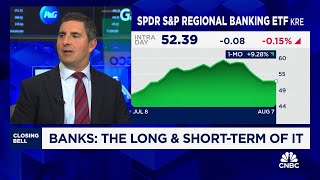
So, it was JP Morgan CEO Jamie Dimon speaking today about the succession plan at JP Morgan. This was an exclusive interview with our own Leslie Picker. Joining me now, after nine, will be Mike Mayo from Wells Fargo Securities about this bank, Mr. Dimon, and the situation with bank stocks. Nice to see you again.
Thank you for inviting me. Uh, Dimon is 68? Is he 68 years old? Well, he has, you know, about 2 and a half years left on his contract. So, are you thinking about this yourself? About the succession at JPM and how you see the future of this bank? I would say that a lot of the institutional investors I talk to ask me about succession at JP Morgan.
They really ask. Um, especially given Jamie Dimon's recent Washington Post article and his letter to shareholders in this year's annual report . He talks about America, the press comments about whether he would go into public service, and in that exclusive CNBC interview you did today, he was asked not once, but twice, if he would consider public service, and he said, "I love what I do." What I read in this is that three, or three or four times.
Maybe three or four times. He didn't answer. So if he's going to be the Treasury Secretary, the next Fed chairman, or something like that, he didn't say no. And that certainly becomes a little more noticeable during an election period like this. And having done a survey of investors, not scientific, it was something like, "How much would stocks fall if Jamie Dimon left?" So, what do you think about this?
by about 5%, which would mean a minus of $25 billion from market capitalization, making Jamie Dimon a man worth $25 billion . What about the financial sector here and now? We need to, you know, consider the stakes. We also have concerns about the economy. So, how do you look at this? Look, the underlying outlook for banks remains good for many years to come.
You are looking at a multi-year revenue and profit tipping point that will begin sometime later this year in 2025. That said , um, no dessert for bank investors in August, maybe a little longer. And this dessert was taken away. New data has emerged. The unemployment rate increased slightly. Um, interest rates are much lower than people expected.
Uh, the "R" word is back, recession. So you'll have to reconsider your expectations for the extra capital market returns you might have expected in the summer— you might not get them. Additional income from spreads due to higher interest rates and the so-called revaluation of underlying assets — this may not happen either.
And additional release of reserves for problem loans—that's something to forget about for now. So, the trend is still positive, but perhaps not as strong as before, and we need to adapt to that . So I say this is just a small setback in my long-term strategy that requires a little more short-term caution.
What are your expectations for capital markets, since you mentioned it? I mean, David Solomon from Goldman Sachs was quite optimistic about this in his last speech. Rich Handler of Jefferies has published what I think is one of the most optimistic notes on the current state of capital markets, if not the most optimistic, that I have ever seen.
There are huge long-term enabling factors for capital markets, especially that “x- factor” of private equity: trillions of dollars to invest, years of pent-up demand, and significant liquidity. But this market hitch could put a damper on things , at least for the near term. Another thing I think about before going to bed and wake up with in the morning: is there any serious problem in the market due to such volatility in recent days?
So far, I don't see anything catastrophic. By the way, Jamie Dimon, whom Leslie asked about whether there is a recession now. The first thing he mentioned was lending. He said that everything was fine with that. Of course, the situation could worsen at any moment, but he doesn't see it that way right now , and the credit markets confirm this.
I agree with this, so the outlook for banks remains good . One indicator is that corporate bond spreads over Treasury bonds are still close to a relative minimum. They are 100 basis points above. In 1998, they were twice as high. By the way, the spreads of bank bonds of the largest players are also close to a relative minimum.
So the $ 7 trillion investment bond market is reacting calmly, while the stock market is panicking a bit. This is the opposite of what happened, say, during the global financial crisis. Remember, the fixed income market was a much better indicator of the future than the stock market. The stock market, you know, all my colleagues, we were slow to take this signal.
In this case, the bond market seems to say, "So what?" Is there any signal today or this week in the fact that JP Morgan is in the black despite the turbulence? Goldman Sachs is also in the black for the week. And City fell by 4 and 1/3%. Why? It's just a Pavlovian reflex. The bell rings—and you drool .
There is a market failure and you think, “Who is most likely to win?” Those who have won in the past, Goldman, JP Morgan. Who is most likely to lose? Citigroup. I think it's just a spur-of- the-moment reaction based on their performance over the last 10-20 years. I don't think it matters much. There is a certain connection with reality, but I would n't attach too much importance to it.
We will see the results in the third quarter. And by the way, if Citigroup can handle another similar industry problem, it could help their re-rating. This is still my number one pick, but with a caveat: in the short term, we are more cautious about the entire group. What about regional banks, or perhaps it's better to ask about large regional banks?
This is , in fact, what you are covering when it comes to such promotions. What should I think about this now? Well, I think there is a problem with lowering rates. Be careful with your wishes. Everyone was saying, "Let's lower the rates." Banks are often viewed as a cyclical instrument . So, the Fed lowers the rate—you get growth.
But net interest margin, I think, will increase for banks, but not as much as you expected earlier, because by reinvesting these securities at a yield that is 70 basis points lower than a month ago, you won't get that effect. OK. Nice to see you. Thank you for coming. This is Mike Mayo, Wells Fargo.


Comments 0