원문 보기
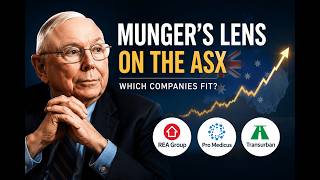
So, the question for today. If you took Charlie Munger's mindset, the same rules he talked about his whole life, and applied them to the Australian stock market, which companies would most closely resemble the type of business he loved? Not the ones he would buy—we can't know that. And only those that meet his criteria.
That is the essence of today's task. But before that, a brief warning. Nothing in this video constitutes financial advice. I am not a licensed counselor. This video is for educational purposes only. Do your own research. If necessary, consult a specialist. Well, let's go. So, who is Charlie Munger? For most of his life, he was the " quieter" half of Berkshire Hathaway, Warren Buffett's business partner, and the person Buffett credits with changing his approach to investing.
Munger's main idea was easy to voice, but difficult to put into practice. Buy a great business at a fair price, not a mediocre business at a great price. In other words, the quality of the business is more important than the hunt for cheapness. He spent decades reading annual reports, biographies, scientific and historical works, creating what he called a "grid of mental models" for solving problems.
And he had a level of patience that we often lack. He could wait years for the right business at the right price, doing nothing in the meantime. This patience and focus on quality are the foundation of the lens through which we will evaluate the market. So , let's turn his words into a checklist . I created it solely based on what Munger actually said.
His speeches, letters to shareholders, Daily Journal meetings. Four mandatory requirements. The first: a strong "moat", that is, a business with a real lasting advantage that is not easy for competitors to copy. Second: high return on capital. Munger aptly put it back in 1994. In the long run, a business that yields 18% on its capital will give you much more than one that yields six.
That's why I set a threshold for return on equity— that is, profit relative to shareholder funds— at at least 15 %. Third: low debt levels. Munger was very suspicious of loans, so I needed a clean cash reserve or minimal debt. And fourth: a business you can truly understand. If it falls into the "too difficult" category, we cross it out.
Now, how do you go from a few thousand registered companies to a shortlist? I started with the 200 largest, the ASX 200. I first removed the sectors that Munger avoided: extractive industries, banks and heavily leveraged real estate trusts. There are about 70 left. Next is the basic selection by quality: sufficient size, several years of audited reporting, real profitability.
About 55 companies passed this stage. Then four mandatory conditions as hard filters. Only a few passed all the barriers without exception. The company with the highest score is REA Group, the business behind realestate.com.au. Let me show you why it's suitable. Its return on equity is about 34%. This is an exceptional indicator achieved with net cash in the accounts.
No debts doing all the hard work. This is the moat that Munger loved so much . When you sell a house, you place your ads where the buyers are, and the buyers go where the ads are. This circle is very difficult to break. But, and this is important, I'm not saying this is a call to buy. Every leader must show where he loses.
And here is the gap of REA Group. It is never cheap. The market knows exactly how good this business is, so it almost always trades at a high price. So, it has the highest score on Munger's criteria for a great business. He simply rarely offers that fair price, which was the second part of his famous phrase.
Second on the list is Pro Medicus, a medical imaging software development company. Based on the " naked" numbers, it's almost hard to believe. Return on equity is around 77%, no debt, and still run by the founders. The catch is that it is even more expensive than REA Group and depends on a fairly small number of large contracts in the US.
A great business, rated as excellent. And now the part that I find most useful. Let's look at the one that seems like it should fit, but doesn't. Transurban, a toll road company. At first glance, she is perfect. Almost a monopoly with prices rising every year. A moat you can literally drive on. But it fails two of the mandatory criteria.
It has about $21 billion in debt against $ 9.5 billion in equity. And its return on capital is meager. Profits are built on borrowed funds. And that's exactly what Munger advised people to stay away from. Now I want to be frank about what this screening cannot do. He reads the numbers. And numbers won't tell you whether management is honest or whether the corporate culture is good.
And Munger took great care of both of these aspects. It also won't tell you about the price and time. A great business can still be a bad investment if you pay too much for it today. And he can't see the future. Moats that now seem unshakable may imperceptibly erode. Technology has a tendency to do this.
So treat this as a starting point for questions, not a list of answers. So, if you take only one thing from Munger's experience , let it be this . See how businesses actually make their money. Profits based on sustainable advantage and a transparent balance sheet can grow for years. Profits made by accumulating debt usually do not. No matter how good the story sounds, you don't need Munger to suggest action.


댓글 0