원문 보기
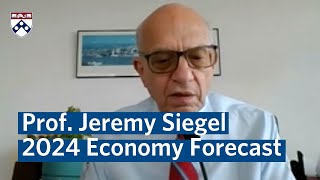
Dan Loney: Well as we start our year-end recap, pleasure to be joined by Wharton Emeritus Professor of Finance, Jeremy Siegel. Jeremy, thanks for your time today. Happy to be here, Dan. - All right, let's start with 2023. And kind of give us a recap of what happened in regards to the expectations I guess you had a year ago of what we might see play out.
Right. Well, I was right on some things, not on others. I was right that the economy would rebound. That I thought productivity would come back, which it did. I was also right this— I was bullish on the stock market. And that was way out of line with consensus, which was, for the first time in 20 years, actually predicting negative.
What I was out of line with is I thought the Fed would start lowering rates by the middle of the year, and it certainly didn't. It kept on raising them. We're in a pause now, which I think we are in. So I was right on the stock market. I think I was right on the rebound on the economy. But I didn't— what I didn't appreciate was how much internal strength this economy had.
And everyone was surprised. The Fed, private forecasters. They all thought that if interest rates would stay this high, that we would be in a much slower economy than we did. We're going to have an economy that is going to rise more than 2%. Way out of consensus. However— and this is important as we look forward to 2024, Dan— we do have a really slowing economy now.
So we do have to watch out for 2024. The expectation is, I think, that after we had the 5.2% GDP in Q3, that we were going to see a slowdown. To what level, I guess, we're still to be determined. And is your expectation that we'll probably see that carry over at least through the first quarter of next year?
- Oh, absolutely. So current expectations are between one and two. And they're going down. We actually do have the Atlanta Fed, now, which actually tends to be on the whole overly optimistic, down to 1.2, which would be the slowest quarter this year if in fact that is realized. Of course, it all depends on Christmas sales.
December's really important, how does sentiment hold up or not? So the whole year certainly is way above expectations. But we're in the slowest quarter. And it seems to me that unless the Fed starts realizing that all its tightness is— is in the pipeline and will press on the economy in 2024, they have to start thinking about lowering rates.
Inflation is beat, basically beat. There will be core elements that will continue to rise institutionally, determined elements that take months to flow through. But to crush those would mean crushing the economy to an extent that I think would be unadvisable from an economic standpoint. Your expectations, then, from this past year in terms of the stubbornness of the economy— is it more around the labor market?
Is it around the spend that the consumer had? What— where were the areas that— that maybe caught you off guard? Certainly the consumer spending. And that's the area I was pointing to that was much stronger than anticipated. There was still a lot of pandemic money that had to be absorbed. And it isn't— I think being in the last stages absorbed right now, but that— that definitely had a stronger effect.
Also, the higher interest rates are not having quite the negative effect that many of us thought. Housing has remained— not thriving but not collapsing. Although recently, the Homebuilders Sentiment Index has gone back down again. People still view homes as great long- term hedges against inflation.
Builders are buying down mortgages to five and 6%. And home— homeowners are continuing to put their money in that. Same thing as far as consumers. They still have excess money. If you have your home, you have a lot of excess equity. Home prices have gone up 50% in the last three years. So there's a lot of home equity that is built up also that's supporting consumer spending.
So— and corporations now regard, you know— the debt is— is more costly than it was. But, you know, debt is "promise to pay" dollars. And if we're going to have inflation in the future, there's hope that those dollars will be worth less. They're more willing to take that on than they had before. Are you expecting to see, then, some sort of labor contraction as we move forward?
I mean, we've obviously seen companies, anecdotally, over the course of the year, announce job cuts. It hasn't seemed to be kind of this wide swath that maybe some people had believed that it would be, but it still feels like even as we enter the end of the year and head into the new year, that that is still a possibility of occurring.
Yeah, absolutely. I mean, you know, as we're recording, now, we're going to get, you know, another labor report Friday. And we're gonna get the JOLTS report, which is a job openings and labor market turnover report. These are also going to be important. But there is definitely a slowdown, there is no question.
And the real data has really become almost consistently on the weak side— weaker than expectations over the last six weeks. So— and you're beginning to hear anecdotal statements about the job market that are more negative than I've heard since the pandemic. You know, even in the erstwhile hot areas such as biotech, people are saying it— it isn't the way it used to be.
So we have to be on— on the lookout there. We also have to realize that employment has gone down— up from 3.4 to 3.9%. Could reach four. That's generally a trigger for an— a recession watch, once it goes up by one half percent. So we are near a recession watch at the present time. I don't expect a recession, if we have it, to be severe.
However, certainly, we do not have the robustness that we've had for two years. Firms are finding people, even in the high tech area. A lot of high tech was let off. Across the board, the labor market is far more normal now than it has been for several years. But it still seems like we're at a point right now, where as we go into next year— that even though there is that concern, that there is still a strength in the labor force in general.
That, you know, the mass layoffs that I think a lot of people expected just have not come to the level that a lot of people expected. Absolutely. And I thought we would begin to see much more labor softness early, although I wasn't as pessimistic as a few economists— Larry Summers and others— who predicted, you know, a deep recession by the second half of the year.
And we're almost of course, done with that. But even the Fed, in predicting the unemployment, way over- predicted— everyone over- predicted what the unemployment rate would be. So everybody did not expect the economy to be as strong, and the labor market to be as strong. So, you know— and this is positive.
At the same time inflation has gone down quite well. Hasn't been vanquished 100%. It's a long process. My big hope is that the Fed doesn't get stuck on the downside and delay the way it did on the upside, as we had talked about last year and even before that, tightening way too late. The Fed has to be pre- emptive, they have to start thinking about lowering it even if they're not going to lower— certainly not at this December meeting.
But even if they don't lower it at January, they may have to lower it at— in the March meeting. That's— that's the interesting thing, because there's more and more. I hate to use the Las Vegas term, but it seems like the betting money is saying that March would be a possibility. I think it's almost a lock that a rate cut at May would occur.
But March may come into the radar a little bit more. And is your expectation that when they cut, that it's probably going to be fairly incremental, like quarter point, for the most part? Oh, yeah, I think so unless the data falls off the cliff. Which I don't expect. Not impossible. But, you know, a slow creep up would first be a quarter— be just changing direction has a tremendous psychological effect.
If Powell just states, at the December meeting, you know, "We began talking about possibilities if the economy further weakens. However, if inflation strengthens, we still have the option of going up." A real two-sided debate must begin, not just one-sided. Remember, at the November meeting, he said, "We're not even talking about a rate cut." He should start talking about a rate cut.
We should also realize that the Fed is really totally data- dependent. At their September meeting, which is less than three months ago, a majority of the Federal Open Market Committee expected one more increase by December. Now, it's virtually certain there will be no increase by December. So there was— 10 weeks ago, the majority got it wrong.
Certainly, there's going to be a lot of buzz about the dot plot and looking ahead for 12 months. But one has to realize how tenuous those estimates are, just by looking at the last three months— how wrong they could be, just like they were wrong on how many times they would have to hike it in 2022 and 2023, way underestimating it.
And the reason is, because no one really knows what's going to happen until it happens. And the Fed is not any better. There's a debate about whether they're worse, but not any better than the private sector, in terms of really knowing when a recession is going to come on. And so they've got to be completely wedded to the data.
I've talked with you in the past about this, but I'll bring it up as we're heading into the new year, is kind of how unique this time is in terms of economic history and obviously, what we went through the pandemic. But making the adjustments and being able to, you know, try and bring this plane in for a soft landing with all these different dynamics at play.
Yeah, I mean, it is really difficult. I mean, we— you know, we really haven't had a pandemic. Only 100 years ago, really. The economy didn't shut down. So we've really never experienced what happened before. So that automatically means that there could be unorthodox things happening. I hear a lot of people praising the Fed.
My goodness, we get a soft landing, it'll be the first one and how great Chairman Powell is. Before one praises him so fulsomely, one should realize, in my opinion, he was the one that let it go too late, even caused the inflation. So it's almost like when we ran over the pedestrian, now we're praising the car owner for driving him to the hospital so quickly that he survives.
We didn't have to have as much inflation as we had, had the Fed start raising in early '22, instead of early 2023. We, in my opinion, would have had much less inflation. So yes, it'd be great if they could get into a soft landing. I'm not discounting it, it could happen. May not. But it still does not, to me, give a let's— let's give Jay Powell the Nobel Prize So here in Economics for what he's accomplished over the last three years.
So what's your expectation, then, we will see play out with the Fed that over the course of the year? How many times do you think that they are going to cut? And is it going to get to a point where— and again, a lot of this is data dependent, that it's going to have to be kind of a a normal routine to make these quarter point rate cuts, three, four or five times over the course of next year?
One has to remember, Dan, debt that normally, the term structure dictates that we have higher long-term rates than short-term rates. Right now the Fed funds rate is between five and a quarter and five and a half. While the long term bond is fully a point or— or more below that. That's called an inverted term structure.
It is unusual. It has, over the last 60 years, predicted recession with a very high probability. We don't want to keep that curve inverted. So we— my feeling is that we got to bring that short rate down. I would prefer to bring it down 50 basis points below the long rate— which, if it stays at the current level would mean bringing it down to 3.75.
And I'm not talking about doing it tomorrow or— or the next month. But over the course of the year, we should see the Fed funds rate in the three area as the long bond stays near to 4%. We're joined by Wharton Professor Jeremy Siegel, talking about what we've seen play out in the markets in 2023, and what we head for in 2024.
I remember a few years ago, talking with you, around Dow 30k. Is it time to even start to consider Dow 40k at this point? Yeah. I mean, let's put it this way, if the Fed responds quickly to a decline with the drop in interest rates, I'm— I think we could get another 15% next year or even higher, with the small and mid caps participating more fully, because of the fear of recession being obviated.
We have to get our money supply growing again, we've got to get the reserves of the banks going again. They've been stagnating. Money supply has gone nowhere in two and a half years. You need money to grow at about 5% a year to give you two, two and a half percent real growth, and then two to two and a half percent inflation, which is the Fed target range.
If you keep money stationary, as it has been over the last two to three years, I think you are really looking a recession right in the face. So we need to get that going. But if he does get that going, and you get that going by lowering rates, because that encourages loan activity, banks, then can loan more.
Build up deposits. I think we could have an excellent year next year. I think the productivity rebound that we see this year can continue next year. I can make a positive contribution to that productivity. We could have higher labor force participation. And the reshoring of many production processes would be another positive for the United States.
Going forward, we could definitely get to 40,000. I'm not saying, you know— you know, by the end of of the year. But, you know, ten to 15 and even 20%, not out of the question. If the Fed is stubborn, and says "I'm just going against inflation, even if the data gets soft," you know, those— those goals would have to be modified greatly.
Jeremy, always great to talk to you. Thanks for your time today. All the best. Thank you and happy new year. Dan. Happy New Year to you too, as well. Professor Jeremy Siegel Wharton Emeritus Professor of Finance.


Comments 0