저자: AndriiMakakhov · 외국인
요약 보기
마이클 베리가 부진했던 마이크로소프트(MSFT)를 매수한 사실을 계기로, 사업 펀더멘털(매출 약 810억달러, 높은 마진, 잉여현금흐름)과 내부자 매수를 근거로 회사 자체는 견고하다고 평가. 밸류에이션은 과거 10년 중간값 대비 저렴한 편(P/OCF 20배 미만, 선행 PER 25배)으로 제시. 소프트웨어 ETF(IGV) 동반 하락에 휘말린 과매도 가능성 언급. 역DCF 분석상 시장은 상당한 FCF 성장을 반영하지 않는 수준으로 보이나, 크게 저평가된 '딥밸류'는 아니고 '시장이 약간 틀렸다'는 수준의 베팅으로 정리.
다듬은 글
Microsoft is supposed to be one of the biggest AI winners in the market, but this year the stock hasn't acted like it. In fact, compared to the rest of Magnificent Seven, it's been surprisingly quiet. And today, Michael Burry announced that he opened a position in Microsoft. And that's interesting because this is not kind of stock he usually goes for.
So, the real question is this the contrarian opportunity or the market actually right about the Microsoft this time? Because when people think about Burry, they think about someone who goes against the crowd. He usually buys things that are ignored, hated, or misunderstood. Microsoft is the opposite of that.
Everyone knows it. Everyone owns it. Everyone talks about it. So, if he's buying here, he's probably not betting on attention. He's betting on mispricing. Right now, the story about Microsoft is pretty simple. On one side, you have the bull case, AI, Azure, OpenAI IPO later this year, massive opportunity, one of the strongest businesses in the world.
But on other side, there are concerns. Growth is not accelerating as fast as some expected. AI expectations are already very, very high. And the valuation is not cheap, especially when you look at price to free cash flow ratio. So, the market is basically asking, "How much [snorts] upside is actually left?" So, let's quickly break down what's actually happening inside the business.
Microsoft generated about $81 billion in revenue this quarter. And what stands out immediately is how balanced the business is. You've got productivity and business processes at $34 billion. Here you have Office, LinkedIn, Dynamics. Then you have Intelligent Cloud at $33 billion. Here you have Azure, the real growth engine.
And More Personal Computing at $14 billion. Here you have Windows, gaming devices. So, right away, this is not a one-trick company. It's diversified across multiple massive markets. Now, look at profitability. Out of that $81 billion of revenue, Microsoft keeps about $55 billion in gross profit. That's an incredibly high margin business.
Even after spending $17 billion on operating expenses, including heavy R&D, they still generate about $38 billion in operating income. And here is the key point. Even while aggressively investing in AI and cloud infrastructure, this business is still printing cash at scale. After everything, taxes included, Microsoft ends up with roughly $38 billion in net income.
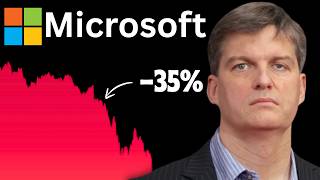
That's absolutely insane. The stock was down almost 35% from the highs, which could make Michael Burry interested in the company. Let's go through the key financials of Microsoft to see if this 35% drawdown was justified. The company is incredibly profitable, and most of the revenue are recurring revenue.
That's why the chart is as smooth as it gets. Revenue is growing up to the right. Net income, similar story. And free cash flow in the last 4 years did not grow as much, and the main reason is because Microsoft is investing significantly in CapEx. The margin story is beautiful. Gross margin improved from 64% in 2017 to 68, almost 69% in 2025.
And the only free cash flow margin currently is showing not the best story, but as I just mentioned, the reason is the significant investment in CapEx. And if you believe that this investment in CapEx will be justified and will have return on investment, this is absolutely worth it. Management is doing great job with controlling stock-based compensation.
Free cash flow improved from 30 billion to 70 billion in the last 10 years. Meanwhile, the stock-based compensation is just around $12 billion, dollars, which is not significant part of free cash flow for Microsoft. And as the company is very profitable and generating significant amount of free cash flow, 71 billion dollars generated in the latest financial year, 18 billion dollars was spent for share buybacks, and 24 billion dollars was spent for dividends for shareholders as a way to return cash to shareholders.
Another thing I found very interesting when I was analyzing insider transactions is that we have very recent insider transactions for Microsoft a buy in open market. Now, my opinion is that there are millions of reasons for insiders to sell the stock, and there is only one reason for insiders to buy the stock.
And that reason is that they expect the stock to go higher. Now, in InvestKit we visualize both politicians transactions buy and sell, and also insider transactions. Let me disable politicians transactions and we will focus only on insider transactions. High management directors of Microsoft. If we disable politicians, we can see that most of the transactions are sell.
Sell, sell, sell, sell, sell everywhere. And here we can see that director just purchased in the open market 2 million dollars at 397 dollars per share for Microsoft in February. I see this as a very good signal that management is confident in the direction of the company. After having look at financials of Microsoft, we can see that the business itself is extremely strong.
Margins are holding up. This is not a broken company whatsoever. And now the most interesting part, valuation. Let's start from price to earnings. Historically, in the last 10 years the medium price to earnings for Microsoft was 33 times. Now, Microsoft is trading at 26 times. In terms of the price to sales, Microsoft is trading at medium levels of 10 of the last 10 years.
For the price to operating cash flow, which I believe is the best magic to value Microsoft or value any company which is investing into the CapEx aggressively, is price to operating cash flow. And in terms of the price to operating cash flow, 10 years average was 23, and now Microsoft is trading less than 20 x price to operating cash flow.
And free cash flow could be ignored for now because it's skewed by high capex. Currently, Microsoft price to free cash flow is a 40 times with median over the last 10 years of 33 times. So, looking at valuation, we can confirm that the Microsoft is not trading dirt cheap like the companies usually Michael Burry prefers, but it's also not extreme depending on how you look at the growth and also the quality and the moat of the company because the moat for Microsoft is one of the strongest in the world.
The business is very diversified. It has software, devices, cloud exposure. But looking at Microsoft alone is not enough. What really matters is how it compares to the rest of big tech and why Michael Burry chose Microsoft over other big tech stocks. Here, I visualized all Magnificent Seven stocks with forward P, forward two years P, and forward three years PE.
And based on the data and analyst expectations, currently Microsoft is trading at 25 times forward P, which is cheaper than Google, cheaper than Amazon, and cheaper than Apple, but more expensive than Nvidia and Meta. But if you have a look at forward three years PE, we can see that Microsoft is trading cheaper than all other Magnificent Seven except Nvidia and Meta.
So, let's find out what Burry actually is betting on. I think one possible explanation is that Microsoft got punished together with the software trade. If you look at IGV, the software ETF is down roughly 27% from its highs. So, investors clearly became worried about software, AI disruptions, slower growth, high valuations, compressing gross margins, seat-based model for most of the SaaS companies, and Microsoft was partly dragged into the same narrative because Microsoft is a large part of IGV software ETF.
To some degree that makes sense. Microsoft is still has a huge software business, but the mistake may be treating Microsoft like a normal software company because Microsoft also has cloud, AI infrastructure, enterprise distribution, security, gaming, and one of the strongest balance sheet in the world.
And this is interesting because Burry wasn't only buying Microsoft, he also was buying other beaten-down software names. And I already made a separated video about that, so you can check it after this one. So, maybe Burry is betting that the market grouped Microsoft with the software weakness. When in reality, Microsoft may be one of the software survivors.
To see if the market is mispricing Microsoft, we can use a reverse DCF to see what implied free cash flow growth is priced in for Microsoft today. Based on the reverse DCF, implied free cash flow growth for Microsoft is a 17.87% for the next 10 years. But remember that currently Microsoft free cash flow margin is not optimized because they are investing in capex.
So, in 2021 and 2022, free cash flow margin for Microsoft was 33% in average. So, if we take the revenue of $281 billion and multiply by 33, which is optimized free cash flow margin for Microsoft, we'll get $93 billion in free cash flow for Microsoft. And now, coming back to the reverse DCF calculator, we need to override custom free cash flow to apply $93 billion for Microsoft.
And in this case, we'll get not 17% free cash flow growth, but just 14% free cash flow growth. And now, we need to compare this 14% free cash flow growth with the expectations for the revenue growth for Microsoft for the years to come, for the next 10 years to come. Looking at the revenue estimates, Microsoft is very well covered company by analysts 51, analysts 53, 33.
So, a really nice covering for Microsoft. We can see 16%, 15%, 16%, 15%, 13%, and then we have deceleration to 10%, 10%, 5%, but here is a relatively small amount of analysts are covering the company. So, overall, I don't think this is a crazy move from Michael Burry, but this is not a deep value play either.
There is more of a bet that the market is slightly wrong, not massively wrong. And in a company like Microsoft, even a small mispricing can still lead to solid returns. If you was buying the deep in Microsoft when it dipped under $400 per share, let me know in the comments below and specify which price you got.
Would be really interesting to see. If you want to analyze stocks like this yourself, you can check out InvestKit. We have all US companies available, financials, advanced projections, reverse DCF, insider transactions, screener to find hidden gems in the market, and chart builder where you can visualize and see any chart and compare different companies.
We are doing beta test for InvestKit now, and all the premium features are available for free. Link will be in the description below. .


Comments 0