
저자: 미상 · 외국인
요약 보기
영상은 젠슨 황 인터뷰와 엔비디아 GTC 발표 내용을 편집한 것이며, 후반부 분석가는 엔비디아가 현재 시장 평균 PER 수준에 거래되나 향후 12개월 이익이 60~70% 성장할 것으로 보고 저평가로 판단. 블랙웰·루빈 수주잔고 5,000억 달러 증가, 2030년까지 3~4조 달러 AI 팩토리 투자 전망 제시. 상승 시점은 특정하지 않으나 펀더멘털상 상승이 불가피하다고 주장. 장기 낙관 견해 중심.
다듬은 글
First Jensen, I want to thank you. I've been with a number of people over the last 6 months whom you made your company made millionaires. I've never seen it happen in 42 years on Wall Street. So, thank you. Thank you. Well, that's what that's what we do all this for. Make a small difference in people's lives.
There are a lot of people who feel that your stock is tapped out. The institutions own all that they could possibly have. I think they have to look at it differently. I think your stock represents incredible value and individuals understand that and a whole other cohort of mutual funds understand that.
Yesterday you presented things that would make it so it could be a level of growth that we've never seen. And yet your stock's a value stock. Have you thought about that? Well, you know, we're a very large company and yet we are accelerating growth at the scale that we currently are. And I think that's part of the story that a lot of people don't understand.
It's probably difficult to understand how a company as large as we are could actually be accelerating growth. But the reason for that is we're opening up so many new opportunities. We used to start out at the hyperscalers, but now we've expanded well beyond the hyperscalers. The number of new companies that we're working with, new countries we're working with, just ex- you know, just really really growing fast.
And so we're accelerating our growth. Well, and there's a loss narrative. And the narrative is this. There are a couple companies that control your business. There's a Google and there's Amazon, there's Microsoft. They are spending a fortune and they're making nothing. Aren't you the principal reason why people even go to them?
You know, we are they're not just our customers. We are their market partners. We bring customers to them. And the reason for that is because if you come to this conference, GTC, they're all of these industries that built on top of CUDA. We integrate CUDA into their clouds and then we get developers that come to their clouds that consume the computing.
So, they they're all here. AWS is here, Google Cloud is here, Azure is here, OCI is here, CoreWeave is here, and they're having a great time because we're bringing customers to them. And so, that's number one. I think number two is that we're expanding beyond the hyperscalers. You know, there's a there are many parts of the market that we could address that it's very difficult for other comp- companies to address because a lot of computing on prem, for example, all the work that we do with Dell and Dell's growing incredibly.
They have a huge pipeline ahead of them. HP's doing incredibly. They've got a huge pipeline ahead of them. I spoke with Lenovo yesterday. They've got a huge pipeline ahead of them. And all of that all of those on-prem opportunities, people are still building data centers. They're building it around the world.
They're building it in their companies. Those are very difficult to address for hyperscalers. Well, also, what I'm hearing is not really a semiconductor company. It's a company that is a platform with software loaded with software. And if you decide that all this company is is the four walls of a piece of metal, you're missing what is going to make it so we'll put a man on the moon a woman with on Mars that a self-driving car will be able to drive on black ice that we will see robots that take the place of the things that we don't want to do.
These are not what people should they don't understand that. And yet that's what you're talking about. You know, we invented this chip called the GPU. It is so revolutionary, people forget that we're, you know, grown well beyond that. And so Nvidia is today really an AI infrastructure company. We built all the technology inside an AI factory.
Everything from GPUs, of course, networking switches and CPUs and we optimize across the entire stack of software and chips and systems and we have ecosystem partners that span, you know, a hundred trillion dollars. And so the company has really grown well past the GPU. We're very proud of the GPU, of course, sure.
And we build the world's best GPUs, but the company is much much larger than that. Well, one of the things that I found myself thinking about was when we first met it was like 10 years ago. You've been on TV with us before, but you talked about one day we'd have an agent and I didn't understand it. I but it turned out to be like Harvey the rabbit.
It's right there and it's going to make us so much smarter. And people think, well, sure, 10 years old. Love it. It I maybe I get one in 8 months. You get one sooner. I think the well, the the the idea of agent an agent is someone who's able to reason and act autonomously. Has agency. There are two types of agents.
There that's right. There's two types of agents. There's one that is physical. It looks like a robot. And we recognize that as um some- something that has agency. It can move by itself. It can understand us. It can reason, perform tasks. There's a digital version of that. And that digital version of that could do things like, you know, help me optimize my chip design.
Help me write software. Help me plan a trip. Help me etc. etc. and organize my day. And so, the that agent is extremely useful. We use that kind of agent in our company across the board. Software agents for software coding. They made our software engineers incredibly productive and those are agents.
We're going to see agents in every single part of every single company and it's going to help us become a lot more productive. Well, I I've deliberately kept all my questions so far to the outside of trillion dollars. Everything you talked about is not covered by the trillion because I think people I think people were, let's say, a kind of what have you done for me lately about that.
But everything we talked about is going to be in the numbers, perhaps even in the next 18 months. And those who are selling calls and selling puts and making a little bit of money with the stock at 183 are missing the big picture. I know they are the Lilliputians in the equation. There is something much bigger going on.
Why do you think the individual sees the bigger not the institution? Well, because they they don't see the they don't see all the things that we're inventing all the time. You know, when I talked about the trillion dollars, I wanted to give people a reference to last year. This is our Blackwell plus Vera Rubin.
And of course, the purchase orders and the forecast that we have are the things that are in production today. A lot of the things that we're talking about here are going into production soon. And so these are going to be on top of and new and beyond. We're inventing things all the time. All of the self-driving car a lot announcements that we just made, all the robotics announcements we made, the agent announcements that we made, all the new systems that are being introduced here are not in production and already counted in those numbers.
They're going into production. And so, I you know, we still have 21 months to the end of 2027. Oh my gosh, there's a lot of new businesses that we're going to book, a lot of new businesses that that we're going to expand our growth beyond a trillion. Yesterday I was with Renee Haas. It does sound like that you're going to also not dominate cuz you don't want to you're friend, you're not trying to crush anybody, but the CPU business make could make you a lot of money.
Again, not in the trillion. Data processing is going to go through a whole new reset, a whole new reinvention. And and the reason for that is because these agents use data processing at a speed that no humans can. And so we're going to access corporate data, enterprise data a lot faster. And we need new type of processor to do that.
And so we invented a new type of CPU. We call Vera CPU that's designed for, you know, CPU of the AI era, if you will. Okay. Yeah. Well, I also Brand new type of CPU. It's going to grow the industry. It's going to be good. One of the things that that could be involved with that. One of the things that Jesus, didn't people realize that you came up with a chip that was faster, better, and certainly more useful than when it came to inference than other companies that are so proud of their inference chip.
No need to knock anyone. I mean, you've got customers that do a great job, but your inference chip with combined with Vera Rubin is much much cheaper, cheaper by token, cheaper by total cost of ownership. I mean, look, I don't mean to be a salesperson for it, but wasn't your inference gambit much better than what's out there now?
The thing I wanted to teach the world to recognize this very important idea. The cost of the system for computing and the cost of the token it generates are unrelated. It is very very possible that the most expensive system, the ones that we make, generate the lowest cost tokens because it's so efficient, it's so performant, and it generates so many more tokens per second, intelligence per second, than any other system, the token cost is the lowest.
And so people have to think about the efficiency of their factories, the performance of their factory, and make sure that the output is what they consider. You have to take in order to calculate cost, it's output divided by input. But you know who gets it? Zuckerberg. Yeah. He does he's not here, but he's the one.
It's very clear. That's it's the FORCE MULTIPLIER. HE GETS IT. I wish he'd come out and say it, but why should he? It all it does is make it so everybody else figures it out. Well, last year we were very very fortunate to add new AI companies to all the AI companies we've been working on. And so one of the ones that we added, of course, is Meta super intelligence lab and they're all in on on AI, and it's really terrific.
Uh another one that we added that we're really proud of it, Anthropic. And so Anthropic next, darn it. We Can we go to Anthropic in the next segment? Sure. Jim. Jim. People who are born in the next 5 years, could they live to a 100 because of Nvidia? Absolutely. Uh there's no question that science is going to help us live longer.
And it's video powered science. I I I really I really can't wait. I really can't wait. Now, who will determine what they do with you to make us get to 100? Will it be Anthropic? Will it be Eli Lilly? Who's going to work on that? Both. Good. Yeah, both. Um the work that we do with Eli Lilly Eli Lilly is um uh the well, I call them Lilly.
Uh the the what we've done is we've set up a co-innovation lab, a research lab, where their scientists and our scientists get together, and they're working on digital biology, how to advance the discovery of new new drugs. And and the large language models, the AI models used for digital biology um understands biology, not just language.
And so that work is very, very different. Um the work that we do with Anthropic, you know, we we're just so happy that last year that they decided to to uh uh adopt Nvidia's architecture as well. So this is a uh it gives us an opportunity to really boost their output, and um uh boost their compute. Their demand is so high.
They need compute capacity like crazy. As you know, in the in the old world of computing, the computer was used to store files and interact with, you know, drag-down menus and things like that. But today, the computers are a factory of tokens. And these computers generate revenues. It generates generates growth for companies like Anthropic and OpenAI.
And so I'm really delighted that that we're able to serve Anthropic as well, and really increase their output. We're kind of trapped here. We think what is Google going to do? Well, they're going to open They got a TP what? We got Trainium and Amazon. But no one's talking about the possibility that that OpenAI and Anthropic could be your largest customers 2 years from now.
Yeah, no doubt. You know, first of all, um we have a great partnership with Google. We bring lots of customers to Google. And um uh they're working on Vera Rubin right now as we speak, and they're they're uh uh going to be one of the first to get to market with Vera Rubin. We have great energy with engineering and technical and and marketing relationships with them.
We bring lots of customers to them. The thing that that people don't realize, Nvidia's architecture is the only architecture in the world that supports confidential computing, which means companies like OpenAI and Anthropic could take their really their valuable models completely protected inside our computer, so that even the people who operate the computer can't see their models.
Even the people that operate the computer can't see their models. That says they could run their models anywhere. They could run it across all the clouds. So OpenAI is in Azure today. They could be They were in CoreWeave. They're in OCI. They're going to go to Amazon on top of Nvidia's architecture.
Anthropic could run across AWS, but now Anthropic is going to run in Microsoft and other places. And so our architecture with confidential computing is really a game-changer for us. Well, another game-changer that we didn't talk enough about, Open Claw. I mean, Open Claw is something that sounds like a force multiplier bigger than we've ever had.
It was open-sourced just recently, a few weeks ago. It is now the largest, most popular, the most successful open-source project in the history of humanity. Well, this is like ChatGPT when you told me in November it would be bigger than it turned out to be in January. This This could be the next thing.
This is definitely the next ChatGPT. Well, then why the hell aren't people talking about Why aren't people talking Well, they're phenomenons of Open Claw all all over the world as we speak. You used to say, "I'm going to ChatGPT." In one line of code, you could get yourself I would I I would, you know, get a small computer.
I'll We we have one that's called DGX Spark. You could also set it up in the cloud. In one line of code, you could create for yourself your own agent. And you could then after that just ask the agent to do whatever you want it to ask you. smarter than us? We're still quite smart. Well, can we ask the agent to build us a heart so that we don't have to use human transplants?
So you can build us a heart that is artificial, so that we get away from the idea I would have it do all kinds of mundane stuff first. Like, for example, you know, design me a kitchen. Okay. You know, here's a picture of here's a picture of my current kitchen. Here's a picture of a kitchen I would love to have.
Now, I would like you to go off and design that kitchen and select furniture to put in it. It'll go off and learn how to design a kitchen, use 3D tools. It actually read manuals. You could just see watch it, you know, reading manuals, try new things, and then it'll come back with a design, and it it'll reflect on it.
It'll say, "Hey, this design that I came up with isn't as good as the one that you showed me a picture of. Let me try again." Well, okay, so let's deal with the company that's laying people off Every carpenter could now be an architect. Every plumber will become an architect. We're going to elevate the capability of every
laying off people saying that, "You know what? Nvidia's giving me the opportunity to do more with less." Uh why not do more with more? Because you're out of imagination. For companies with imagination, you will do more with less. For companies that are, you know, when the leadership just out of ideas, they have nothing else to do, they have no reason to imagine greater than they are, then when they have more capability, you know, they don't do more.
Now, to go Let's follow up on on imagination, cuz that's really at the heart of things. I have so many things to do. Dillon, you have to learn how to talk to the agent to be able to get the I I think that people are going to have to be taught how to talk to the agent. One of the things that's really great is that these agents speak English.
Or any language you like them to You know, if it goes off if it only could spoke English at the time, you could just ask it, "I would like you to learn Japanese." And it has to go off and learn Japanese. This is really fantastic. I ask the agent why your stock still stuck at 183 after all the things you announced yesterday?
The market is a magical place, but it can't hold us back forever. And the reason for that is our growth is accelerating. Our customer base is expanding well beyond the hyperscalers. We're adding more and more AI capabilities onto our platform. Used to be just OpenAI, now it's OpenAI and xAI and Meta and now Anthropic.
And of course, Open Claw. Open Claw is such such a big deal. Open Claw is as big of a deal as ChatGPT, no doubt. Yeah. And so we've added all of this into our into our platform, and now our growth is just accelerating. struggle because I think when the numbers come out, we're going to say, "Wow, the stock is as cheap as Mondelez.
That you're as cheap as Oreos." You know, I guess our company is just at a scale that nobody's ever seen before. Right. And it's hard. Maybe Yeah, maybe that's the hard part. Well, I think that that if they don't No one's ever If you decide you're just a semiconductor company, then yeah, I mean, wow, what an aberration.
But if you're something bigger with imagination, they could see that your company might be earning 10 trillion. Is it Do you Do you remember you told me you work backwards, you go 20 years and work back? Isn't it possible that we're talking to the first 10 trillion-dollar company? Absolutely Absolutely possible, and that's our hope.
And and I think we're on our way there. The market will take care of itself. Our growth is accelerating. Our customer base is expanding. The number of ways that we're using AI is growing. And now, of course, you know, Open Claw is a very big deal. Well, let's use something that we saw yesterday. We saw tokens that were demonstrably almost not No, more than lifelike.
How about that? And you once showed me you could do shading. Well, you've gone far beyond that. I I Am Amazon, let's give it Let's go right there. Amazon has the creative rights to James Bond. Why would they have to hire someone, pay them a fortune, when James Bond could look much more uh realistic using your technology?
Well, I'm going to have to advocate for the actors. And the reason for that is because, you know, AI is a probabilistic um technology. We can make things look more realistic. But you know, a great actor, a great artist, brings out something that is the intangibles. And we never know what it is. Okay, how about Olaf?
Let's Let's go there. I mean, Disney doesn't have to have real actors, they can have you. Yeah, but, you know, Olaf is Olaf. And and um you know, so I'm I'm going to I'm going to take a side of the artist. I I'm a deep love of artists, and and uh I love the work that they do. You know, that in a lot of ways, Jim, you're an artist.
I'm an artist. Um we bring out something that is outside of the average distribution. Some intangible that the world didn't predict. Great companies do that. Great people do that. You do that. You know, you're out of the distribution. The thing about AI is that we could recreate the distribution. We can recreate something um we can create something that's realistic.
But we probably won't create something that is unexpectedly incredible. And that's where, you know, the artists and actors, you know, they bring out that We want you and I want and I want them to keep doing that. But we can make their work we can we can make their work um more productive. Like, for example, maybe they they didn't have a perfect take and they didn't want to go back to the studio and do that perfect take.
They could take, you know, all of the takes that they've already taken and then extrapolate, you know, that extra take and maybe that extra take, you know, it's going to be exactly perfect is exactly the way the directors wanted it. All right, let's get a little pedestrian, but it does matter. Uh your stuff burns hot.
We worry about the environment. When when the first time we had a serious talk about fire and you were able to find fire and end it before a forest burned down. It must hurt you to see how hot your machines burn. I've got I know someone who's buying 2,000 Caterpillar engines, attaching them to the Marcellus Shell pipeline natural gas and running in the middle of West Virginia a giant data center.
I didn't think you set out to have that happen. We need energy to produce anything. Our country needs energy. Right. We convert what Nvidia's AI factories do. They convert energy into valuable intelligence tokens. It's just this magical piece of instrument. It's giant like this. And of course, right, much much bigger than these.
And when all connected together and you apply energy to it and monetizable tokens, valuable tokens come out. Well, it takes energy to do so. It takes a lot of energy to produce enormous amounts of it. Nvidia's very large company. We're going to be building lots and lots of these factories around the world and all of the United States and it's going to produce incredible economic value, but it's going to take energy.
We are the most energy efficient architecture in the world. It is the reason why they called me, you know, the token king. Nvidia is the inference king. Well, I want to know how long the inference king and the token king is going to continue to work. You know, people ask me how long I'm going to work.
I'm hoping to die on the job and I'm not hoping to die anytime soon. So, uh so that you make it so that you live to 100 and die on the job cuz then we'll be dealing with a company that could be $20 trillion. Uh that's my dream come true. That's my dream come true. about it when you were waiting tables at Denny's that you might be able to create a 10 to $20 trillion company?
I was just trying to make it through the shift, you know. When you're on the job, you got to stay focused on the job. That's why I don't wear a watch. I'm 100% there. And when I was a tip you ever got? Uh a couple bucks. A couple bucks? two, three dollars. Uh I I You know, that was it was fine. realize how many lives you've changed.
You got together with the millionaires for our investing club. Thank you. Uh I've only seen institutions make incremental amounts of money for people. I've never seen a person and a company make people not of means into incredible means. I've never seen it. It is joyous. It is uh ethereal what you do.
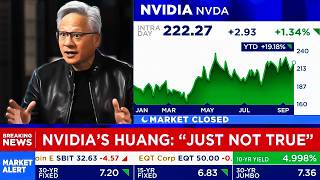
Ethereal. Thank you. Never seen it before. Thank you. And I would just want to say it's a privilege to do so and I'm just getting started. Jensen Huang, co-founder and CEO of Nvidia. And I have to tell you, the idea that we'll look back and say 183, that number will mean nothing. Nothing at all cuz we're going so much higher.
Thank you so can't hold us back forever. Absolutely. All right, I hope we'uesday afternoon, Jensen shared that Nvidia has received approval from both the United States and China to sell the H200 in China. Nvidia is receiving purchase orders from customers in China and Nvidia's supply chain is in the process of restarting manufacturing.
There's been a lot of back and forth over this topic in recent months and so I think many market participants are probably somewhat skeptical until we see actual shipments delivered to customers in China. But that is the current state of the situation. and a lack of China revenue would not be a thesis breaking event since Nvidia's business is accelerating even without China revenue.
We don't know the specifics around how many H200s Nvidia will be allowed to sell in China. It's also important to remember that the US government will take a 25% cut of revenue from Nvidia's China sales. And so all things considered, this would be a positive bonus to Nvidia's top line revenue that many analysts are not yet factoring into their estimates.
And at the same time, China sales of H200 will likely put pressure on Nvidia's gross margins, especially with the 25% cut going to the US government. It's also being reported that Nvidia is preparing a new version of a Grok chip for customers in China. It's important to consider that there's a lot happening around the globe geopolitically right now and so the situation could change in the days ahead.
I think that's why we're seeing a muted response to this news. Many analysts are skeptical about Nvidia actually being allowed to sell in China given the many months of starts and stops regarding Nvidia's China access. But that's the current state of the situation and we will see what happens in the days ahead.
All right, now I want to recap what we learned from the financial analyst Q&A on Tuesday as well as Jensen's keynote on Monday. We have learned so many important details over the past couple of days and I want to make sure that we're all on the same page moving forward. On Tuesday, we got confirmation that the $1 trillion revenue figure Jensen shared during his keynote is just cumulative revenue for Blackwell and Rubin.
It does not include any Grok chips, the new Grok LPX system, CPX or CPU racks. Those other products are also part of data center revenue, but they're not included in the $1 trillion figure that Jensen shared during his keynote. Jensen provided more clarity on this topic during the financial analyst Q&A on Tuesday.
Jensen told us that if 100% of Nvidia's customers were to adopt Grok, then it would increase their CAPEX by 25%, which would make the revenue figure $1.25 trillion rather than $1 trillion. And CPUs would probably add another 5% to the $1 trillion. Also, this is important. Jensen told us that the $1 trillion revenue figure does not include any Rubin Ultra revenue.
That's interesting because we're expecting Rubin Ultra to launch in the second half of 2027, but Jensen did not include any early ramps of Rubin Ultra in the $1 trillion revenue figure. And Jensen said in an interview that there are still 21 months for Nvidia new business before the end of 2027. Like I said in Monday night's video, there's plenty of time for Nvidia to gain new orders and fulfill those orders before the end of 2027.
And so I'm expecting the number to be notably higher than $1 trillion and I think we may get an update to that number on a future earnings call or at a future GTC event. We also learned during the financial analyst Q&A that Grok LPX will launch in the second half of this year, probably in Q3 and that Vera Rubin will ship first before Grok LPX.
So that means we're on track for a launch of Vera Rubin either in Q3 or sooner. Jensen was asked about Nvidia's customers' return on investment and he said that AI startups like OpenAI and Anthropic are seeing their revenues increase by one or two billion dollars a week and he wishes that these companies were public so that the public could see what he sees.
This next point is very interesting. Jensen spoke about Nvidia's customer diversity and shared this graphic once again. He said that the 60% on the left represents the hyperscalers and the other 40% are the non-hyperscaler customers. And here's what's very interesting. Jensen says he expects both groups to grow at a similar rate for a few years until we get to physical AI.
At that point, he thinks the non-hyperscaler customer segment could grow at a faster rate than the hyperscaler customer segment and eventually non-hyperscaler customers could represent 70% of Nvidia's data center revenue. This is a big deal. Jensen is essentially telling us that Nvidia's customer mix will grow more diverse over time and that should reduce Nvidia's customer concentration risk by diversifying data center revenues beyond the major hyperscalers.
Nvidia's CFO also mentioned capital allocation and said that Nvidia has some commitments that they have to deliver on during the first half of this year. But after that, they expect to use 50% free cash flow for investor returns in the form of share repurchases and dividends. That is very positive news for long-term investors.
All right, now I want to recap what I shared in Monday night's video in case you missed it because Jensen covered a lot of important details during his keynote and I want to make sure we're all on the same page moving forward. ood out to me. Jensen mentioned that there's been a surge in new AI-native companies and those companies will need a lot of compute.
Jensen mentioned that over the past few years, there have been multiple inflection points. First, there was the generative AI ChatGPT moment in 2023. Second, we had advanced reasoning models in 2024, which increased the amount of computation tremendously. And now more recently, there's been another major inflection, a genic AI, specifically a genic inference.
With a genic AI, the models are now able to solve problems and perform tasks. AI is now able to do productive work. Therefore, the inference inflection has arrived. In the last two years, computing demand has gone up 10,000 times and the amount of usage has gone up by about 100 times. Putting those two together, Jensen believes that computing demand has increased by 1 million times in the last two years.
This next point is very important for investors. Jensen mentioned the $500 billion figure that he shared at GTC back in October. And during his keynote, Jensen told us that he sees at least $1 trillion of cumulative revenue through 2027. That's cumulative revenue in 2025 through 2027. And that number is still growing.
Jensen told us that even then, Nvidia will still be short, meaning that he is certain that the computing demand will be much higher than what Nvidia can supply. In other words, Jensen does not see demand slowing down through 2027. He sees the opposite. Jensen reiterated that it's extremely important for customers to choose the correct architecture.
Nvidia is the absolute best on the market today and it isn't even close. If companies are constrained by power and space, then those companies must choose the absolute best architecture to maximize their revenues given those constraints. Jensen shared semi-analysis inference ex performance data again, showing that Blackwell Ultra systems deliver up to 50x higher throughput, 35x lower cost.
Jensen also revealed a new Grok system consisting of eight new Grok LP3 chips, which are in volume production now. I'll have more to say about that in a moment. Jensen told us that Nvidia is selling a lot of CPUs stand-alone and that alone will be a multi-billion dollar business for Nvidia. As a reminder, Meta and Nvidia announced an expanded partnership last month in which Meta will make significant stand-alone purchases of Nvidia CPUs.
Jensen also showed us Rubin Ultra, which features 144 GPUs in one NVLink domain. Jensen also told us that Rubin Ultra is currently in tapeout, which is good to hear. Jensen shared that Vera Rubin will increase throughput substantially compared to Grace Blackwell. Jensen compared the two platforms and showed that Vera Rubin can deliver roughly five times the revenue for customers compared to Grace Blackwell.
And Vera Rubin in combination with Nvidia's integration of Grok's ultra-latency technology can deliver up to 10x higher revenues for Nvidia's customers compared to Blackwell. Make no mistake, Nvidia's customers will want to get Vera Rubin as quickly as they can because it directly drives greater revenues and lowers costs.
Jensen told us that Vera Rubin is in full production. And the Vera Rubin system now includes seven unique chips, up from six chips previously after the addition of a new Grok chip to the Vera Rubin system. Jensen told us that Nvidia and Grok rearchitected the way that inference is done, putting the work that makes sense for Rubin on Rubin and offloading the decode generation, the low latency, the bandwidth limited part of the workload to Grok's chip.
Nvidia unified two very different processors, one for high throughput, Rubin, and one for low latency, Grok, creating the new Nvidia Grok 3 LPX system. The new Grok LP30 chip is in production being manufactured by Samsung and is expected to ship in the second half of this year, probably around Q3. Jensen told us that Nvidia supply chain can manufacture thousands of Vera Rubin systems per week, essentially multiple gigawatts of AI factories per month.
Jensen told us that in the future Nvidia is going to scale up with both copper and optical. With optical, Nvidia will be able to scale up Oberon to NVL576. Yes, we're now talking about 576 GPUs in an Oberon rack via optical scale up. And with a Kyber rack, Nvidia will scale up with both copper and co-packaged optics.
Jensen emphasized that copper is not going away. Nvidia and the AI ecosystem need a lot more capacity of both copper and optical. Jensen provided an updated product roadmap. I've already shared some of the details regarding Rubin and Rubin Ultra. But we also learned more about Nvidia's next architecture after Rubin Ultra, which is Fiman.
Fiman includes the new Rosa CPU, Bluefield 5, and the upcoming Grok LP40 chip. Jensen briefly mentioned that Nvidia is going to space Nvidia is working with partners on a new computer named Vera Rubin Space One. Jensen also spoke about the incredible importance of OpenCL and how it has skyrocketed in usage, doing a matter of weeks what took Linux 30 years to achieve.
Jensen explained that OpenCL is revolutionary. It basically allows anyone to create their own AI agents, and enterprises would benefit greatly from this. But if an enterprise were to integrate claws, those claws would have access to the company's private internal data, be able to execute code, and be able to communicate externally.
That creates a major security risk, and it's the reason why many enterprises have been hesitant to adopt OpenCL. But during his keynote, Jensen announced Nvidia Nemo CL reference OpenCL. Nvidia has worked with the world's best security and computing experts to make OpenCL . Now OpenCL is enterprise ready.
s I've said in the past, large enterprises are the ideal customers for agentic AI because they can immediately start using it to drive productivity . Jensen emphasized that every enterprise needs to have an agentic strategy. Every enterprise needs to have an OpenCL strategy. This technology is going to transform society, and it really is that important.
Jensen reiterated that every single software company of the future will be agentic. Jensen also spoke about open-source models and emphasized that Nvidia is determined to be the leader in open source. As I've said before, Nvidia being a leader in open-source models should lead to a very advantageous situation for Nvidia in which many popular AI applications are built on Nvidia's own models.
Plus, open-source models drive greater consumption. Greater consumption leads to a greater need for compute. And of course, Nvidia sells the compute. Jensen also mentioned sovereign AI. As a reminder, we learned from Nvidia's recent earnings that their sovereign AI business more than tripled in 1 year.
This will be an important growth vertical for Nvidia moving forward. Jensen also announced a Nimatron coalition to partner with Nvidia to advance open frontier models and make Nvidia Nimatron 4 even more amazing. Jensen also spoke about physical AI and announced four new partners for Nvidia's robotaxi-ready platform, BYD, Hyundai, Nissan, and Geely.
This is in addition to Nvidia's previously announced partners, which include Mercedes-Benz, Toyota, and GM. Overall, I was very happy with Jensen's keynote. Nvidia's Blackwell and Rubin backlog grew by $500 billion just since last October. Regardless of market participants' expectations, that's incredible.
still think that this company has plenty of runway ahead of it. For now, likely going to grow earnings somewhere in the range of 60 to 70% over the next 12 months based on hyperscaler capex guidance and commentary from Nvidia leadership. By comparison, the broader market is expected to grow earnings by roughly 1/4 that amount over the next 12 months.
. I think this i. Looking out further with a longer-term perspective, we need to remember that we are just at the beginning of agentic AI systems being adopted at scale. This is going to drastically increase the nee.



Comments 0