
저자: DanIves · 외국인
요약 보기
엔비디아는 GTC에서 2027년까지 누적 매출 1조 달러 이상 수주잔고를 발표했고 AI 수요가 공급을 크게 초과한다고 주장. Dan Ives는 엔비디아가 경쟁사보다 2~3년 앞서 있고 현재 주가에 physical AI·에이전틱 AI 성장이 반영되지 않았다며 강세 견해 제시. 목표가 약 300달러 기본 시나리오, 2027년 시총 6조 달러 전망. 한편 Brent(Requisite)는 200달러대 저항을 언급하며 콜 매도 전략을 취하고, Doug Clinton은 소프트웨어 반등 둔화 가능성을 언급하며 엔비디아 보유를 유지.
다듬은 글
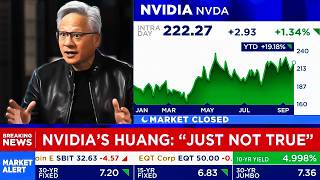
Nvidia CEO Jensen Huang could get on stage to deliver his keynote address on the next generation of AI any moment now. I'll bring you those headlines as they happen. The market for its part still around session highs. The stock is up, too, Nvidia is it's up nearly 3% now in the session, and it's up, you know, a cool 22,000% over the past decade.
But as you can see, it has made you zero money over the past 6 months or so as sentiment around the AI trade has cooled off. So, can today's announcements get its shares moving again? Let's ask Dan Ives. He's head of technology research at Wedbush. Great to have you here, Dan. Appreciate you coming in in studio with us.
Um, maybe let's just start with this question we we started to get into a little bit last hour, but this competition with Google, you know, when if Google can answer questions with Gemini really well and fast and they're using their own chips and their TPUs, how does Nvidia answer that? Yeah, look, the reality is, I mean, Nvidia's two to three years ahead of anyone, including Google.
So, look, with TPUs or you know, what OpenAI is going to come out with, I mean, there are some alternatives, but the reality is you want the gold standard when it comes to Nvidia. Now, if you look at Meta and others, you can't get for every 10 chips that you want to get, you can maybe get three of them.
Wow. So, it speaks right now. We're talking demand and supply is 12 to 1 for Nvidia chips. But when it comes to Grok and what they're showing on inferencing, this is them saying, "We're not losing that market." Grok with a Q, not Grok with a K. Grok with a Q, exactly. And but this is basically and that was from the acquisition, you know, in terms of essentially what they did.
This is basically Jensen and Nvidia saying that is going to be our market as well, and it speaks to three to four trillion market opportunity they're going after because right now there is their world, everyone else paying rent. So, this is like the Lollapalooza for for chips and learning and inference chips and everything like that.
Which a Lollapalooza has a lot of different acts. Sure. But you're saying there's really only one act going on there. Look, their third-rate chip restricted H200 China is still what, 2 years ahead of Huawei? Right. They're on the out stage. Look, and the real Look, they they're on I mean, going back to that, they're the main stage.
Everyone's waiting for when Jensen comes But it's all about getting people to sign on and sign up for more in video chips. Because once you're in it, you're not leaving. And and it speaks to what they recognize where they are and they'll talk of Jensen with the better GTC just saying how like demand continues to accelerate.
You look at like the 500 billion that Christina talked about. I mean, that's probably closer to what, 6 to 700? In terms of their order backlog, that they that they that they have to talk about. I mean, I think he's going to touch on it, but it speaks to this whole point where streets giving really think minimal credit after what was just what I would think of Michael Jordan-like quarter that they just had to what is actually happening on the AI demand story.
And it just speaks to the CapEx. You got to follow the numbers. And the reality is that those CapEx dollars, the vast majority, it's coming to Nvidia. But I I just want to get this because what you're It sounds like what you're saying is winning perforce creates more winning. Mhm. So there's this order book, but there's this whole other thing happening underneath here where when you bring somebody on, you've going to create more orders down the down the road.
Yeah, to put it like maybe in numbers, just to what you say like 20, 30% is right now what they maybe like they they already have stamped. Right. But they're focused on what's the 70, 80% down the road. And that's really what the whole conference about is that as when it comes to things like physical AI, autonomous robotics, I mean, that's really something that Jensen and Nvidia are going after.
And none of that is factored into the stock. It just speaks to our view like you're in year three of an 8 to 10-year out. And I just think a lot of that is not being factored into this stock. And I also think when it comes to software and the AI growth trade, Anthropic, and every I think it's being very significantly miscalculated and underestimated how software is going to play a huge role in the use cases.
Yeah, you're more bullish on on that piece of it, yeah. So, not factored suggests there's a number in your head. Mhm. At 185, what's not factored in? I mean, I'd say 130 to 150 dollars left is not factored into the stock. It's already like 300 dollar base case. 8 trillion company? Look, I believe by 2027, 6 trillion.
Yeah. In terms of what this market is. Now, I get it right now in terms of like geopolitical, white-knuckle period, New York City cab drivers bearish on tech. But, we will get to a point as the numbers play out, and Nvidia, I say it's still a cheap stock. And like Jensen's going to come out. There's going to be no old Bard.
I think you're going to see very aggressive Jensen talking about this is our market. Now, Nvidia CEO Jensen Huang giving the keynote address at the company's GTC event in California. Christina Partsalidou is there, joins us with the latest. Christina. Infrastructure investment Yeah, Nvidia giving stockholders exactly what they wanted just now.
Jensen Huang just finished saying that their 500 billion dollar backlog of Blackwell and Rubin products that they gave about 5 months ago is now being bumped up to 1 trillion dollars of backlog through 2027. The share price was holding steady at about 2%, but now you can see it climbing roughly up about 4%.
That was the big newsmaker so far. Aside from that big 1 trillion dollar number, uh there's been a parade of partnership call outs, Dell, Palantir, Coreweave, Oracle you saw, IBM, Google, Synopsys. And IBM shares actually moved briefly on the mention, but there hasn't been any new product details per se just yet.
Uh CEO Jensen Huang also expanding his telecom push. T-Mobile now joining Nokia in using Nvidia GPUs to power edge AI as part of its 6G buildout. Nvidia first announced the Nokia partnership just last fall. That's when you saw that share price really skyrocket. Intel separately also put out a press release saying its Xeon processors, those are CPUs, will be in Nvidia's new Rubin rack systems.
Worth noting though that Intel has been the host CPU in Nvidia systems since Blackwell, so since its previous generation. So this is an existing relationship just carrying forward, not necessarily a new one, and that's why Intel shares aren't really moving on this news. The market overall though was waiting for this $500 billion backlog order to be updated.
It has been updated. And then we're still waiting for details on the new chip Jensen has teased that he will talk about the CEO, which will involve grok technology, so just memory on the chip. So we're still waiting to hear about that. John? All right, that's that's quite a bit, but I wonder, and this is somewhat subjective kind of color wise.
For a while there, every company Jensen mentioned that was public seemed to get some kind of a bump. Is that bump effect still seen with all the volatility we're also seeing in the market? John, whenever I write scripts for CNBC I called it the Midas touch of Nvidia, and unfortunately it hasn't necessarily been the case over the last several months with the exception of that investment in Lumin Light, LITE ticker as well as Coherent.
Those two names really popped up, but today he just mentioned he's mentioned dozens of companies. Are you Are you seeing all of these share prices just soar and all of the markets go up tenfold just within the last 30 minutes or so? Not really, right? Yeah, a lot of companies you're dealing with. Lumentum is the one that you were looking for.
I looked it up for you since you gave me the ticker. Christina, thank you. I blanked. I got you. The ticker gets us there. Christina, thanks. Now, let's bring in a couple of Nvidia shareholders, Doug Clinton of Intelligent Alpha and CNBC contributor Brin Talkington of Requisite Capital Management. Welcome.
Doug, um over the past 12 months a lot of things have been going on in the markets that we haven't seen before. So, can LLMs still figure things out or or are they just flying blind? I think they can figure things out, John. I'm biased because at Intelligent Alpha we do use the large language models to do stock analysis and portfolio management for us.
And I think we've had a good start to the year with our GPT ETF. What we do, and I think what we've been benefiting from that the broader industry is getting excited about, is really creating agents that go out and perform specific tasks. We look at macro environment. We look at specific micro components to stocks, and we create a thesis just like a human investment team would.
And ultimately, I think we're going to see productivity like we have in Intelligent Alpha go to many other industries as well. So, what's that telling you about Nvidia right now? We own Nvidia. It's one of our top holdings. Are you adding more or are you shedding it? Uh we've been consistently, I'd say, owning it.
Our models have liked it really for the last year and a half at this point. And the models also do like some other infrastructure players. I'd tell you this though, what's interesting in my opinion is the models have actually softened a little bit on the software trade. I think the models, our models at least, thought we were kind of bottoming.
Software has been terrible this year. Everybody knows that. Feels like it's due for a reversion. We've gotten a little bit right now, but our models are now saying this might be it. It might be it like we're not going to go up more or The reversion might slow down from here, I think is what our models think.
And if you look long-term, John, I think this is the question for software. Are the terminal multiples, you know, can can we trust in them? Our models are saying it's getting harder and harder. Brent, um this trillion-dollar backlog news out of Nvidia, it's kind of hard to wrap your mind around a a backlog that big.
Is that just expected at this point, or does it change the way you look at Nvidia? Let me try to contextualize a trillion dollars from a billion. You think about it, a billion seconds is 32 years. A trillion seconds is roughly 32,000 years. So, I don't feel that's priced in, right? This is such a big amount of money.
And I think we you you asked Doug what happened the last year. Well, I mean, Nvidia's was up 51% over the last year. It's been a wonderful year. I do think from the stock perspective, $200 feels like like outer Earth orbit. It just can't get get past it. I think ultimately will, but still I think for sure for investors like myself, that $200 is where we continue to sell calls against it.
But but but to but to me what's so incredible is Nvidia just keeps cannibalizing on their own products, and that's why they're so hard to catch up with. Because while Vera Rubin's getting ramped up, you know, Blackwell's out there, but Vera Rubin's going to cannibalize Blackwell. And so that's what Nvidia and Jensen and his team have been so masterful, is just being two steps ahead of their own products by continuing to have best-in-breed products, which continue to have such a strong moat around the company.
Brent, this reminds me of Apple years ago when it first hit a trillion-dollar market cap, and people were saying, "I don't know what what it would take to get to two trill. The iPhone's not going to get them there. They got to get another iPhone, the car, or you know, whatever." And actually, they they didn't need to do that.
I mean, how psychologically do investors have to shift their idea of what's possible um when we tend to look at what's possible based on what's happened before? I think that we continue to get what's possible by the spending of Meta, by the sovereign wealth spending, by Google, by by everybody except Apple, by the way.
And as long as that spending that that trajectory's just getting bigger, while we're waiting to see actually what they're spending all this money for, I'm not exactly sure. Most of that money goes to Nvidia, right? And so I just think this is continuing to be a really strong name. It's one of the reasons why earnings growth are expected to grow 26% this year.
It's really Nvidia and Broadcom are driving the vast majority of those returns. & Jensen delivered his GTC keynote and we learned a lot of important details covering a wide range of topics. that stood out to me. Jensen mentioned that there's been a surge in new AI native companies and those companies will need a lot of compute.
Jensen mentioned that over the past few years there have been multiple inflection points. First, there was the generative AI chat GPT moment in 2023. Second, we had advanced reasoning models in 2024 which increased the amount of computation tremendously. And now more recently there's been another major inflection, agentic AI, specifically agentic inference.
With agentic AI, the models are now able to solve problems and perform tasks. AI is now able to do productive work. Therefore, the inference inflection has arrived. In the last two years, computing demand has gone up 10,000 times and the amount of usage has gone up by about 100 times. Putting those two together, Jensen believes that computing demand has increased by 1 million times in the last two years.
This next point is very important for investors. Jensen mentioned the $500 billion figure that he shared at GTC back in October. In today's Jensen told us that he sees through 2027 at least $1 trillion of cumulative revenue. That's cumulative revenue in 2025 through 2027. And that number is still growing.
Jensen told us that even then Nvidia will still be short, meaning that he is certain that the computing demand will be much higher than what Nvidia can supply. In other words, Jensen does not see demand slowing down through 2027. He sees the opposite. Jensen reiterated that it's extremely important for customers to choose the correct architecture.
Nvidia is the absolute best on the market today and it isn't even close. If companies are constrained by power and space, then those companies must choose the absolute best architecture to maximize their revenues given those constraints. Jensen shared semi-analysis inference X performance data again, showing that Blackwell Ultra systems deliver up to 50X higher throughput, 35X lower cost.
Jensen also revealed a new Groq system consisting of eight new Groq LP30 chips, which are in volume production now. I'll have more to say about that in a moment. Jensen told us that Nvidia is selling a lot of CPUs stand-alone, and that alone will be a multi-billion dollar business for Nvidia. As a reminder, Meta and Nvidia announced an expanded partnership last month in which Meta will make significant stand-alone purchases of Nvidia CPUs.
Jensen also showed us Rubin Ultra, which features 144 GPUs in one NVLink domain. Jensen also told us that Rubin Ultra is currently in tape-out, which is good to hear. Jensen shared that Vera Rubin will increase throughput substantially compared to Grace Blackwell. Jensen compared the two platforms and showed that Vera Rubin can deliver roughly five times the revenue for customers compared to Grace Blackwell.
In Vera Rubin in combination with Nvidia's integration of Groq's ultra-latency technology can deliver up to 10X higher revenues for Nvidia's customers compared to Blackwell. Make no mistake, Nvidia's customers want to get Vera Rubin as quickly as they can because it directly drives greater revenues and lowers costs.
Jensen told us that Vera Rubin is in full production, and the Vera Rubin system now includes seven unique chips up from six chips previously after the addition of a new Groq chip to the Vera Rubin system. Jensen told us that Nvidia and Groq re-architected the way that inference is done. Putting the work that makes sense for Rubin on Rubin, and offloading the decode generation, the low latency, the bandwidth limited part of the workload to Groq's chip.
Nvidia unified two very different processors, one for high throughput, Rubin, and one for low latency, Groq, creating the new Nvidia Groq 3 LPX system. The new Groq LP30 chip is in production being manufactured by Samsung and is expected to ship in the second half of this year, probably around Q3. Jensen told us that Nvidia supply chain can manufacture thousands of Vera Rubin systems per week, Essentially, multiple gigawatts of AI factories per month.
Jensen told us that in the future Nvidia is going to scale up with both copper and optical. With optical, Nvidia will be able to scale up Oberon to NVL 576. Yes, we're now talking about 576 GPUs in an Oberon rack via optical scale-up. And with the Kiber rack, Nvidia will scale up with both copper and co-packaged optics.
Jensen emphasized that copper is not going away. Nvidia and the AI ecosystem need a lot more capacity of both copper and optical. Jensen provided an updated product roadmap. I've already shared some of the details regarding Rubin and Rubin Ultra. But we also learned more about Nvidia's next architecture after Rubin Ultra, which is Fiman.
Fiman includes the new Rosa CPU, Bluefield 5, and the upcoming Grok LP40 chip. Jensen briefly mentioned that Nvidia is going to space and Nvidia is working with partners on a new computer named Vera Rubin Space One. Jensen also spoke about the incredible importance of Open Claw and how it has skyrocketed in usage, doing a matter of weeks what took Linux 30 years to achieve.
Jensen explained that Open Claw is revolutionary. It basically allows anyone to create their own AI agents, and enterprises would benefit greatly from this. But if an enterprise were to integrate claws, those claws would have access to the company's private internal data, be able to execute code, and be able to communicate externally.
That creates a major security risk, and it's the reason why many enterprises have been hesitant to adopt Open Claw. But today has worked with the world's best security and computing . Now Open Claw is enterprise ready. . As I've said in the past, large enterprises are the ideal customers for agentic AI because they can immediately start using it to drive productivity .
Jensen emphasized that every enterprise needs to have an agentic strategy. Every enterprise needs to have an Open Claw strategy. This technology is going to transform society, and it really is that important. Jensen reiterated that every single software company of the future will be agentic. Jensen also spoke about open-source models and emphasized that Nvidia is determined to be the leader in open-source.
As I've said before, Nvidia being a leader in open-source models should lead to a very advantageous situation for Nvidia in which many popular AI applications are built on Nvidia's own models. Plus, open-source models drive greater consumption. Greater consumption leads to a greater need for compute.
And of course, Nvidia sells the compute. Jensen also mentioned sovereign AI. As a reminder, we learned from Nvidia's recent earnings that their sovereign AI business more than tripled in one year. This will be an important growth vertical for Nvidia moving forward. Jensen also announced a Nematron coalition to partner with Nvidia to advance open frontier models and make Nvidia Nematron 4 even more amazing.
Jensen also spoke about physical AI and announced four new partners for Nvidia's RoboTaxi platform. BYD, Hyundai, Nissan, and Geely. This is an addition to Nvidia's previously announced partners, which include Mercedes-Benz, Toyota, and GM. We learned a lot of details during today's keynote, and I'm still trying to process all of it.
I'm sure I'll have more to say in the days ahead. In the meantime, let's consider the implications of today's news for investors. Let's start with the $1 trillion in cumulative revenue through 2027. I assume Jensen was speaking of cumulative revenue from Blackwell and Rubin since that's what the $500 billion figure was that he shared back at GTC in October.
It's important to notice the difference in time frames. The $500 billion is for 2025 through 2026, and the new $1 trillion figure is for 2025 through 2027. Now, last I checked, consensus estimate for data center revenue over that time frame seemed to be roughly $930 billion. And so, Jensen essentially guided 7% above what the street was expecting.
Now, that's interesting because Jensen specifically told us that the number is still growing. Meaning, as the year goes on, I expect Nvidia will gain more orders, including orders that will lead to greater data center revenue in 2027. And so, I think Nvidia's actual cumulative Blackwell and Rubin revenue is very likely to be higher than $1 trillion by the end of 2027.
I think we may get another update to the cumulative revenue figure on a future earnings call or at a future GTC event. Additionally, Jensen specifically said he sees, quote, at least $1 trillion in revenue. Jensen using the phrase at least in combination with Jensen's history of guiding conservatively implies that we're looking at well over $1 trillion in cumulative revenue for Blackwell and Rubin by the end of 2027.
And one more point on this topic, given the time it takes for Nvidia to fulfill orders of Blackwell and Blackwell Ultra and given that there's still very strong demand for those systems, there is still plenty of time for Nvidia to receive additional orders for Blackwell and fulfill those orders before the end of 2027.
And so again, I think we're ultimately going to see well over $1 trillion in cumulative revenue by the end of 2027. Overall, I was very happy with today's keynote. Nvidia's Blackwell and Rubin backlog grew by $500 billion just since last October. Regardless of market participants' expectations, that's incredible.
still think that this company has plenty of runway ahead of it. For now, forward earnings even though Nvidia is likely going to grow earnings somewhere in the range of 60% to 70% over the next 12 months based on hyperscaler capex guidance and commentary from Nvidia leadership. By comparison, the broader market is expected to grow earnings by roughly 1/4 that amount over the next 12 months.
And yet, at the time I'm making this video, forward earnings. I think this i. Looking out further with a longer-term perspective, we need to remember that we are just at the beginning of agentic AI systems being adopted at scale. This is going to drastically increase the nee.



Comments 0